Behavioral Genetics of Golden Retrievers
Golden Retrievers are not behaviorally generic large dogs. They are a breed with a specific working history and a corresponding behavioral profile shaped by long selection for cooperation with humans, retrieve drive, social tolerance, and handler focus. The key word is profile, because breed averages are real without becoming fate for each individual dog. A Golden Retriever as a breed category shows up at a different location in behavior space than a Border Collie, a Belgian Malinois, or a Basenji, and that difference is neither accidental nor imaginary. It is the cumulative effect of selection choices made by generations of breeders working toward consistent functional goals, and understanding the resulting behavioral tendencies is an important part of choosing and raising a Golden Retriever well. Documented
What It Means
The working history behind the profile
Golden Retrievers were developed as working gun dogs in nineteenth-century Britain, primarily for retrieving shot waterfowl and upland game. That functional history matters because it tells us what traits were repeatedly favored in the breed's formative generations: willingness to work cooperatively with a handler over long sessions, sustained interest in carrying and returning objects, tolerance for close human direction without developing resistance or stress, soft-mouth restraint that brings birds back undamaged rather than crushing the bite on retrieval, social confidence in a human-led working context, and stable arousal management that allows the dog to switch between active work and patient waiting. Documented
Those are not random household traits. They are the behavioral residue of selection history, and they persist in modern Golden Retrievers even when the dogs have never seen a duck or a shotgun. The selection pressures that shaped the breed were applied over many generations at the level of whole behavioral tendencies, and the resulting distribution of traits is carried forward genetically rather than being re-learned in each new generation. A Golden Retriever puppy arrives with a behavioral starting point that reflects its ancestry, and that starting point differs in measurable ways from the starting point a puppy of a different breed would arrive with.
What modern behavior data shows
Modern population-level data and breed-comparison work support that broad picture. Golden Retrievers consistently score as highly social with other dogs and with people, highly trainable in the sense of responding well to handler cues and showing interest in cooperative work, and relatively low in aggression-related traits compared with many other breeds. These findings come from large questionnaire studies using standardized instruments like C-BARQ, from professional behavioral assessments in working and assistance-dog programs, and from comparative observations across breeds in structured testing environments.
That does not mean every Golden is easy or calm. It means the breed's average location in behavior space is different from breeds selected for very different jobs, and the differences are large enough to be measurable at the population level across many studies. Documented A Golden and a guarding breed sit at visibly different points on traits like stranger sociability, handler focus, and reactivity profile, and the difference is not artifact. It is real genetic architecture expressed through behavior.
Why within-breed variation matters as much as breed averages
Within-breed variation still matters enormously and should not be treated as a minor footnote to the breed average. Goldens are not one homogeneous temperament block, and pretending they are leads to the kind of "all Goldens are the same" thinking that sets families up for disappointment when the individual dog they brought home turns out not to match the stereotype.
Show lines and field lines often differ in behavior style because they have experienced different secondary selection pressures over the decades since the breed split. Observed-JB Field lines tend to be somewhat more intense, more kinetic, and more driven in working-related behavior because field-line breeders have continued selecting for performance in hunt tests and working retrieves. Show lines have often been selected for more moderate working drive because the primary evaluation context is the conformation ring rather than the field, and the judging criteria have tended to favor different phenotypic traits. Neither direction is wrong; they are simply different priorities, and the behavioral consequences of those priorities are visible in the distribution of adult temperaments.
Within each of those broad categories, individual breeders make further selection choices that narrow the range further. A show-line breeder focused on therapy-dog and family work may select more tightly for calm stability than another show-line breeder focused on the ring alone. Documented A field-line breeder focused on hunt test performance may select more tightly for high drive than another field-line breeder focused on companion-home placements. Those breeder-level choices produce real differences in the puppies a family will encounter when choosing between different programs.
Three levels of selection, three levels of outcome
This is where breed genetics meets breeder philosophy. A breeder is not creating behavior out of nothing, nor is a breeder simply a passive distributor of breed-average traits. The breeder is selecting a specific corner of an already existing breed range, and the corner selected has measurable consequences for the average puppy produced by that program.
For JB, that selected corner is the low-arousal, high-stability end of the Golden Retriever temperament distribution. The target is not the maximum-drive retriever suited to intense field work, nor is it the cosmetically quiet but socially dull dog that some programs drift toward when selection gets confused between calm and checked-out. The target is a dog that remains relationally present, composed, and readable in a family environment while still retaining full Golden Retriever breed identity, including the social warmth, trainability, and cooperative interest that make the breed what it is.
That is an important distinction because it shows how behavioral genetics works at three distinct levels simultaneously. Breed-level selection created the Golden Retriever as a distinct behavioral category separated from other breeds. Within-breed selection created different line tendencies over decades as different breeders pursued different priorities. Breeder-level selection pulls toward one specific subrange inside the breed based on the individual program's goals and values. All three levels are real, all three are operating at the same time, and any honest discussion of what a particular puppy is likely to become has to account for all of them rather than treating the breed name alone as a complete answer.
The limits of breed-level prediction
None of this means breed averages provide a reliable individual forecast. They do not, and treating them as if they did is a version of the ecological fallacy that confuses population statistics with individual predictions. A Golden Retriever is more likely than a random dog from the general population to show the breed-typical behavioral pattern, but any individual Golden can sit at the tails of the distribution rather than at the mean, and any individual Golden can be shaped significantly by its developmental environment in ways that pull it further from or closer to the breed average.
Breed averages are real, line differences are real, and individual variation is real. All three are happening at once, and honest breeder communication holds all three in view rather than collapsing the picture into whichever level is most convenient for the current conversation.
Why It Matters for Your Dog
Families usually choose a Golden because they want a certain kind of dog. That expectation is not irrational. Breed averages exist for a reason, and the aggregate experience of millions of Golden Retriever families over decades has produced a recognizable picture of what the breed typically looks like in daily life. Families who want a calm-ish, trainable, socially warm family dog are not wrong to look for that pattern in Goldens, and the breed delivers on the pattern often enough to sustain the stereotype.
But the more useful question is not "Are Goldens nice dogs?" which collapses the full distribution into a single average. The more useful question is which Golden population this specific breeder is drawing from and what corner of the breed range the program is actually selecting toward. Two breeders can both produce purebred Goldens, both belong to the same national breed club, and both use the same title dogs and still be selecting for very different daily-life experiences. A field-bred Golden raised in a high-drive kennel environment will feel different to live with than a show-bred Golden raised in a calm household setting, and the family that wants one may be unhappy with the other even though both are technically the same breed.
That is where breeder quality becomes visible and where the right questions start to matter. A family asking a breeder about temperament goals should expect specific answers about what the breeder is selecting for, how those goals show up in the dogs produced, and how the selection target is reinforced by the raising environment. Documented A breeder who cannot answer those questions in detail is not engaging with the reality that within-breed variation is substantial and that breeder-level choices matter.
For JB, this matters because the selection target is closer to the stable household mentor than to the higher-arousal sporting specialist, and that choice is visible in the adult dogs the program produces. It is an observed breeder-level choice, not merely a breed stereotype borrowed from the American Kennel Club's standard description, and the consistency of the outcome across litters over years is part of why the program can talk about its target without sounding like it is making things up.
Why It Matters for Your Dog
What This Cannot Predict
Breed-typical behavior cannot tell you exactly what one Golden puppy will be like as an adult. The breed average is a statistical tendency, not an individual prediction.
It cannot eliminate line differences, and families who ignore the show-versus-field distinction may end up with a dog whose working drive does not match the lifestyle they planned.
It cannot justify the ecological fallacy of assuming every Golden will show the breed average in the same way. Individual variation around the breed and line averages is substantial and should not be discounted.
And it cannot tell you what a specific breeder's selection target is without actually asking the breeder and observing the dogs they produce. The breed name is a starting point for the conversation, not a conclusion.
That is the load-bearing caution for this page. Golden Retriever behavioral genetics describes real breed tendencies and real within-breed structure. It does not predict any individual dog with certainty.
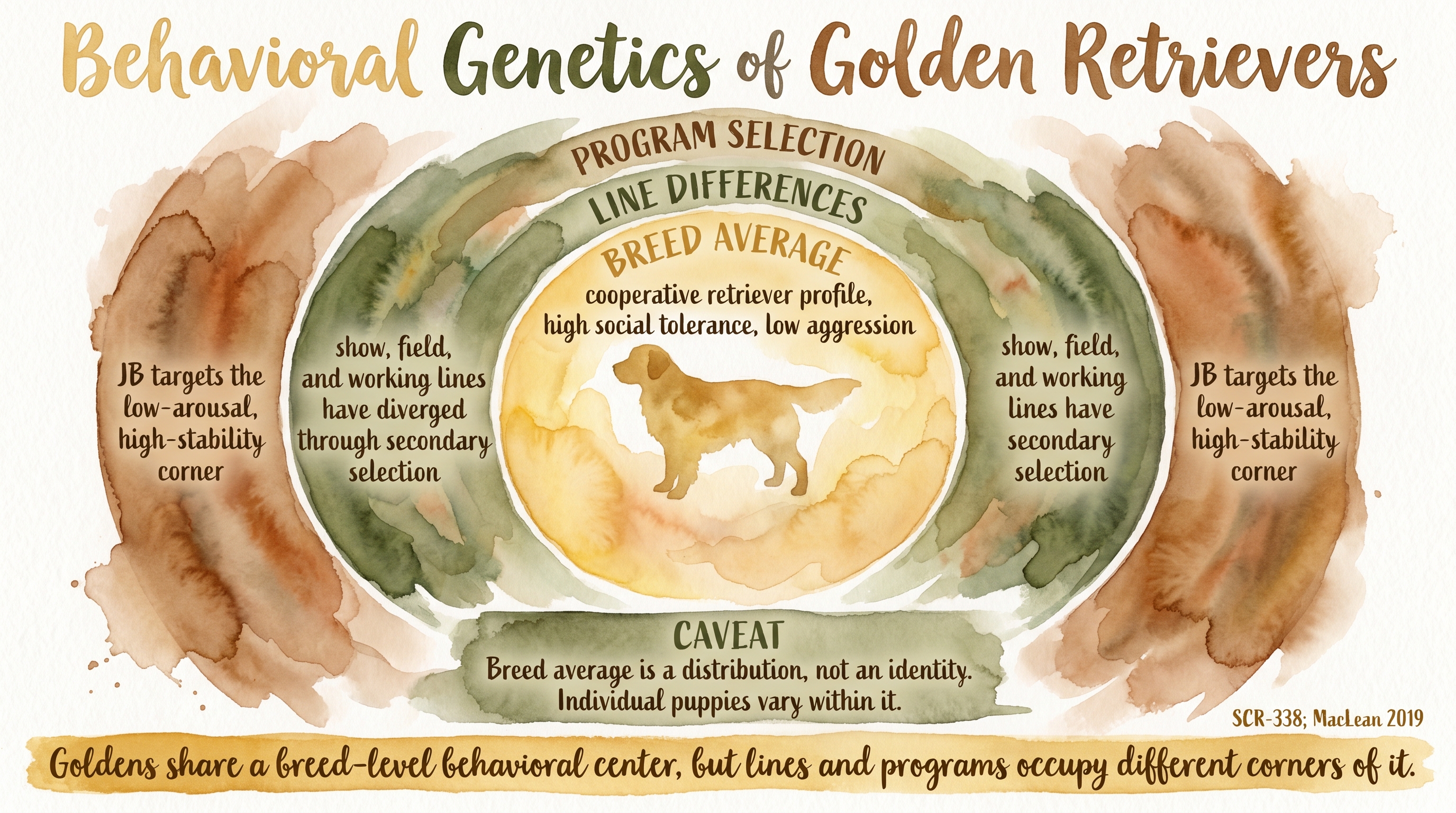
Goldens share a breed-level behavioral center, but lines and programs occupy different corners of it.
Key Takeaways
- Golden Retrievers have a real breed-typical behavioral profile shaped by long selection for cooperation, retrieve work, and handler focus.
- Breed averages are meaningful, but line-to-line variation inside the breed remains substantial.
- Show and field populations can differ behaviorally because they have experienced different secondary selection pressures.
- Breeder quality is partly visible in which corner of the Golden Retriever behavioral range the breeder is actually selecting toward.
- Three levels of selection (breed, line, breeder) all shape what any individual puppy is likely to become.
The Evidence
- Breed-comparison and C-BARQ-style literaturedogs and Golden Retrievers
Golden Retrievers consistently rank as highly social and highly trainable with relatively low aggression compared with many breeds, while still showing within-breed variation in excitability and other traits. - Working-dog and breed-history literatureGolden Retrievers
The breed's historical selection for retrieve work and close handler cooperation is consistent with modern Golden patterns of biddability, affiliative social behavior, and object-carrying interest.
- JB breeder observationsGolden Retrievers
JB selects toward the low-arousal, high-stability end of the Golden Retriever temperament range rather than treating the whole breed range as behaviorally interchangeable.
No published study has directly tested whether breeder-level temperament selection in Golden Retrievers produces measurably different behavioral outcomes compared to breeders selecting primarily on conformation or health clearances alone.
SCR References
Sources
- MacLean E.L., Snyder-Mackler N., vonHoldt B.M., & Serpell J.A. (2019). Highly heritable and functionally relevant breed differences in dog behaviour. Proceedings of the Royal Society B: Biological Sciences, 286(1912), 20190716. doi:10.1098/rspb.2019.0716
- Morrill K., Hekman J., Li X., McClure J., Logan B., Goodman L., et al. (2022). Ancestry-inclusive dog genomics challenges popular breed stereotypes. Science, 376(6592), eabk0639. doi:10.1126/science.abk0639
- Ilska J., Haskell M.J., Blott S.C., Sánchez-Molano E., Polgar Z., Lofgren S.E., Clements D.N., & Wiener P. (2017). Genetic Characterization of Dog Personality Traits. Genetics, 206(2), 1101-1111. doi:10.1534/genetics.116.192674
- Strandberg E., Nilsson K., & Svartberg K. (2025). Genetic parameters of personality traits in dogs based on behavioral assessment and questionnaire information. Applied Animal Behaviour Science, 286, 106619. doi:10.1016/j.applanim.2025.106619
- Saetre P., Strandberg E., Sundgren P.-E., Pettersson U., Jazin E., & Bergström T.F. (2006). The genetic contribution to canine personality. Genes, Brain and Behavior, 5(3), 240-248. doi:10.1111/j.1601-183X.2005.00155.x
- Goddard M.E. & Beilharz R.G. (1983). Genetics of traits which determine the suitability of dogs as guide-dogs for the blind. Applied Animal Ethology, 9(4), 299-315. doi:10.1016/0304-3762(83)90010-X
- Jones A.C. & Gosling S.D. (2005). Temperament and personality in dogs (Canis familiaris): A review and evaluation of past research. Applied Animal Behaviour Science, 95(1-2), 1-53. doi:10.1016/j.applanim.2005.04.008