Narrow-Sense vs Broad-Sense Heritability in Dogs
Heritability is one of the most widely quoted and most widely misunderstood ideas in dog breeding. People hear a number like 0.3 or 0.4 and immediately translate it into "this dog is 40 percent genetic." That is not what heritability means. Heritability is a population statistic about variance, not a personal destiny score for one dog, and almost every popular mistake in the field traces back to conflating those two things. Documented
What It Means
The formal definition
Heritability asks how much of the observed variation in a trait, inside a defined population under defined environmental conditions, is attributable to genetic differences. Documented
That definition has three important parts that often get lost in popular translation:
- it is about variation in a population, not absolute composition of any one animal
- it depends on the environment the population is living in at the time of measurement
- it says nothing simple about one individual's genetic versus environmental makeup
The broad idea is straightforward. If dogs in a population differ in hip scores, fearfulness, or body size, some of that variation comes from genes and some from environmental factors. Heritability estimates how much of the between-dog variation is attributable to genetic differences. Crucially, the statistic describes the variance in the population as a whole, not the composition of a particular dog inside that population.
Two versions of heritability
There are two major versions of the concept, and confusing them is the first place breeder literature usually goes wrong.
Narrow-sense heritability, usually written h2, includes only additive genetic variance. Additive effects are the ones that stack in a way selection can reliably act on from one generation to the next. Each copy of a liability allele adds a small, roughly independent increment of effect, and those increments sum across the genome to determine the dog's underlying breeding value. This is the version breeders care about most because it directly predicts response to selection. If you want to know how fast a population mean will shift when you select on a trait, narrow-sense heritability is the operational number to use.
Broad-sense heritability, usually written H2, includes all genetic variance: additive effects, dominance effects (interactions between the two alleles at a single locus), and epistatic interactions (interactions between alleles at different loci). Observed-JB
That makes broad-sense heritability a larger umbrella by construction. It captures more of the total genetic contribution, but not all of those components are equally useful for selection decisions. A dominance effect or epistatic interaction can matter biologically without translating cleanly into predictable generational progress in a breeding program, because those effects depend on specific allele combinations that may or may not recur in the next generation's pairings.
That is why narrow-sense heritability is the more operational number for breeders. If a breeder wants to shift a population mean over time, additive variance is the engine that matters most. Broad-sense heritability is useful for thinking about total genetic contribution to a phenotype, but it over-estimates what can actually be captured through generational selection on breeding values alone.
Why the same trait can report different heritability numbers
This is also why two heritability numbers for "the same trait" may not actually contradict each other when you look closely. One study may be reporting h2 and another may be reporting H2, so the numbers are measuring different quantities even though the trait label looks identical. Documented One may be using pedigree-based estimation and another may use genomic relatedness matrices, which can give different answers even on the same dogs. One may study a tightly managed working-dog population with standardized rearing and another may rely on owner questionnaires across hundreds of pet homes, where environmental variance is enormous and heritability will inevitably look lower by comparison. Those are not interchangeable contexts and they should not be summed or averaged as if they were estimates of a single universal constant.
The classic interpretive error is to turn heritability into an individual pie chart. A heritability of 0.4 does not mean 40 percent of one dog's temperament is genetic and 60 percent is environmental. It means that, in the population studied under those measurement conditions, 40 percent of the observed variation between dogs was attributable to additive genetic differences. The same dog moved into a different population with a different environmental distribution could contribute to a completely different heritability estimate without any change in its underlying biology, because heritability is a statement about variance partitioning in a population rather than a statement about composition within an animal.
Change the population and the number can change.
Change the environment and the number can change.
Change the measurement tool and the number can change.
That flexibility is not a weakness of the concept. It is the point. Heritability is a description of a trait in a particular population at a particular time under a particular measurement regime, not a universal constant pinned to the trait itself.
What the numbers actually look like in dogs
Dog-breeding examples make this easier to see concretely.
Hip dysplasia heritability estimates often land in a low-to-moderate range, commonly around 0.2 to 0.4 depending on breed, scoring system, and dataset. Estimated That range means there is meaningful additive genetic variance available for selection, but also substantial environmental and non-additive variance in the picture. Breed-wide phenotypic selection has produced measurable improvement in dysplasia prevalence in populations that have committed to consistent screening over decades, which is the strongest real-world evidence that the heritability estimates are capturing something real and selectable.
Elbow dysplasia looks similar, generally in the 0.2 to 0.4 range with somewhat more trait-definition variance because "elbow dysplasia" is an umbrella term for several distinct developmental joint pathologies.
Temperament traits usually show the same low-to-moderate pattern. Fearfulness, boldness, sociability, and trainability often come back with heritability estimates in the 0.15 to 0.35 range, but the exact numbers vary sharply with breed, instrument, age at measurement, and environmental context. Estimated In Golden Retrievers specifically, some measured behavioral dimensions show clear non-zero heritability, while still leaving substantial room for developmental effects, maternal effects, and later environmental shaping.
Longevity heritability in dogs is lower still, generally in the 0.1 to 0.3 range depending on the population and how lifespan is measured, reflecting the fact that lifespan is the downstream product of many biological processes layered on top of each other plus accidents, injuries, and environment.
Two opposite mistakes breeders make
This is where breeders sometimes misread the literature in opposite directions, and both directions are wrong.
One mistake is genetic fatalism: "Temperament is heritable, so the puppy is basically born fixed and raising does not really matter." Wrong. A heritability of 0.3 leaves 0.7 of the between-dog variance outside the additive genetic column, and that 0.7 includes the very environmental and developmental inputs that raising is trying to manage.
The opposite mistake is environmental romanticism: "Because raising matters, genetics do not matter much." Also wrong. A heritability of 0.3 is a meaningfully non-zero number, and over many generations of consistent selection it is enough to move population means in a real direction. Ignoring that mathematics does not make it stop operating.
Heritability sits between those extremes. It says additive genetic differences are real and selectable, but they operate inside an environment that can amplify, suppress, or reshape expression over a dog's lifetime. Both layers matter. Neither substitutes for the other.
Why It Matters for Your Dog
What This Cannot Predict
Heritability cannot tell you how much of one dog's behavior, hips, or health is "caused by genes." The question itself is malformed at the individual level; heritability simply does not answer it.
It cannot tell you whether one specific puppy will develop a problem. A litter from two excellent hip-scored parents can still produce a dysplastic puppy, and a litter from two less-than-ideal parents can still produce a clinically sound one, because the trait is polygenic and probabilistic.
It cannot be compared across studies as if every 0.25 means the same thing. Documented Different populations, different environments, different measurement protocols, and different underlying methods (pedigree versus genomic) all affect the estimate.
And it cannot rescue vague breeder claims. If someone quotes a heritability number without naming the trait definition, the population, or the environmental context, the number is being stripped of the very context that gives it meaning.
This matters especially in temperament writing. A breeder may cite a heritability estimate for boldness, fear, or trainability and then speak as if the litter has therefore been mapped. It has not. The estimate describes the population studied, not the destiny of every puppy in the whelping box. An honest use of heritability literature tells families that the odds are being managed carefully through breeding choice. A dishonest use tells families that the outcome has been fixed at conception.
Families do not need to become quantitative geneticists, but they do need the basic filter this page provides.
When a breeder says a trait is heritable, the right takeaway is:
- selection on the trait can matter over generations
- progress is usually gradual and measurable only on long arcs
- environment still matters within any individual dog's life
That is especially relevant for temperament. JB's breeding decisions care deeply about social stability, composure, and the kind of dog that can live naturally inside the Five Pillars. But those are not single-switch traits. A breeding program can bias the odds in the right direction over time by selecting consistently on stable, mentor-present adult temperaments as breeding stock. It cannot produce a litter whose outcomes are mechanically guaranteed, because the polygenic architecture and the environmental layer both remain in play after the whelping box.
The same reasoning helps families read orthopedic claims more soberly. If hip scores have meaningful heritability, then careful breeder selection matters and the breed-level data show that selection works on decade timescales. But nutrition, growth rate, body condition, and injury history still shape the final expression in the individual dog. Good genetics reduce risk. They do not erase management. Families who believe their breeder's hip work has removed the need for sensible growth management are importing false certainty into the puppy's first two years.
That is the right middle ground: selection matters, raising matters, and heritability is the population-level bridge between those two truths. Breeder work changes the odds the puppy is born into. Family work changes how those odds play out across the life of the dog.
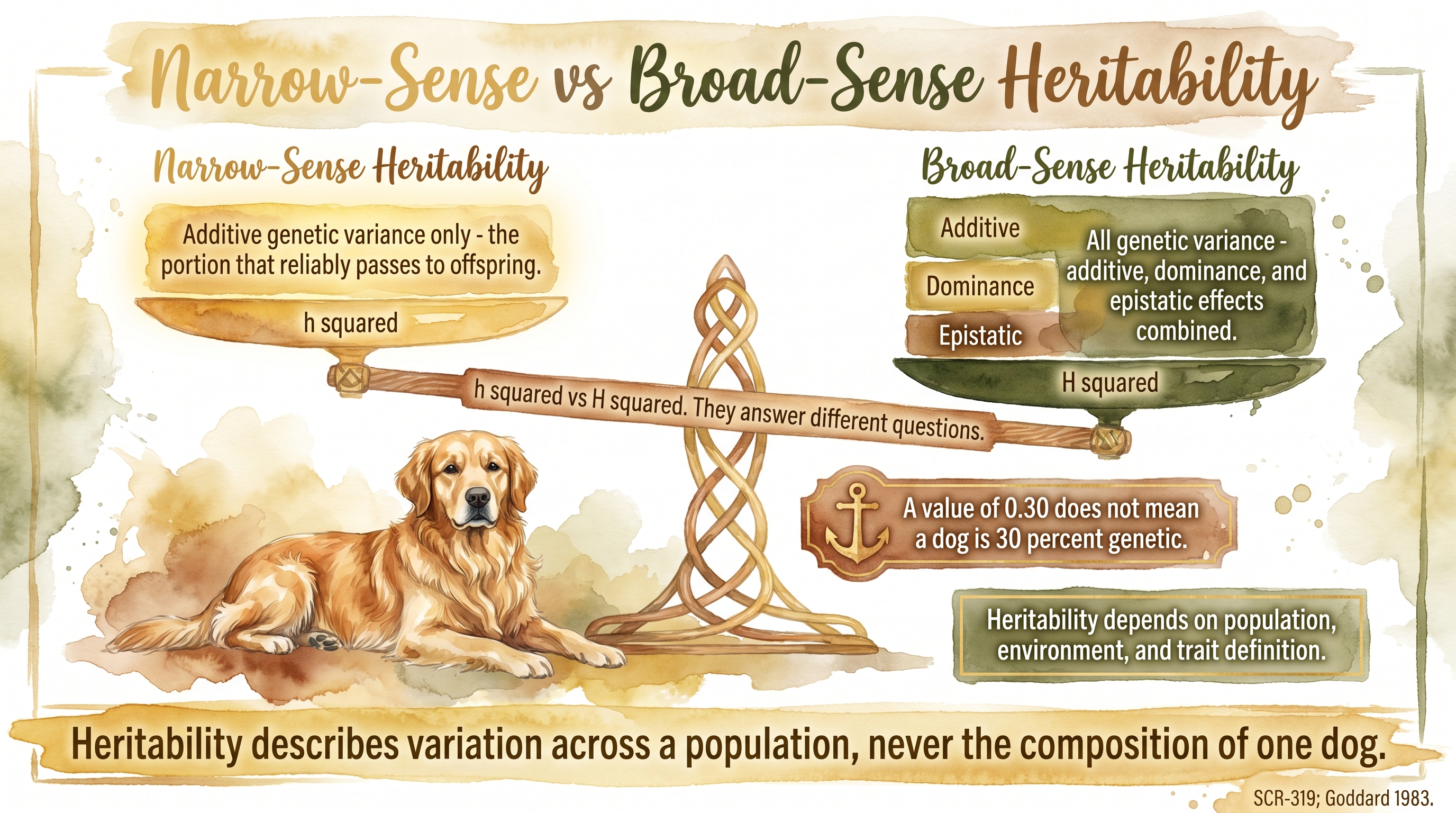
Heritability describes variation across a population, never the composition of one dog.
Key Takeaways
- Narrow-sense heritability measures additive genetic variance and is the breeder-relevant form of heritability.
- Broad-sense heritability is larger because it includes dominance and epistatic genetic effects as well.
- A heritability estimate describes variation in a population under specific conditions, not the composition of one dog.
- Low-to-moderate heritability still supports meaningful selection, but it never removes the importance of development and environment.
- Heritability numbers for the same trait can legitimately differ between studies because the populations and measurement contexts differ.
The Evidence
This entry uses observed claim-level tags beyond the dedicated EvidenceBlocks below. These tags mark JB program observation or practice-derived claims that need dedicated EvidenceBlock coverage in a later content pass.
This entry uses estimated claim-level tags beyond the dedicated EvidenceBlocks below. These tags mark approximate ranges or timing claims that should remain bounded by the cited sources.
- Quantitative-genetics frameworkgeneral genetics and dogs
Narrow-sense heritability estimates the proportion of phenotypic variance attributable to additive genetic variance, while broad-sense heritability includes additive, dominance, and epistatic genetic variance. - Canine orthopedic and behavior datasetsdogs and Golden Retrievers
Hip and temperament traits commonly show low-to-moderate heritability estimates, indicating meaningful but not destiny-level additive genetic contributions. - Temperament heritability source synthesisdogs and Golden Retrievers
Behavioral heritability estimates depend strongly on breed, population structure, measurement instrument, and developmental context.
- Canine quantitative-genetics interpretation guidancedogs
Heritability is a population statistic about variance at a point in time and cannot be converted into a simple percentage breakdown of one dog's trait expression. - Comparative heritability literaturedogs and livestock
Heritability estimates for the same trait can differ across populations, measurement instruments, and environmental conditions without any of the estimates being incorrect.
No study has estimated narrow-sense heritability for Golden Retriever temperament traits under standardized assessment conditions with both parental and offspring measurements across multiple years.
SCR References
Sources
- Goddard M.E. & Beilharz R.G. (1983). Genetics of traits which determine the suitability of dogs as guide-dogs for the blind. Applied Animal Ethology, 9(4), 299-315. doi:10.1016/0304-3762(83)90010-X
- Saetre P., Strandberg E., Sundgren P.-E., Pettersson U., Jazin E., & Bergström T.F. (2006). The genetic contribution to canine personality. Genes, Brain and Behavior, 5(3), 240-248. doi:10.1111/j.1601-183X.2005.00155.x
- Strandberg E., Nilsson K., & Svartberg K. (2025). Genetic parameters of personality traits in dogs based on behavioral assessment and questionnaire information. Applied Animal Behaviour Science, 286, 106619. doi:10.1016/j.applanim.2025.106619
- Wilsson E. & Sundgren P.E. (1998). Behaviour test for eight-week old puppies - heritabilities of tested behaviour traits and its correspondence to later behaviour. Applied Animal Behaviour Science, 58(1-2), 151-162. doi:10.1016/S0168-1591(97)00093-2
- Ilska J., Haskell M.J., Blott S.C., Sánchez-Molano E., Polgar Z., Lofgren S.E., Clements D.N., & Wiener P. (2017). Genetic Characterization of Dog Personality Traits. Genetics, 206(2), 1101-1111. doi:10.1534/genetics.116.192674
- MacLean E.L., Snyder-Mackler N., vonHoldt B.M., & Serpell J.A. (2019). Highly heritable and functionally relevant breed differences in dog behaviour. Proceedings of the Royal Society B: Biological Sciences, 286(1912), 20190716. doi:10.1098/rspb.2019.0716