Progressive Retinal Atrophy in Golden Retrievers
Progressive retinal atrophy is one of the clearest examples of canine genetic testing doing exactly what families hope it can do. In Golden Retrievers, several named PRA mutations are well characterized enough that breeders can use mutation-specific testing and straightforward recessive inheritance logic to avoid producing affected puppies with a level of confidence that most canine genetic testing cannot match. This is the part of canine genetics where precision is real, not aspirational, and where the gap between what the testing promises and what it delivers is small enough that families can reasonably treat the results as load-bearing in their decision-making. Documented
What It Means
What PRA actually is
Progressive retinal atrophy is a clinical category of inherited retinal degeneration in dogs in which the photoreceptor cells of the retina die progressively over months or years, eventually leading to blindness. The condition is called progressive because it unfolds gradually rather than appearing suddenly, and it is called retinal atrophy because the pathology involves the thinning and eventual loss of retinal tissue rather than inflammation or trauma. The clinical presentation usually begins with loss of night vision as the rod photoreceptors die first, followed by loss of day vision as cone photoreceptors follow, and eventually by complete blindness in affected dogs.
PRA is not one disease at the genetic level. It is a clinical category that encompasses many distinct inherited conditions that all produce similar retinal degeneration through different underlying mutations. Different breeds have different PRA variants, and some breeds have more than one. The molecular genetics of canine PRA is one of the more successful branches of canine ocular research, and a substantial number of individual PRA mutations have been identified, validated, and developed into commercial DNA tests over the last three decades. Documented
Three variants matter in Goldens
In Golden Retrievers specifically, the breed has at least three important named variant contexts in the literature: prcd-PRA, GR-PRA1, and GR-PRA2. The prcd (progressive rod-cone degeneration) mutation is shared with several other breeds and was one of the earliest PRA variants to be identified at the molecular level. GR-PRA1 and GR-PRA2 are Golden Retriever specific variants identified more recently, and both have validated DNA tests that directly interrogate the causal mutations.
All three are inherited as autosomal recessive conditions, which means the breeding logic is classical. A clear dog has no copies of the mutation at that locus. A carrier has one copy and is clinically normal because the single working copy of the gene is sufficient to support normal retinal function. An affected dog has two copies and is at risk of disease expression, with the age of onset and rate of progression varying somewhat between individual dogs and between the three variants. The three loci are independent, meaning a dog can be a carrier at one and clear at the others, and breeding decisions must consider all three simultaneously to cover the full known molecular risk.
Why PRA testing works so well
This is why PRA testing is so useful in practice. The breeder is not dealing with vague statistical association or polygenic probability estimates. The breeder is managing a specific locus with specific inheritance math at each of three well-characterized mutations. The test results translate directly into mating decisions, and the decisions translate directly into outcomes. A carrier bred to a clear dog at the same locus cannot produce affected puppies at that locus, full stop, and the absence of affected offspring is not a probabilistic expectation but a deterministic consequence of the recessive inheritance math.
Carrier-to-clear matings therefore become the model example of rational disease management. They preserve valuable dogs in the gene pool while producing no affected puppies at the tested locus. That is exactly what responsible Mendelian management is supposed to do, and it is why PRA testing has meaningfully reduced the incidence of these specific conditions in populations where the testing has been adopted widely. The goal is not to eliminate carriers from the population (which would cause avoidable diversity loss) but to prevent affected puppies from being produced while allowing carriers to continue contributing their other genetic qualities to the breed.
PRA testing is also a reminder that good genetic testing is not magic. It is specificity. The test works because the mutation is known to cause the disease, the inheritance pattern is known to be autosomal recessive, the biological mechanism is understood at the cellular level, and the test is directly interrogating the causal variant rather than a statistical proxy. When all of those conditions are satisfied, the test delivers high-confidence results. When any of them is missing, confidence drops rapidly regardless of how sophisticated the marketing language sounds.
What PRA testing does not cover
Even with this success story, PRA testing has limits that responsible breeders and families should understand. A dog clear for prcd, GR-PRA1, and GR-PRA2 is not necessarily clear for every form of inherited retinal degeneration that might exist in the breed. The three tested variants are the ones currently known and validated; if additional PRA mutations exist in Golden Retrievers at low frequency, they would not be caught by current panels, and a dog clear on all three tests could still theoretically develop retinal degeneration from a cause that has not yet been characterized.
This is not a reason to distrust PRA testing. It is a reason to keep ophthalmic examination as a continuing part of the screening architecture rather than treating the DNA panel as the complete answer. The combination of DNA testing (to prevent affected puppies from known mutations) and ophthalmic examination (to catch disease from any cause, including unknowns) is the strongest current protocol, and the two layers complement each other in ways that neither can achieve alone. Documented
It is also worth noting that the three main Golden Retriever PRA variants have different frequencies in different subpopulations of the breed. A dog from one breeding line may have never been exposed to one of the variants while sitting at non-trivial risk of another. Documented Breed-wide frequency estimates are useful population-level information, but individual breeding decisions still require testing the specific parents being considered rather than relying on assumed frequencies.
Why It Matters for Your Dog
Families often hear that DNA testing cannot predict everything and correctly conclude that breeders should avoid false certainty in their claims. Observed-JB That is true, and it is the right posture for most complex traits. But this page shows the other side of the picture: for some specific conditions, DNA testing really is powerful and concrete, and breeders who are using it well deserve credit for doing so.
PRA in Goldens is one of those conditions. When a breeder tests both parents for all three main variants, confirms at least one clear parent at each locus, and explains the results clearly to the family, the breeder is using one of the strongest tools in canine genetics correctly, and the family can reasonably treat the result as close to definitive for the specific risk being addressed. Documented
That means this is an area where buyers can reasonably expect precise breeder language about which specific mutations were tested, what the parental status is at each locus, whether affected puppies are genetically possible from the particular pairing being offered, and how the breeder has structured the mating to prevent affected outcomes. A breeder who can answer those questions in detail is using the tool the way it is designed to be used. A breeder who cannot, or who tries to paper over the details with vague references to "eye testing," is either not testing thoroughly or not understanding what the testing means.
Families should also understand that even with clean PRA test results, continuing ophthalmic examination of the puppy throughout life is still recommended. The PRA tests prevent specific known conditions; they do not provide a warranty against all possible ocular problems.
For JB, this page matters because it represents the strongest, cleanest use case for modern canine molecular genetics. This is what the field looks like when the biology cooperates and the breeder speaks precisely. The program should use PRA testing thoroughly, explain the results to families in specific terms, and treat PRA management as the model for how other molecular tools should be evaluated: by the directness of the causal link, the validation of the test, and the precision of the language used to describe what the results actually mean.
Why It Matters for Your Dog
What This Cannot Predict
PRA testing cannot clear a dog of retinal disease caused by mutations the panel does not test for, including potentially undiscovered variants in the breed.
It cannot guarantee against age-related or acquired retinal conditions that are not inherited at the PRA loci currently tested.
And it cannot replace ophthalmic examination as a continuing part of the screening protocol, even for dogs that test clear on all three main variants.
PRA testing is best understood as a high-confidence tool for preventing affected puppies from specific well-characterized variants, not as a global retinal health guarantee.
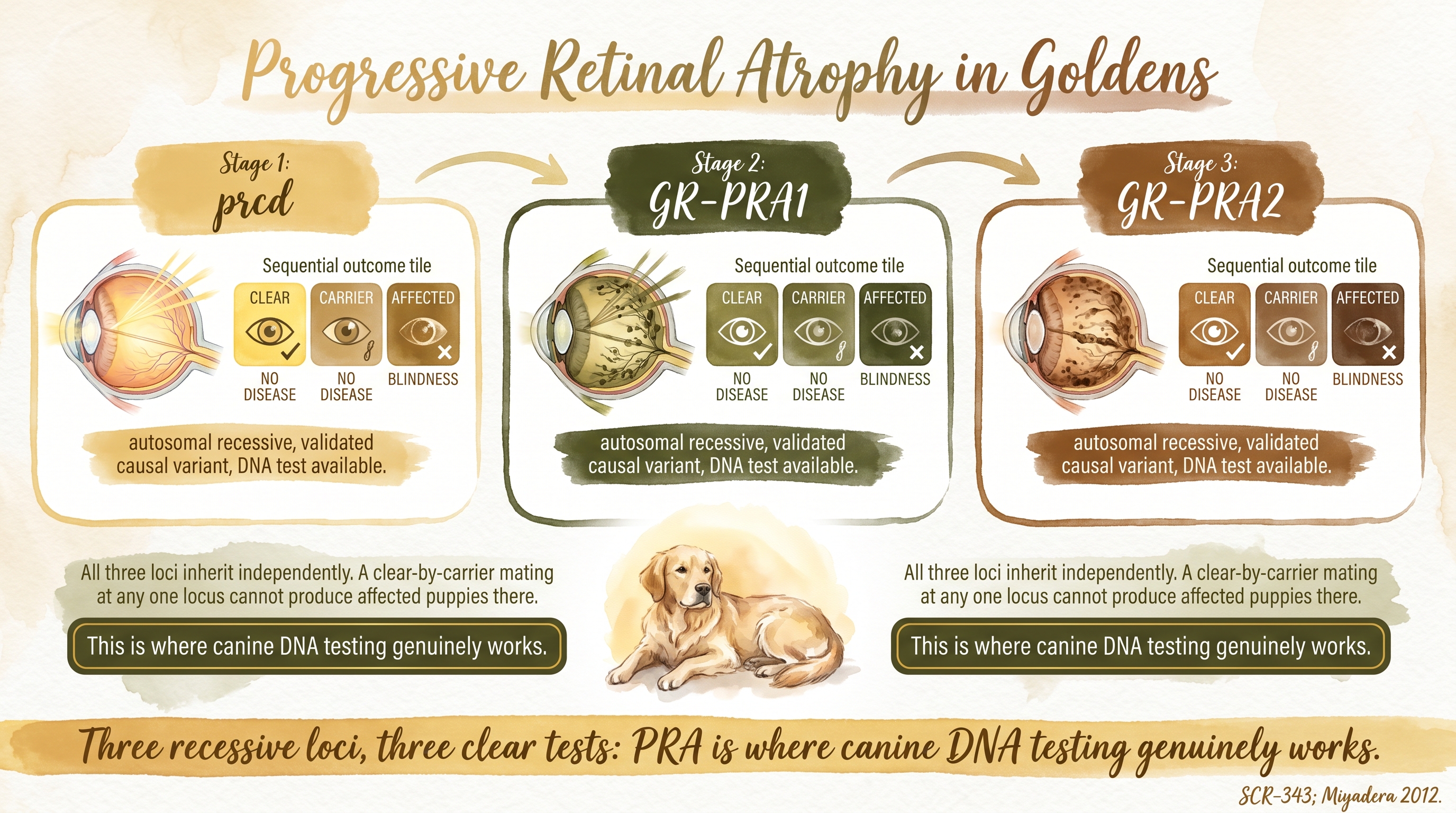
Three recessive loci, three clear tests: PRA is where canine DNA testing genuinely works.
Key Takeaways
- Golden Retrievers have multiple relevant PRA mutations rather than one single retinal disease allele.
- These PRA variants follow autosomal recessive inheritance, which makes carrier-clear-affected status genuinely useful and precise.
- Carrier-to-clear mating is the key breeding strategy because it avoids affected puppies without throwing away useful dogs.
- PRA testing is one of the clearest examples of canine DNA testing working exactly as families hope it will.
- Ophthalmic examination should continue across the dog's life because PRA testing covers only the specific variants currently known.
The Evidence
This entry uses observed claim-level tags beyond the dedicated EvidenceBlocks below. These tags mark JB program observation or practice-derived claims that need dedicated EvidenceBlock coverage in a later content pass.
- Miyadera, Downs, Zangerl, and related ocular-genetics literatureGolden Retrievers and dogs
GR-PRA1, GR-PRA2, and prcd-related PRA variants in Golden Retrievers are documented inherited retinal disease mutations with autosomal recessive inheritance. - Golden Retriever ocular source synthesisGolden Retrievers
Mutation-specific testing for PRA variants allows breeders to distinguish clear, carrier, and affected statuses at the locus level and avoid affected puppies through recessive mating logic.
- Canine recessive-disease management literaturedogs
Carrier-to-clear mating prevents affected offspring for recessive Mendelian disease loci while preserving carriers and supporting broader population diversity. - Ocular DNA-testing outcomes literaturedogs
Widespread adoption of mutation-specific PRA testing has meaningfully reduced the incidence of tested variants in managed populations over multiple generations.
No published study has established whether additional undiscovered PRA-causing mutations remain segregating in the Golden Retriever population beyond the currently tested variants.
SCR References
Sources
- Miyadera K., Acland G.M., & Aguirre G.D. (2012). Genetic and phenotypic variations of inherited retinal diseases in dogs: the power of within- and across-breed studies. Mammalian Genome, 23(1-2), 40-61. doi:10.1007/s00335-011-9361-3
- Downs L.M., Wallin-Håkansson B., Boursnell M., Marklund S., Hedhammar Å., Truvé K., Hübinette L., Lindblad-Toh K., Bergström T., & Mellersh C.S. (2011). A frameshift mutation in SLC4A3 is associated with progressive retinal atrophy in the Golden Retriever. PLOS ONE, 6(6), e21452. doi:10.1371/journal.pone.0021452
- Downs L.M., Wallin-Håkansson B., Bergström T., & Mellersh C.S. (2014). A novel mutation in TTC8 is associated with progressive retinal atrophy in the golden retriever. Canine Genetics and Epidemiology, 1, 4. doi:10.1186/2052-6687-1-4
- Zangerl B., Goldstein O., Philp A.R., Lindauer S.J.P., Pearce-Kelling S.E., Mullins R.F., et al. (2006). Identical mutation in a novel retinal gene causes progressive rod-cone degeneration (prcd) in dogs and retinitis pigmentosa in man. Genomics, 88(5), 551-563. doi:10.1016/j.ygeno.2006.07.007