Autosomal Recessive vs Dominant Inheritance in Dogs
Families hear words like recessive, dominant, and carrier all the time in breeder conversations, but those words only make sense when the disease really follows a Mendelian inheritance pattern. Used correctly, they are precise and helpful, and they give families a genuine ability to understand what a breeder's disclosures mean. Used loosely, they create category errors that confuse simple single-gene disorders with complex polygenic disease, and those category errors are one of the most common ways canine genetic testing gets oversold to buyers who trust the language without knowing which traits the vocabulary actually fits. Documented
What It Means
Autosomal recessive inheritance
Autosomal recessive inheritance means a dog usually needs two copies of the disease allele to express the disorder. A dog with one copy is called a carrier because the allele is present in the dog's genome and can be passed on to offspring, but the carrier dog itself typically does not express the disease because the one working copy of the gene is enough to sustain normal function. A dog with no copies of the disease allele is called clear at that locus, meaning neither of the chromosomes inherited from the parents carries the mutation being tested.
That is the classic context in which carrier language makes biological sense. The category only exists because recessive alleles can hide in a population without causing clinical signs, and carriers are the reason recessive diseases persist across generations even without regular expression in visible dogs. A breed can carry a recessive mutation at moderate frequency for decades before the disease becomes common enough to attract attention, because carriers are not themselves affected and the mutation only becomes visible when two carriers happen to be bred together and produce an affected puppy.
If two carriers are bred, the average expectation across many offspring is approximately 25 percent affected puppies (two copies of the disease allele), 50 percent carrier puppies (one copy), and 25 percent clear puppies (no copies). Estimated Those are averages across the theoretical distribution. Any individual litter can deviate substantially from the expected ratios simply because small samples are noisy, which is why breeders who have seen multiple litters from carrier-to-carrier matings know that the real numbers bounce around considerably even though the population expectation is stable.
If a carrier is bred to a clear dog, no affected puppies should be produced at that locus, though approximately half the resulting puppies will be carriers themselves and will need to be identified through testing before their own breeding careers begin. This is the mating pattern that makes validated Mendelian disease testing so valuable for diversity preservation, because it lets a breeder continue using a carrier dog in the program without producing affected offspring, which means the dog's other genetic contributions are not lost to the line.
Autosomal dominant inheritance
Autosomal dominant inheritance is different. One copy of the disease allele is enough to create risk of expression, which means there are generally no unaffected carriers in the recessive sense. If a dog carries the dominant disease allele, it is already in the risk category for expression, even though penetrance and age of onset can still vary between individual dogs. Documented The population math is different too: a dog carrying one copy of the dominant disease allele will pass it to approximately half of its offspring regardless of the mate's genotype, so dominant alleles can spread through a breeding population quickly unless they are actively managed.
Dominant disease inheritance is in some ways simpler to manage than recessive inheritance because the affected dogs are visible and cannot easily hide in the population as symptom-free carriers. The tradeoff is that every affected dog removed from breeding represents a straightforward loss of that dog's genetic contribution, and there is no intermediate management category comparable to the carrier-to-clear mating that preserves diversity in recessive disease management. Penetrance complications can blur the edges of this picture, however. Some dominant alleles show incomplete penetrance, meaning not every dog carrying the allele expresses the disease, which creates a grey zone that looks superficially like carrier status but has different population-genetic consequences.
X-linked inheritance
X-linked inheritance adds another layer because males and females differ in how they inherit and express variants on the X chromosome. Documented Females have two X chromosomes and males have one X and one Y, which means a recessive X-linked mutation that would need two copies to express in a female can express with only one copy in a male because the male has no second X chromosome to provide a working copy. In dogs, some muscular dystrophy forms illustrate why this matters. Males may express disease with one affected X chromosome, while females can sometimes be carriers with more variable expression depending on the specific disorder and the pattern of X-inactivation during development.
X-linked inheritance also has distinctive pedigree signatures that trained breeders can sometimes spot by eye. Documented Affected males are typically more common than affected females, disease may appear to skip generations through carrier females, and a pattern of maternal transmission from unaffected dams to affected sons is a classic X-linked signal. Those signatures are not definitive in any single case but can provide useful clues when combined with DNA testing and clinical evaluation.
Why the categories matter for breeder decisions
These categories are basic genetics, but they are important because breeder decisions depend on them completely. The same DNA result means very different things depending on the inheritance pattern behind the disease, and a breeder who confuses the categories will make management decisions that do not match the underlying biology. A carrier result for a recessive disease allows the dog to continue in breeding with appropriate mate selection. A carrier result (or its equivalent) for a dominant disease typically means the dog is already at risk and cannot be used in the same way. A carrier result for an X-linked disease requires thinking about sex-specific inheritance patterns that do not apply to autosomal diseases at all.
This is also where complications enter the picture. Some conditions show incomplete penetrance, meaning not all dogs with the risk genotype express the disease. Documented Others show variable expressivity, meaning dogs with the same genotype can express the disease with very different severity. Some diseases are modified by additional loci that amplify or suppress the primary mutation's effect. Those complications do not erase the underlying inheritance pattern, but they do make communication with families harder and they are part of why experienced breeders stay cautious about overselling any single test result even when the inheritance pattern is known.
The load-bearing boundary
The most important boundary to keep in mind is that this vocabulary belongs to Mendelian diseases. It should not be stretched onto polygenic conditions, and stretching it is one of the most common ways genetic language gets misused in canine marketing. A dog is not a carrier for cancer in the same way it can be a carrier for a validated recessive mutation, because cancer susceptibility is polygenic and does not have the clean two-allele architecture the carrier concept describes. A dog is not clear for hip dysplasia because one DNA test said so, because hip dysplasia is influenced by many genes and environmental factors that no single test can capture. Those phrases are only precise when the genetic architecture actually supports them, and using them outside that context is a category error that misleads families about what the test results actually mean.
This slippage is especially common in the marketing of broad commercial DNA panels that advertise testing for dozens or hundreds of conditions. Some of the conditions on those panels are validated Mendelian diseases where the vocabulary is appropriate. Others are complex-trait associations where the vocabulary does not fit the underlying biology and the results are much more probabilistic than the packaging suggests. A careful breeder learns to distinguish which category each test belongs to rather than treating the whole panel as uniform.
Why It Matters for Your Dog
What This Cannot Predict
Inheritance-pattern vocabulary cannot rescue weak evidence. A test that claims to identify a disease allele is only as reliable as the underlying validation work that established the mutation as truly causal in the breed being tested.
It cannot make a poorly validated test trustworthy simply because the words recessive and dominant sound formal. The words describe the architecture, not the quality of any specific assay.
It cannot be extended honestly to polygenic disease. Polygenic traits do not have carriers in the Mendelian sense, and pretending they do is a category error that misleads families about the reliability of the information.
And it cannot handle every real-world complication. Incomplete penetrance, variable expressivity, modifier genes, and environmental triggers can all cause the observed inheritance pattern to deviate from textbook expectations, and no vocabulary alone resolves those complications.
The correct use of the vocabulary is narrower than casual usage suggests. Use it when the disease truly follows a known Mendelian pattern, the locus has been well characterized, and the test is directly interrogating the validated causal variant. Outside those conditions, the words become less precise and should be handled more carefully.
For families, this page matters because breeder disclosures become much easier to interpret once the vocabulary is clear.
If the breeder says a dog is a carrier for a recessive retinal mutation and the mate is clear at the same locus, that disclosure is meaningful and manageable. The mating logic is understandable, the risk to the puppies is zero at that locus, and the breeder is using the testing tool the way it is designed to be used. A family can accept that disclosure and feel confident about what it means.
If the breeder uses the same style of language for polygenic traits like hip quality or cancer susceptibility, that should raise immediate questions about whether the genetic architecture is being oversimplified. A breeder who says a dog is clear for hip dysplasia is either using a legitimate polygenic risk estimate (which should be labeled as such and explained in probabilistic terms) or misrepresenting the reliability of the information. The family's right question in that case is to ask what specific test produced the result and what confidence level the breeder actually has in it.
For breeders, correct inheritance language helps make better pairings and communicate more honestly with families. It is part of evidence discipline, not just genetics terminology. A program that uses the vocabulary precisely will produce better long-term outcomes because the underlying biology is being treated as it actually works rather than as a simplified marketing version of how it works.
For JB, this matters because precision in language protects both dogs and families. Good stewardship depends on saying exactly what the evidence supports and no more, and the carrier-clear-affected vocabulary is one of the places where that discipline matters most because the words carry so much weight in buyer conversations. When the program says a dog is a carrier for a specific validated recessive mutation, the statement is doing real work. When the program refuses to apply the same language to polygenic traits, the refusal is also doing real work, because it preserves the meaning of the words for the contexts where they actually apply.
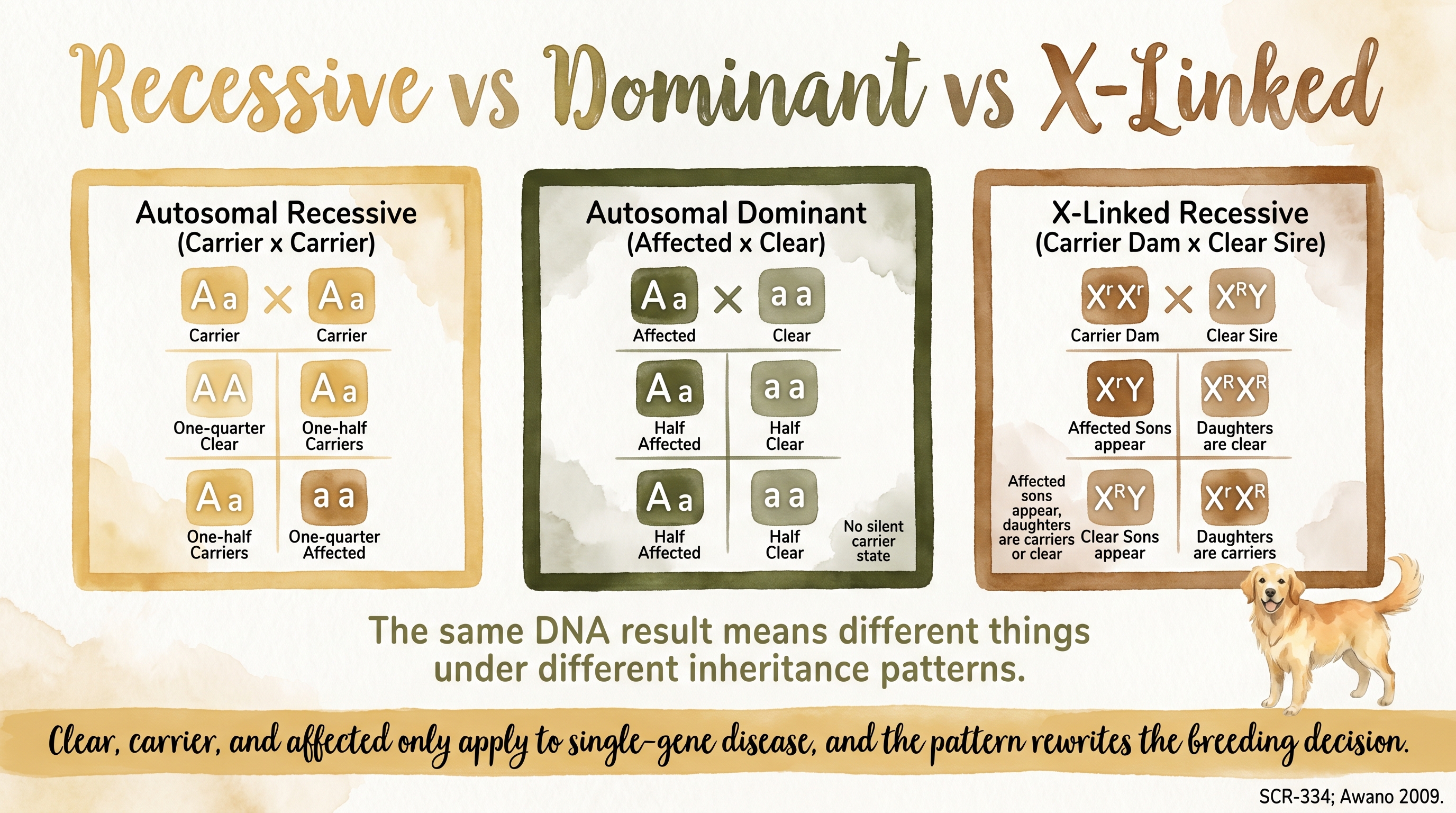
Clear, carrier, and affected only apply to single-gene disease, and the pattern rewrites the breeding decision.
Key Takeaways
- Autosomal recessive, autosomal dominant, and X-linked inheritance describe different ways single-gene diseases are passed on.
- Carrier language belongs mainly to recessive Mendelian disorders where one-copy dogs are typically unaffected but can pass the allele on.
- Dominant disease alleles create a different risk structure because one copy can be enough for expression.
- X-linked inheritance depends on sex-chromosome biology and creates distinctive pedigree signatures.
- These terms are useful only when the disease really follows Mendelian inheritance rather than a polygenic architecture.
The Evidence
This entry uses estimated claim-level tags beyond the dedicated EvidenceBlocks below. These tags mark approximate ranges or timing claims that should remain bounded by the cited sources.
- Classical genetics and canine disease literaturedogs
Autosomal recessive diseases require two disease alleles for typical expression, autosomal dominant diseases can express with one, and X-linked conditions depend on sex-chromosome inheritance. - Canine mutation-specific literaturedogs and Golden Retrievers
Golden Retriever inherited diseases include examples that illustrate recessive and X-linked inheritance clearly enough for practical breeding management.
- Canine inherited-disease genetics literaturedogs
Carrier-clear-affected vocabulary is appropriate for validated Mendelian disease loci and becomes misleading when applied to polygenic conditions. - Penetrance and expressivity literaturedogs and other mammals
Incomplete penetrance and variable expressivity can complicate interpretation of Mendelian inheritance even when the primary genetic architecture is well characterized.
No comprehensive screening has quantified the frequency of incomplete penetrance or variable expressivity in known Mendelian disease variants in Golden Retrievers, making it difficult to estimate the exception rates to classical inheritance patterns.
SCR References
Sources
- Awano T., Johnson G.S., Wade C.M., Katz M.L., Johnson G.C., Taylor J.F., Perloski M., Biagi T., Baranowska I., Long S., March P.A., Olby N.J., Shelton G.D., Khan S., O'Brien D.P., Lindblad-Toh K., & Coates J.R. (2009). Genome-wide association analysis reveals a SOD1 mutation in canine degenerative myelopathy that resembles amyotrophic lateral sclerosis. Proceedings of the National Academy of Sciences, 106(8), 2794-2799. doi:10.1073/pnas.0812297106
- Zeng R., Coates J.R., Johnson G.C., Hansen L., Awano T., Kolicheski A., et al. (2014). Breed distribution of SOD1 alleles previously associated with canine degenerative myelopathy. Journal of Veterinary Internal Medicine, 28(2), 515-521. doi:10.1111/jvim.12317
- Grall A., Guaguère E., Planchais S., et al. (2012). PNPLA1 mutations cause autosomal recessive congenital ichthyosis in golden retriever dogs and humans. Nature Genetics, 44(2), 140-147. doi:10.1038/ng.1056
- Graziano L., Vasconi M., & Cornegliani L. (2018). Prevalence of PNPLA1 Gene Mutation in 48 Breeding Golden Retriever Dogs. Veterinary Sciences, 5(2), 48. doi:10.3390/vetsci5020048
- Gilliam D., Kolicheski A., Johnson G.S., Mhlanga-Mutangadura T., Taylor J.F., Schnabel R.D., & Katz M.L. (2015). Golden Retriever dogs with neuronal ceroid lipofuscinosis have a two-base-pair deletion and frameshift in CLN5. Molecular Genetics and Metabolism, 115(2-3), 101-109. doi:10.1016/j.ymgme.2015.04.001
- Shaffer L.G., Sundin K., Geretschlaeger A., Segert J., Swinburne J.E., Royal R., Loechel R., Ramirez C.J., & Ballif B.C. (2018). Standards and guidelines for canine clinical genetic testing laboratories. Human Genetics, 138(5), 493-499. doi:10.1007/s00439-018-1954-4
- Farrell L.L., Schoenebeck J.J., Wiener P., Clements D.N., & Summers K.M. (2015). The challenges of pedigree dog health: approaches to combating inherited disease. Canine Genetics and Epidemiology, 2, 3. doi:10.1186/s40575-015-0014-9