Hereditary Eye Disease in Golden Retrievers
Golden Retrievers have more than one inherited eye story. Some ocular conditions in the breed are cleanly Mendelian and amenable to mutation-specific DNA testing with the kind of high confidence that modern canine genetics is capable of delivering. Others are late-onset, phenotypically screened, genetically unresolved, or likely more complex in inheritance than buyers usually assume when they hear the word hereditary. That mixed picture is exactly why eye health in the breed cannot be reduced to one panel result or one normal exam, and why the most responsible breeders combine multiple screening layers rather than relying on any single tool to tell the whole story. Documented
What It Means
The range of inherited ocular concerns in Goldens
The main hereditary ocular concerns in Golden Retrievers include progressive retinal atrophy variants of more than one molecular type, hereditary cataract forms with varying ages of onset and genetic architectures, Golden Retriever pigmentary uveitis (a breed-characteristic condition that deserves its own attention), and other structural problems such as distichiasis or entropion that can be inherited and that affect comfort and function even when they are not directly sight-threatening. Documented Not all of these belong to the same genetic category, and not all of them respond to the same management tools, which is the central lesson of the page.
Mutation-specific conditions: the cleanest category
Progressive retinal atrophy variants such as prcd, GR-PRA1, and GR-PRA2 are the most straightforward from a genetic-management standpoint because they are known mutation-linked conditions with recessive inheritance logic and validated causal-variant DNA tests. Documented A breeder who has tested both parents for all relevant PRA variants and confirmed at least one clear parent at each locus has functionally eliminated the risk of producing affected puppies for those specific conditions. This is one of the clearest success stories in applied canine genetics, and it is a case where molecular testing really does what the marketing language promises it will do, provided the testing is thorough and the interpretation is locus-specific.
The caveat is that PRA is not a single disease. It is a clinical category that encompasses multiple distinct genetic causes of retinal degeneration, and the Goldens tested clear for prcd, GR-PRA1, and GR-PRA2 may still carry other retinal disease variants that have not yet been identified or that are too rare to appear on standard commercial panels. The clinical category is broader than any currently available molecular test panel, and that gap is why ophthalmic examination remains essential even when all the DNA tests come back clear.
Conditions that do not behave like solved stories
Other conditions are more complicated. Pigmentary uveitis is important in the breed, late in onset, clinically significant, and one of the leading causes of vision loss in older Golden Retrievers, but it does not currently behave like a solved one-mutation story. Research is ongoing into possible genetic contributors, but as of the current evidence base, the condition is managed primarily through regular ophthalmic examination by a board-certified veterinary ophthalmologist rather than through DNA testing, and the disease often appears later in life after a dog has already been bred, which creates inherent difficulty for prevention through selection alone.
Some hereditary cataracts are also genetically unresolved or more complex than families expect from the word hereditary. The word suggests simple single-gene inheritance, but the clinical reality includes cataract forms that are polygenic, environmentally modified, or produced by multiple independent genetic causes that no single test can cover. Documented A Golden Retriever diagnosed with a cataract may or may not have transmitted risk to puppies already produced, and determining the inheritance pattern of a specific cataract case often requires pedigree analysis and family tracing rather than a simple test result.
Structural problems like distichiasis (extra eyelashes growing from unusual locations) and entropion (inward rolling of the eyelids) tend to be polygenic in their inheritance and are identified through examination rather than DNA testing. These are not usually sight-threatening but can cause chronic discomfort and secondary complications if not managed, and they do show up repeatedly in some Golden Retriever lines, which suggests meaningful heritable risk even in the absence of clean mutation-based testing.
Why two screening layers are both necessary
This mixed architecture explains why two screening layers are both necessary for responsible Golden Retriever breeding on ocular health. Ambiguous DNA testing works where mutation-specific knowledge exists and where the assay is directly interrogating a validated causal variant. Ophthalmic examination works where phenotype remains the only practical way to see the disease, either because the genetic architecture is complex, the mutations are unknown, or the onset is too late for DNA testing to be preventively useful on its own.
The two layers are complementary rather than redundant. A breeder who runs only DNA testing is missing the late-onset and structurally examined conditions. A breeder who runs only ophthalmic exams is missing the chance to prevent affected puppies from being produced at loci where molecular testing could identify carriers before breeding. Both layers together cover the practical ocular landscape in the breed as well as current tools allow, and leaving either one out creates an obvious gap in the screening architecture.
This is especially important because several ocular conditions in Goldens are late-onset. A dog can look normal during one examination window and still develop clinically meaningful ocular disease later in life. That is why repeat exams exist, and why a single clean exam on a young adult dog is not the same as a lifelong ocular guarantee. The standard protocol in responsible breeding programs is to repeat ophthalmic examinations annually or at defined intervals across the dog's breeding career, not to rely on a single examination as permanently dispositive. The exam is a snapshot, not a lifelong warranty.
How the screening layers should be presented
A responsible breeder who understands the mixed architecture will present the screening layers honestly to families. The conversation should distinguish what has been tested by DNA and with what confidence, what has been examined and when the examination was conducted, what remains unresolved because the science has not yet delivered good tools, and what kind of ongoing monitoring the puppy's new family should plan for as the dog ages. A breeder who packages all of this as a single "eye tested" claim without distinguishing the layers is oversimplifying, even if not deliberately, and the simplification costs families the information they need to make good decisions.
Why It Matters for Your Dog
Families often hear that a breeder "did the eye tests" without understanding what that actually covers. The phrase sounds comprehensive, but it can mean anything from a thorough multi-layer screening protocol to a single DNA panel that misses most of the real ocular risks in the breed. This page gives the right framework for asking more specific questions.
The useful question is not whether eye screening happened in the abstract. The useful question is which specific ocular conditions are being managed by DNA testing on the parents, which are being managed by ophthalmic examination and how recently the exams were performed, and whether the breeder is talking as if one negative result settled the whole ocular picture. A breeder who distinguishes between mutation-tested conditions and exam-screened conditions, who knows when each parent was last examined by an ophthalmologist, and who explains that annual ocular exams should continue across the breeding career is using the right mental model. A breeder who collapses everything into a single claim of "eye-clear" is oversimplifying.
Families should also understand that some ocular conditions in Golden Retrievers may not appear until the dog is middle-aged or older. That means no breeder can promise that an individual puppy will not develop an ocular condition later in life, and the honest answer to the question "will my puppy develop eye problems" is that the risk has been reduced by careful parent selection and screening but cannot be eliminated entirely. Buyers who understand that framing can evaluate breeders fairly; buyers who expect an absolute guarantee cannot.
For JB, the answer has to remain honest. Golden eye health requires both molecular precision where available and ongoing phenotypic vigilance where the genetics remain incomplete or the onset is late. The program should use the full testing architecture, communicate the results to families in layered terms, and plan for lifelong ocular monitoring rather than pretending that breeding-time screening settles the question forever. That is the only stewardship posture the current evidence base actually supports.
What This Cannot Predict
One DNA result cannot clear all inherited eye disease. A dog clear for prcd, GR-PRA1, and GR-PRA2 can still develop ocular disease from causes the panel does not cover. Documented
One normal eye exam cannot promise lifelong ocular normality. Late-onset conditions can develop years after a dog has been examined normal, which is why repeat exams exist.
The phrase "hereditary eye disease" should not be treated as though every condition inside it shares the same simple Mendelian logic. The category is broader than the molecular tools currently available to address it.
And no screening layer, whether DNA or ophthalmic, can account for conditions that have not yet been characterized in the breed. The field of canine ocular genetics continues to advance, and today's comprehensive screening protocol may look incomplete in a decade.
For this reason, eye-risk interpretation in Goldens has to stay layered. Some risks are mutation-manageable with high confidence. Others are phenotype-managed with clinical examination. Some remain genetically incomplete and require ongoing monitoring across the dog's life. None of the layers alone is sufficient, and treating any single layer as comprehensive is an error that costs clarity.
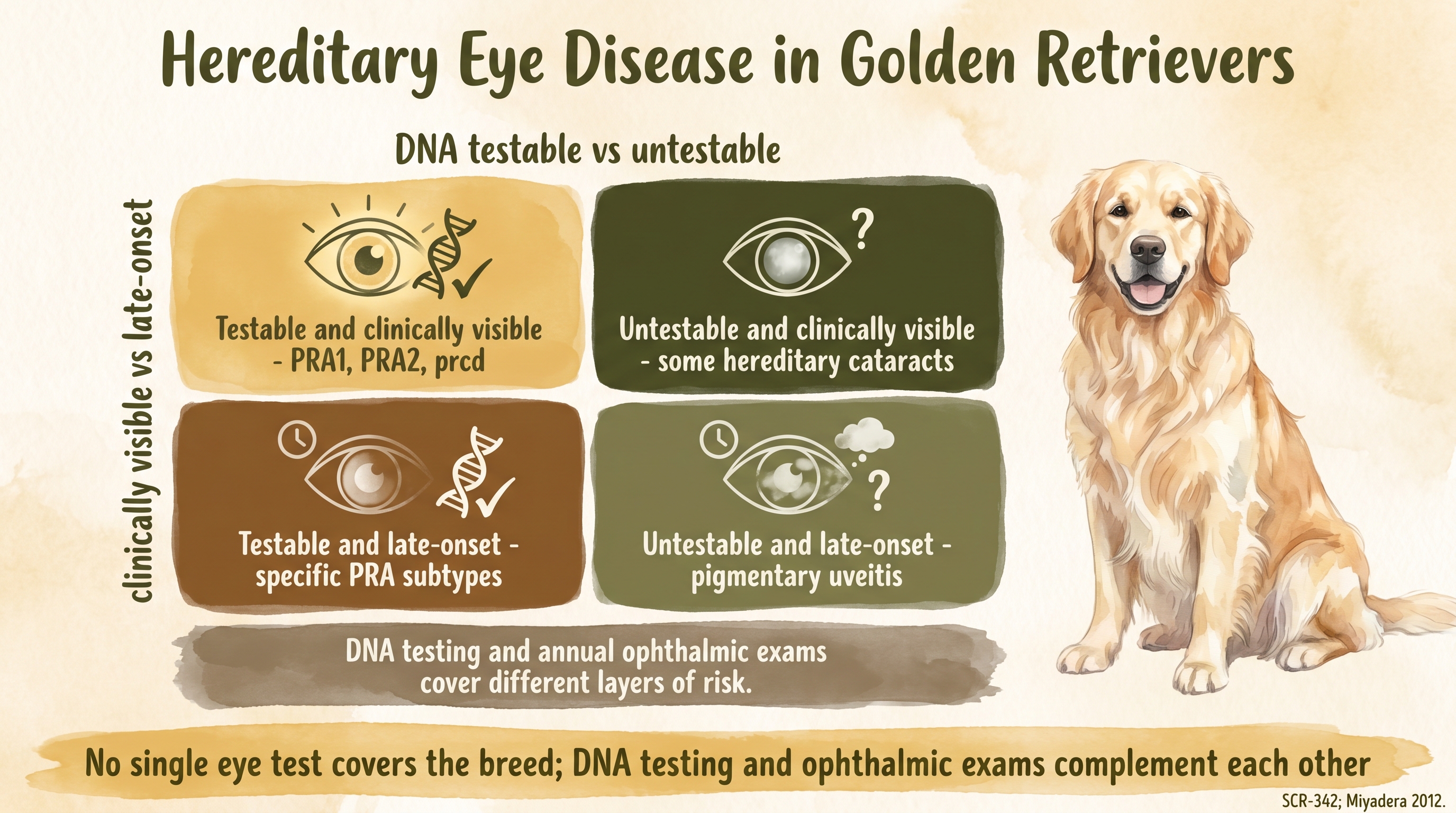
No single eye test covers the breed; DNA testing and ophthalmic exams complement each other.
Key Takeaways
- Inherited eye disease in Golden Retrievers is not one condition but a mixed set of Mendelian and more complex ocular problems.
- DNA testing is strongest for known PRA variants, while other conditions still depend mainly on clinical eye examination.
- A normal eye exam is valuable but time-limited because some relevant diseases are late-onset.
- Good ocular stewardship in the breed requires both mutation-specific testing and repeat phenotypic screening.
- Pigmentary uveitis and some hereditary cataract forms remain genetically unresolved and must be monitored clinically.
The Evidence
This entry uses ambiguous claim-level tags beyond the dedicated EvidenceBlocks below. These tags mark claims where the literature remains unsettled or multiple interpretations coexist.
- Golden Retriever ocular disease literatureGolden Retrievers
The breed carries both mutation-specific inherited retinal disease and other clinically important ocular conditions that are late-onset, phenotypically screened, or genetically unresolved. - Ocular screening source synthesisGolden Retrievers
DNA testing and ophthalmic examination manage different parts of the inherited ocular landscape and should not be treated as substitutes.
- Veterinary ophthalmology literaturedogs and Golden Retrievers
Because some hereditary ocular conditions appear later in life, an ophthalmic exam represents a time-bound clinical snapshot rather than a lifelong guarantee. - Pigmentary uveitis research literatureGolden Retrievers
Pigmentary uveitis is a clinically important late-onset ocular disease in the breed for which no validated causal-mutation test currently exists, making ongoing ophthalmic examination the primary monitoring tool.
No published study has directly compared detection rates and long-term validity of different ocular examination intervals (annual, triennial, before breeding only) across Golden Retriever populations at known risk.
SCR References
Sources
- Miyadera K., Acland G.M., & Aguirre G.D. (2012). Genetic and phenotypic variations of inherited retinal diseases in dogs: the power of within- and across-breed studies. Mammalian Genome, 23(1-2), 40-61. doi:10.1007/s00335-011-9361-3
- Downs L.M., Wallin-Håkansson B., Boursnell M., Marklund S., Hedhammar Å., Truvé K., Hübinette L., Lindblad-Toh K., Bergström T., & Mellersh C.S. (2011). A frameshift mutation in SLC4A3 is associated with progressive retinal atrophy in the Golden Retriever. PLOS ONE, 6(6), e21452. doi:10.1371/journal.pone.0021452
- Downs L.M., Wallin-Håkansson B., Bergström T., & Mellersh C.S. (2014). A novel mutation in TTC8 is associated with progressive retinal atrophy in the golden retriever. Canine Genetics and Epidemiology, 1, 4. doi:10.1186/2052-6687-1-4
- Zangerl B., Goldstein O., Philp A.R., Lindauer S.J.P., Pearce-Kelling S.E., Mullins R.F., et al. (2006). Identical mutation in a novel retinal gene causes progressive rod-cone degeneration (prcd) in dogs and retinitis pigmentosa in man. Genomics, 88(5), 551-563. doi:10.1016/j.ygeno.2006.07.007
- Townsend W.M., Huey L.O., McCalla T., Mathis J.S., Reynolds E.F., Parker V.K., Ginnis S., Ackerman S., & Stuhr C.M. (2013). The post-operative diffractive multifocal intraocular lens implant for ametropia correction in dogs. Veterinary Ophthalmology, 16(Suppl 1), 143-149.