Mendelian Disease Alleles in Dogs
Some inherited canine diseases really do behave like the textbook genetics most people expect. A single locus matters. The mutation is known. The inheritance pattern is clear enough that breeder decisions can be made with near-binary confidence. Those are Mendelian disease alleles, and they are the part of canine genetic testing that deserves the strongest confidence when the assay and the mutation are well validated. They are also the part of the field where the distance between what a test claims and what it delivers is smallest, which is why they are where modern DNA testing has had its most dramatic and legitimate impact on breeding outcomes over the last two decades. Documented
What It Means
The formal definition
A Mendelian disease allele is a variant at one locus that contributes to a disease in a classical inheritance pattern such as autosomal recessive, autosomal dominant, or X-linked transmission. The inheritance math follows Gregor Mendel's classical laws of segregation and independent assortment, which is where the name comes from, and the relationship between genotype and disease status is strong enough that knowing the genotype at the disease locus tells you most of what you need to know about the dog's risk.
That is a rare property in biology. Most traits are not well described by classical Mendelian logic because most traits are polygenic, meaning they are influenced by many loci each contributing small or moderate effects. The Mendelian subset of inherited disease exists because, for some conditions, one specific mutation disrupts a biological process severely enough that the effect dominates any contribution from other genetic or environmental factors. When that happens, the disease becomes a single-locus problem, and single-locus problems are exactly what classical genetic testing is designed to solve.
Why these loci matter so much in breeding
The reason these loci matter so much in breeding is that they are tractable in a way polygenic traits are not. If the mutation is truly causal and the test detects it accurately, breeder decisions at that locus can be made with a level of certainty that complex-trait genetics simply cannot provide. A breeder does not need to estimate risk, weigh probabilities, or reason about effect sizes. The test result is either consistent with clear, carrier, or affected status, and the breeding decision follows from basic Mendelian logic.
Golden Retriever retinal diseases are a good example. Several named progressive retinal atrophy variants follow autosomal recessive inheritance and are supported by mutation-specific evidence. PRA1 and PRA2 are among the most commonly cited in Golden-specific breeding discussions, and both have validated DNA tests that directly interrogate the causal variant rather than a linked marker. In cases like that, the DNA test is not merely providing a vague association based on population statistics. It is interrogating a specific disease-causing locus with known biological consequences, and the result means what the classical Mendelian framework says it means.
The same general logic applies to other well-characterized single-gene conditions in dogs, including some forms of ichthyosis, neuronal ceroid lipofuscinosis, muscular dystrophy, and exercise-induced collapse. The important point is not the disease list alone. It is the kind of evidence underlying the test. A true causal-variant test for a Mendelian condition answers a very specific question with high confidence, and that confidence is earned through functional validation of the mutation's biological effect, not just through statistical association in a population study.
The distinction from marker-based testing
This distinction between causal-variant testing and marker-based association testing is one of the most important concepts in modern canine genetic testing, and it is where consumer confusion is most common. A causal-variant test interrogates the exact mutation that disrupts the gene's function, and the biological chain from genotype to phenotype is understood mechanistically. A marker-based test interrogates a nearby variant that happened to be statistically associated with the disease in the study population, without necessarily being the variant that causes the disease. Documented Both can appear on the same DNA panel and be labeled as genetic tests, but they deserve very different levels of confidence when used to make breeding decisions.
Causal-variant Mendelian tests are the strongest form of canine genetic testing currently available. Marker-based tests are useful within their validation population but fragile when applied outside it, as discussed in the linkage and pleiotropy entry. A careful breeder learns to ask which category a given test falls into before treating the result as load-bearing in a mating decision.
Classical recessive management strategy
Mendelian disease management differs sharply from management of polygenic disease because the math is precise. When the disease follows classical recessive inheritance, breeder strategy follows directly from the genotype combinations involved. A clear-to-clear mating produces only clear offspring at that locus, with zero risk of affected puppies and zero carriers introduced to the next generation. Documented A carrier-to-clear mating produces no affected offspring, though approximately half the resulting puppies will be carriers themselves and will need to be identified before their own breeding careers. A carrier-to-carrier mating risks approximately one in four affected offspring on average and is generally avoided in responsible programs, though it is sometimes used carefully when both dogs are particularly valuable and the breeder is prepared to test and manage the resulting litter.
That precision is a gift. It lets breeders reduce disease risk without necessarily purging valuable carrier dogs from the population, which is the single most important practical consequence of having a reliable test. Documented Before validated DNA testing existed for these conditions, the only conservative response to a suspected carrier was often to remove the dog from breeding entirely, which meant losing whatever other genetic contributions that dog would have made to the line. With a validated test, a carrier can continue contributing to the program as long as its mate is clear at that locus, and the line loses nothing while the disease risk at that locus remains fully managed.
This is why Mendelian disease testing has genuinely improved diversity outcomes in breeds that adopted it carefully. The ability to keep carriers in the breeding population without producing affected puppies is a diversity-preserving tool, not just a disease-prevention tool, and it is one of the few places in modern breeding where precision and diversity management pull in the same direction rather than against each other. Documented
Keeping the evidence boundary intact
The category only works, however, when breeders keep the evidence boundary intact and do not extend the confidence of Mendelian testing beyond the locus it actually covers. A dog can be genetically clear for a named Mendelian mutation and still not be globally "genetically healthy" in any meaningful sense. The test is answering one locus-level question, not summarizing the whole dog, and the answer to that question tells you nothing about any of the hundreds of other possible genetic contributions to the dog's health profile.
This slippage happens often in marketing language when a breeder lists several Mendelian clears on a dog's profile and implies that the combination guarantees health. It does not. It guarantees freedom from the specific Mendelian diseases tested, which is genuinely valuable, but it says nothing about polygenic diseases like hip dysplasia or cancer susceptibility, nothing about diseases caused by mutations the test does not cover, nothing about environmental or developmental contributors to health, and nothing about the dog's overall genetic diversity. The breeder who stays specific about what the tests cover is being honest. The breeder who packages the results as a global health guarantee is overclaiming.
Why It Matters for Your Dog
What This Cannot Predict
A clean result for one Mendelian mutation does not clear a dog for every disease in that clinical category. A dog clear for PRA1 and PRA2 may still develop a retinal degeneration caused by a different mutation that the panel does not test for, and the list of possible genetic causes for many clinical categories grows longer as more mutations are identified. Documented
A direct test for a recessive retinal mutation does not clear every possible retinal degeneration. Retinal disease in dogs can arise from many different genetic and environmental causes, and a clean result on the most commonly tested variants simply means those specific variants are not present.
No single-locus test tells you much about polygenic conditions such as hip dysplasia, cancer susceptibility, or temperament. Those traits operate by different genetic architecture entirely, and Mendelian testing is not the right tool for reasoning about them.
And no Mendelian test, no matter how well validated, tells you about mutations that have not yet been identified. The canine genetic disease catalog continues to grow, and today's comprehensive panel will look incomplete in a decade as new causal variants are discovered.
That is why responsible breeder language stays specific. The test reduces or manages risk at the locus tested. It does not replace the rest of the screening architecture, which still needs to include phenotypic evaluation, line knowledge, population management, and honest communication about what the tests do and do not cover.
Families benefit from this page because it shows where DNA testing is strongest and most trustworthy, and where the breeder's confidence should be highest.
When a breeder discusses a well-validated Mendelian disease locus, the conversation can be concrete and precise. The mating logic is understandable. The risk management is rational. The result means what the test claims it means, and the breeder can explain exactly how the mating decisions prevent affected puppies from being produced. This is the part of canine genetics where molecular testing most clearly improves breeding outcomes and where the gap between marketing claims and actual utility is smallest.
A family evaluating a breeder can reasonably ask which Mendelian disease tests the program runs on its breeding dogs, which results are available for the parents of a specific litter, and how the breeder has used the results to structure their mating decisions. A breeder who can answer those questions in detail is using Mendelian testing the way it is designed to be used. A breeder who cannot, or who treats the questions as inappropriately technical, is either not testing or not understanding what the testing means.
For breeders, the implication is equally important. The right response to a carrier at a validated Mendelian locus is usually management, not panic. Removing every carrier from breeding can damage diversity unnecessarily and eliminate genetic contributions the program actually values for reasons completely unrelated to the disease locus. Carrier-to-clear matings avoid affected puppies while preserving useful dogs in the population, and that tool exists precisely because the Mendelian framework allows for it. Using the tool is stewardship. Refusing to use it because of imprecise worry about carrier status is the kind of overreaction that eventually costs the population more than it saves.
For JB, this matters because precision is part of stewardship. When a disease really is controlled by a known Mendelian allele, the program should use that information soberly and well, without overextending its meaning to the rest of the genome. The discipline of saying "we manage PRA risk through direct testing at validated loci" is different from and better than the marketing language of "our dogs are genetically tested" without specificity. Families deserve the precise version, and the program is built to deliver it.
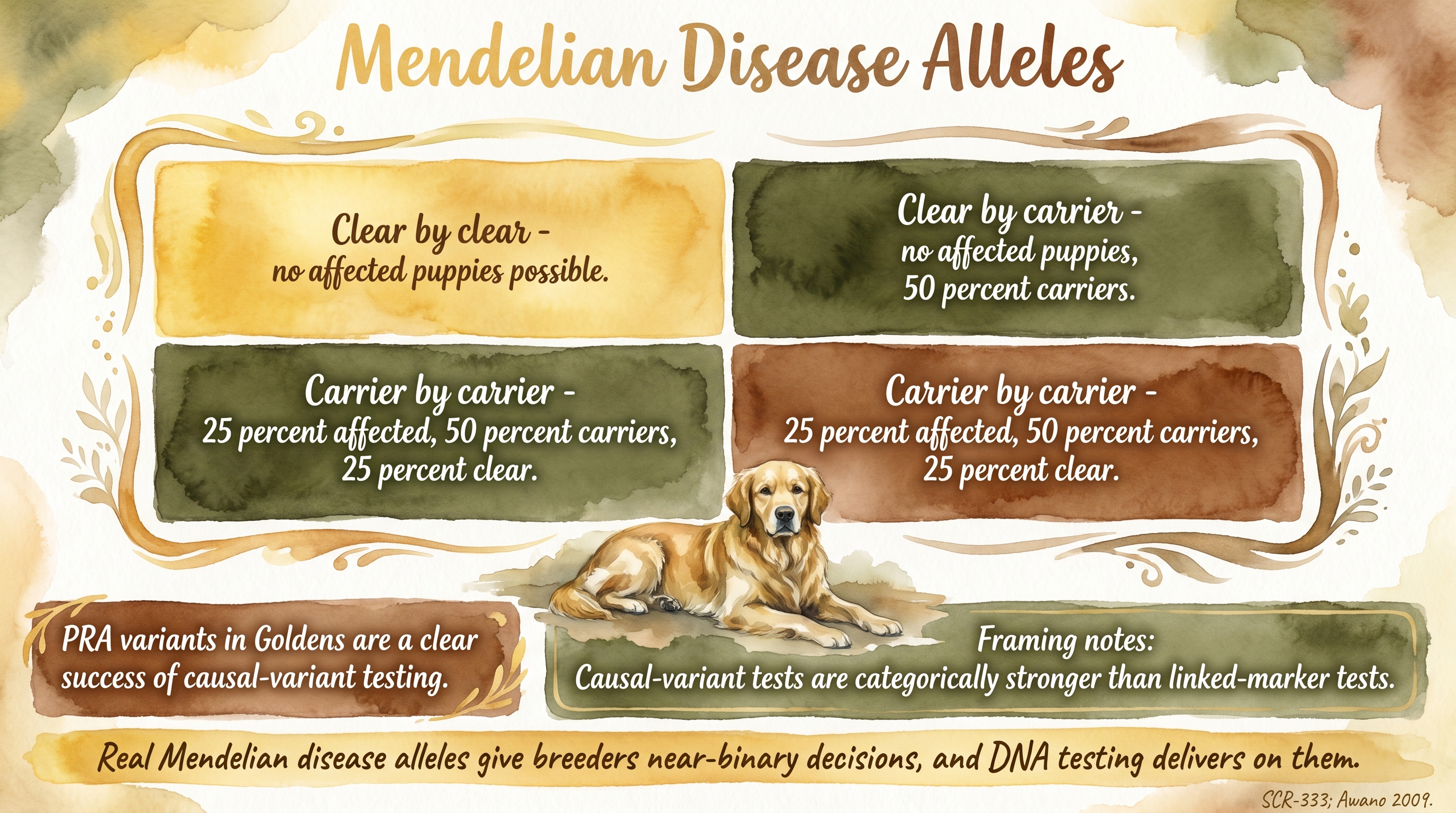
Real Mendelian disease alleles give breeders near-binary decisions, and DNA testing delivers on them.
Key Takeaways
- Mendelian disease alleles are single-locus variants with classical inheritance patterns and unusually strong testing utility.
- When the causal mutation is known and the assay is valid, breeder decisions at that locus can be made with high confidence.
- Single-gene disease testing is strongest when interpreted specifically rather than expanded into claims about the whole dog.
- For recessive Mendelian diseases, carrier management usually preserves diversity better than reflexive carrier exclusion.
- Causal-variant tests deserve more confidence than marker-based tests, even when both appear on the same commercial panel.
The Evidence
- Canine inherited-disease genetics literaturedogs and Golden Retrievers
A subset of canine inherited diseases follows classical Mendelian inheritance with known causal mutations and high-confidence DNA tests. - Golden Retriever mutation-specific literatureGolden Retrievers
Named retinal disease variants and several other single-gene conditions in Golden Retrievers can be managed through locus-specific testing and classical mating logic.
- Canine carrier-management literaturedogs
For validated recessive Mendelian alleles, carrier-to-clear matings prevent affected puppies while preserving population diversity better than blanket carrier removal. - Causal-variant versus marker-based testing literaturedogs
Testing confidence is strongest when the assay interrogates a mechanistically validated causal variant rather than a statistically linked marker, which is the category most Mendelian disease tests belong to.
No systematic review has quantified how many causal variants remain undiscovered for each major Golden Retriever inherited-disease category, making it difficult to estimate the completeness of current testing panels.
SCR References
Sources
- Awano T., Johnson G.S., Wade C.M., Katz M.L., Johnson G.C., Taylor J.F., Perloski M., Biagi T., Baranowska I., Long S., March P.A., Olby N.J., Shelton G.D., Khan S., O'Brien D.P., Lindblad-Toh K., & Coates J.R. (2009). Genome-wide association analysis reveals a SOD1 mutation in canine degenerative myelopathy that resembles amyotrophic lateral sclerosis. Proceedings of the National Academy of Sciences, 106(8), 2794-2799. doi:10.1073/pnas.0812297106
- Grall A., Guaguère E., Planchais S., et al. (2012). PNPLA1 mutations cause autosomal recessive congenital ichthyosis in golden retriever dogs and humans. Nature Genetics, 44(2), 140-147. doi:10.1038/ng.1056
- Gilliam D., Kolicheski A., Johnson G.S., Mhlanga-Mutangadura T., Taylor J.F., Schnabel R.D., & Katz M.L. (2015). Golden Retriever dogs with neuronal ceroid lipofuscinosis have a two-base-pair deletion and frameshift in CLN5. Molecular Genetics and Metabolism, 115(2-3), 101-109. doi:10.1016/j.ymgme.2015.04.001
- Sharp N.J., Kornegay J.N., Van Camp S.D., Herbstreith M.H., Secore S.L., Kettle S., et al. (1992). An error in dystrophin mRNA processing in golden retriever muscular dystrophy, an animal homologue of Duchenne muscular dystrophy. Genomics, 13(1), 115-121. doi:10.1016/0888-7543(92)90210-J
- Kornegay J.N. (2017). The golden retriever model of Duchenne muscular dystrophy. Skeletal Muscle, 7(1), 9. doi:10.1186/s13395-017-0124-z
- Shaffer L.G., Sundin K., Geretschlaeger A., Segert J., Swinburne J.E., Royal R., Loechel R., Ramirez C.J., & Ballif B.C. (2018). Standards and guidelines for canine clinical genetic testing laboratories. Human Genetics, 138(5), 493-499. doi:10.1007/s00439-018-1954-4
- Slutsky J., Officer A., & Giger U. (2013). A web resource on DNA tests for canine and feline hereditary diseases. The Veterinary Journal, 197(2), 182-187. doi:10.1016/j.tvjl.2013.02.021
- Farrell L.L., Schoenebeck J.J., Wiener P., Clements D.N., & Summers K.M. (2015). The challenges of pedigree dog health: approaches to combating inherited disease. Canine Genetics and Epidemiology, 2, 3. doi:10.1186/s40575-015-0014-9