Principles of Canine Population Genetics
Population genetics is the branch of genetics that asks what is happening to gene frequencies in a population over time. In dogs, that means stepping back from one mating or one puppy and looking instead at how whole breeds gain, lose, or concentrate genetic variation across generations. That is the right scale for understanding diversity, drift, inbreeding, and long-term breed health, and it is the scale at which most of the hardest purebred-dog problems actually live. Documented
What It Means
Most families first meet genetics through simple inheritance stories. One parent carries a trait. Another parent carries a trait. A puppy ends up clear, carrier, or affected. That classical Mendelian view is real and useful, but it describes only one layer of what genetics actually does in a living breed.
Population genetics asks the broader questions that classical Mendelian reasoning cannot answer on its own:
- how common is an allele across the whole breed, not just in one mating
- how quickly is that allele rising or falling across generations
- how much heterozygosity remains in the overall gene pool
- how strongly are drift, selection, and non-random mating reshaping the pool over time
- what does the structure of the breed look like when you step back far enough to see more than one pedigree at a time
That shift in scale matters because most of the hardest problems in purebred dogs are not really one-dog problems. They are population problems in disguise. A breed can have tens of thousands of living dogs worldwide and still behave genetically like a much smaller population because of popular-sire effects and closed studbooks. A breeder can make a sensible single mating and still be operating inside a breed structure that has been steadily losing diversity for decades. A disease allele can be rare at the level of any one bloodline and still be widespread enough across the breed to produce recurrent affected puppies every year. None of those patterns become visible until you ask the population-level question.
The core vocabulary
The field begins with two linked ideas: allele frequency and genotype frequency. Documented An allele frequency tells you how common one version of a gene is in a population expressed as a proportion of all copies of that gene present in living animals. A genotype frequency tells you how often specific two-copy combinations appear in living animals.
From those two ideas come the diversity terms families hear most often: homozygosity, meaning the two copies at a locus are the same, and heterozygosity, meaning they differ. Those are not abstract bookkeeping categories. Rising average homozygosity narrows the range of possible genetic combinations that the next generation can draw from. Falling average heterozygosity removes buffering capacity from the population by leaving fewer alternative alleles available at each locus. That is why diversity conversations across breeds usually revolve around them.
Layered on top of that simple vocabulary are the four classic forces that move allele frequencies: mutation, which is slow and rare at a generational scale but real over long arcs; migration, which in dogs is mostly blocked by closed studbooks; selection, which in dogs is constant and often intense; and drift, which is the random sampling noise that matters disproportionately in small populations. Population genetics is, in part, the formal accounting of how these four forces combine to reshape a gene pool generation by generation.
Hardy-Weinberg as the null model
The classic baseline model in the field is Hardy-Weinberg equilibrium. In simple terms, Hardy-Weinberg is the null model population geneticists use to ask: "What would allele and genotype frequencies look like if nothing evolutionarily important were pushing them around?" The model assumes random mating, no mutation, no migration, a very large population, and no selection.
Dog breeds violate every single one of those assumptions by design.
Purebred dogs do not mate randomly. Breeders choose pairings deliberately, usually with strong preferences about lineage, type, and title. Mutation still happens, even if rarely enough to be negligible within one generation. Migration is largely blocked by the closed-studbook convention that underpins most breed structures. Population size is finite and, as the effective-population-size literature keeps showing, often dramatically smaller in practice than the census size suggests. Selection is constant, whether the target is conformation, working ability, coat, temperament, or some combination. In short, dog breeds are almost the photographic negative of a Hardy-Weinberg population.
That is precisely why breeds turn out to be such useful natural experiments in population genetics. They are closed, highly structured populations under strong artificial selection with traceable pedigrees and, in recent decades, dense genomic marker data available from sampled dogs. Researchers can often see founder effects, drift, popular-ancestor dynamics, and long blocks of linkage disequilibrium more clearly in dogs than in many comparable human datasets. The breed structure that seems like a limitation when you are trying to find outcross options turns out to be an asset when you are trying to study the forces that built the structure in the first place.
Wright's framework and the modern canine literature
This is also where Wright's F-statistics enter the picture. Families do not need the equations to interpret breeder claims, but the conceptual framework helps. Wright's system gives a way to describe how genetic variance is partitioned across levels of population structure, including how much inbreeding or differentiation is showing up within individuals, within subpopulations, and across the broader population as a whole. In dog-breed work, that framework helps explain why a breed can contain hidden internal structure (show lines versus field lines, regional clusters, kennel clusters) even when everyone still calls it one breed. Documented The breed label is a social fact. The underlying genetic structure may be finer-grained.
The modern canine population-genetics literature grew out of exactly these features. Work by Sewall Wright laid the conceptual foundation in the early twentieth century. Later quantitative-genetics texts (Falconer and Mackay is the standard reference) clarified the variance framework. Canine genomics then added high-density marker data starting in the early 2000s, making it possible to compare pedigree expectations with realized genomic structure for the first time in the breed's own DNA rather than only through pedigree arithmetic. The result is a distinctive dog literature that now includes demographic studies, breed-diversity studies, genome-wide association work, and quantitative analyses of effective population size, runs of homozygosity, linkage-disequilibrium structure, and disease-allele distribution.
One of the most important lessons from that literature is that gene pools change even when nobody thinks they are "doing genetics." Documented Every repeated breeding choice is a population-genetics event whether the breeder notices or not. Using the same narrow lines repeatedly changes allele frequencies. So does concentrating a fashionable male across many litters in one decade. So does selecting hard for one visible trait while quietly assuming the rest of the genome will stay put. None of those decisions look dramatic in any single mating. Compounded over thirty years, they can move a breed's effective size, disease-allele frequencies, and average homozygosity in ways that later breeders cannot easily reverse.
Population genetics therefore sits underneath every later breeding discussion in this category. Coefficient of inbreeding, effective population size, founder effects, drift, heritability, linkage mapping, and carrier management all make more sense once this population-level frame is in place. Documented Without it, the field's statistics float as isolated numbers; with it, they become a coherent description of a gene pool in motion.
Population-genetics events in plain breeder language
It is worth naming a few of the population-genetics events that happen inside everyday breeding decisions, because that is where the abstractions actually bite.
Using the same high-profile male across many litters in one generation is a founder-effect amplifier. It raises the contribution of one dog to the next generation's gene pool sharply and narrows the allele menu that subsequent breedings can draw from.
Closing a studbook means every generation thereafter operates inside a finite pool with no replenishment from outside. Mutation alone is far too slow to rebuild diversity on a breeder-relevant timescale.
Selecting only visible phenotype without considering pedigree depth lets drift do its work in the background. Some alleles will become rarer or disappear entirely simply because the dogs that happened to carry them were not used, not because those alleles were selected against on any real criterion.
Strongly selecting for one target trait will, through linkage, drag nearby genetic variation along for the ride. Some of that hitchhiking variation will be neutral. Some of it will not.
None of those events require a laboratory or a degree. They are the normal mechanics of a closed breeding population. Population genetics is simply the language that lets you describe what those mechanics are doing to the gene pool over time.
Why It Matters for Your Dog
What This Cannot Predict
Population genetics describes populations. It does not predict the exact fate of one dog. Documented
That is the load-bearing rule of the whole category.
A population-level statistic can tell you that a breed has low effective population size, rising average homozygosity, or a shrinking pool of rare alleles. It cannot tell you that one specific puppy from one specific litter will become unhealthy, infertile, long-lived, fearful, or behaviorally perfect. It can change the odds landscape the puppy is born into. It cannot tell a single life story from start to finish.
This is where a great deal of breeder marketing and amateur online discussion goes wrong. A family sees a number, hears a phrase like "low COI" or "high diversity," and assumes the individual puppy has thereby been guaranteed a certain outcome. That is not what population genetics offers. It offers risk structure, trend structure, and population description. Any implication that a population-level number translates directly into an individual guarantee is either a misunderstanding or a sales move.
The right question is therefore not, "What does this statistic prove about this puppy?" The right question is, "What does this statistic say about the population context this puppy comes from, and does that context look like something I want to support over the long arc of a decade of living with the dog?"
Framed that way, population genetics becomes a useful filter for evaluating breeders rather than a false promise to families. It tells you something real about the gene pool. It does not tell you everything about one life.
Families rarely need to do population genetics themselves to make a day-to-day puppy decision, but they do need the basic framework to interpret breeder claims intelligently.
If a breeder says a line is diverse, the real question becomes: diverse by what measure, at what generational depth, and relative to what population baseline? A breeder can honestly describe a line as diverse compared to one narrowly bred subset of the breed while that same line is concentrated relative to the breed's overall gene pool. The word "diverse" is almost meaningless without the comparison point.
If someone says a DNA panel "proves health," population genetics reminds you that many health outcomes live well above the level of one locus. A panel that tests for specific known-mutation recessives is doing something real, but what it is doing is very different from guaranteeing overall health. Most of the breed-health work is polygenic and statistical, and no panel resolves that layer by itself.
If someone speaks as if one impressive mating tells you everything about a breeding program, population genetics asks what has been happening across generations, not just in a single well-photographed litter. Programs reveal themselves on a decade timescale, not a one-litter timescale.
For breeders, the implications are even more direct. Selection decisions, carrier management, outcrossing within the breed, use of popular sires, and long-term line planning all sit inside a population-genetics framework whether the breeder uses that language or not. Ignoring the framework does not make it stop applying; it only makes the effects less visible until they show up as reduced fertility, rising homozygosity, or recurrent recessive disease.
For JB specifically, this category matters because health stewardship is upstream of raising. The Five Pillars describe how a dog is raised and what the dog learns through a structured social environment. Population genetics helps define the biological terrain that raising is working on. A structurally narrow breed population does not become robust through rhetoric alone. It becomes more stable only through patient, diversity-aware decisions made across many breeders over many years. No single kennel fixes the problem by itself. No single litter proves the problem has been fixed.
That is why this first page sets the epistemic tone for the whole subcategory: science with humility. Population genetics is powerful, but its power lies in describing patterns across populations and generations, not in pretending it can read the fate of one puppy like a horoscope. Families who understand that distinction end up asking better questions, and breeders who understand it end up making better decisions on the long arc.
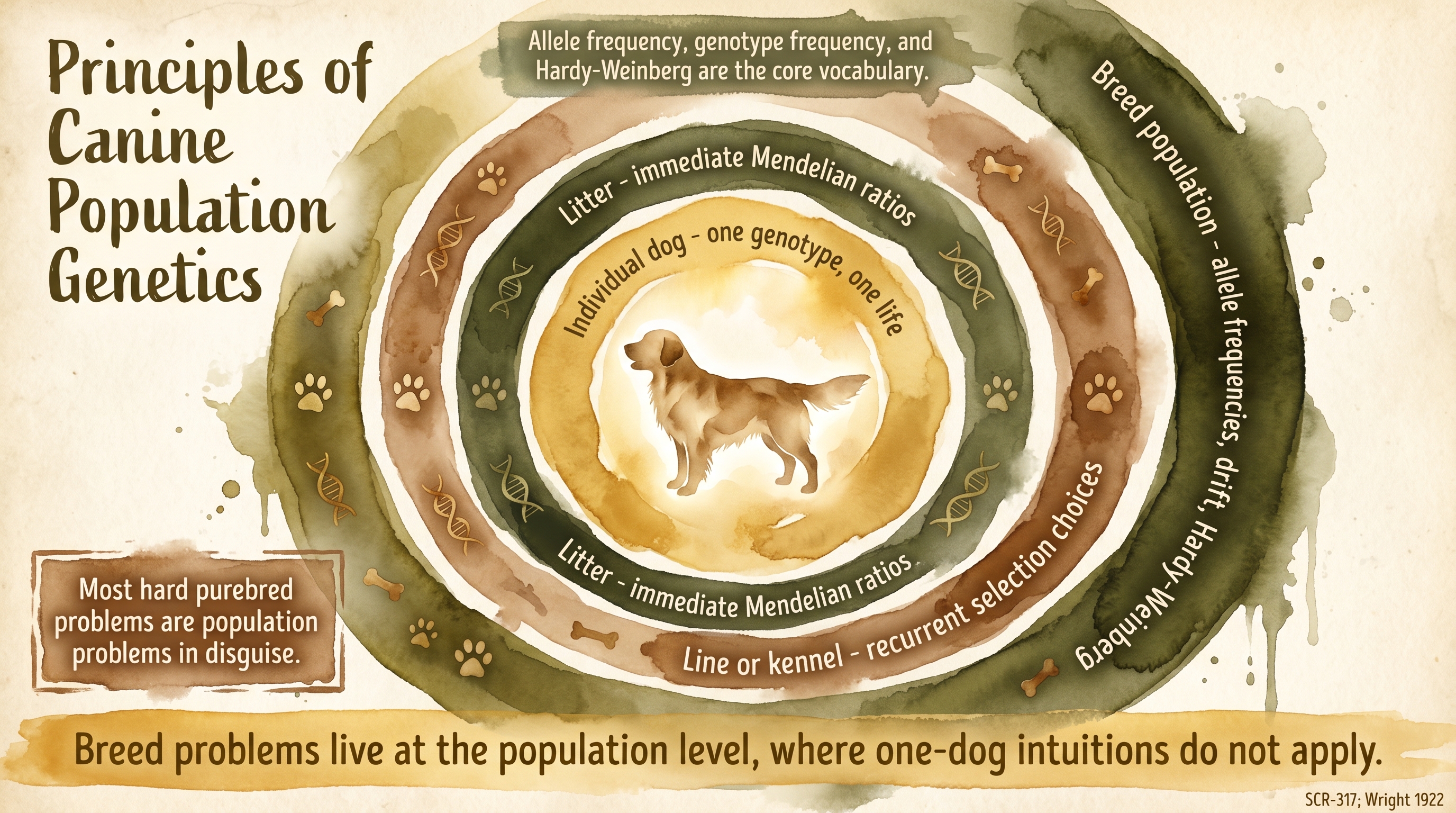
Breed problems live at the population level, where one-dog intuitions do not apply.
Key Takeaways
- Population genetics studies how gene frequencies and diversity change across whole populations, not just within one mating.
- Dog breeds violate the assumptions of Hardy-Weinberg equilibrium by design because they are finite, closed, selectively bred populations.
- The core population-genetics vocabulary includes allele frequency, homozygosity, heterozygosity, drift, and selection.
- Population-level statistics shape the odds landscape for a breed, but they cannot predict one puppy's fate with certainty.
- Every repeated breeding choice is a population-genetics event whether the breeder uses that language or not.
The Evidence
- Wright and later quantitative-genetics literaturegeneral population genetics
Population genetics analyzes how allele and genotype frequencies change across populations over time, with homozygosity, heterozygosity, drift, and selection as core concepts. - Hardy-Weinberg frameworkgeneral population genetics
Hardy-Weinberg equilibrium provides the null model for a large randomly mating population with no mutation, migration, or selection. - Canine breed-population literaturedogs
Purebred dogs are closed, highly structured populations under strong artificial selection, making them unusually informative models for applied population genetics.
- Canine diversity and pedigree-versus-genomic analysesdogs
Population-level statistics describe gene-pool structure and risk architecture, but they do not deterministically predict the health or behavior of an individual dog. - Canine genomic diversity literaturedogs
High-density marker data confirm that realized genomic homozygosity in closed breeds often exceeds the expectations derived from shallow pedigrees, underscoring the limits of pedigree-only diversity claims.
No longitudinal study has directly compared population-genetics metrics at the time of a mating against long-term health, temperament, and fertility outcomes for the resulting individuals, controlling for environmental variables.
SCR References
Sources
- Wright S. (1922). Coefficients of Inbreeding and Relationship. The American Naturalist, 56(645), 330-338. doi:10.1086/279872
- Calboli F.C.F., Sampson J., Fretwell N., & Balding D.J. (2008). Population structure and inbreeding from pedigree analysis of purebred dogs. Genetics, 179(1), 593-601. doi:10.1534/genetics.107.084954
- Dreger D.L., Rimbault M., Davis B.W., Bhatnagar A., Parker H.G., & Ostrander E.A. (2016). Whole-genome sequence, SNP chips and pedigree structure: building demographic profiles in domestic dog breeds to optimize genetic-trait mapping. Disease Models & Mechanisms, 9(12), 1445-1460. doi:10.1242/dmm.027037
- Leroy G. (2011). Genetic diversity, inbreeding and breeding practices in dogs: Results from pedigree analyses. The Veterinary Journal, 189(2), 177-182. doi:10.1016/j.tvjl.2011.06.016
- Bannasch D., Famula T., Donner J., Anderson H., Honkanen L., Batcher K., Safra N., Thomasy S., & Rebhun R. (2021). The effect of inbreeding, body size and morphology on health in dog breeds. Canine Medicine and Genetics, 8(1), 12. doi:10.1186/s40575-021-00111-4
- Ontiveros E.S., Hughes S., Penedo M.C.T., Grahn R.A., & Stern J.A. (2019). Genetic heterogeneity and diversity of North American golden retrievers using a low density STR marker panel. PLoS ONE, 14(2), e0212171. doi:10.1371/journal.pone.0212171
- Frankham R., Bradshaw C.J.A., & Brook B.W. (2014). Genetics in conservation management: revised recommendations for the 50/500 rules, Red List criteria and population viability analyses. Biological Conservation, 170, 56-63. doi:10.1016/j.biocon.2013.12.012