Coefficient of Inbreeding (COI) in Dogs
Coefficient of inbreeding, usually shortened to COI, is one of the most cited numbers in breeder conversations and one of the most misunderstood. COI does not mean a dog is "12 percent inbred" in some personal or moral sense. It is a probability statement about expected homozygosity from shared ancestry. Used carefully, it is informative. Used carelessly, it becomes a false-certainty machine attached to a single number that cannot do everything people want it to do. Documented
What It Means
The formal definition
The classic definition comes from Sewall Wright in the early twentieth century. COI is the probability that the two alleles at a locus in an individual are identical by descent, meaning both copies trace back to the same ancestral source through the sire and dam lines.
That definition explains why COI belongs to population genetics rather than everyday intuition. Documented It is not measuring how much a dog "looks inbred" or how closely the parents were related in a social sense. It is measuring the expected probability of shared ancestral origin across loci in the genome as a whole. The unit is probability, not percentage of personhood.
Expressed mathematically, Wright's COI for an individual is computed by summing the contributions of every common ancestor in the pedigree, weighted by the number of generational steps that separate the individual from each occurrence of that ancestor in the sire and dam lines. The details matter less than the concept: COI captures the probability that the two copies of any given gene come from a single identifiable source some number of generations back. Documented
Two broad kinds of COI
In practical breeding conversations, two broad kinds of COI appear, and they are not interchangeable.
Pedigree COI is calculated from a known pedigree using the classical Wright algorithm or a modern computational descendant of it. The calculation traces common ancestors in the ancestry chart and estimates the expected probability of identity by descent under the assumption that founders at the edge of the pedigree are themselves unrelated. This is the classic paper-pedigree approach and is still widely used because it is cheap, familiar, and historically accessible. Any breeder with registration papers can run it.
Genomic COI uses DNA markers and usually estimates realized homozygosity directly, most often through methods such as runs of homozygosity (ROH). Rather than asking what the pedigree predicts, genomic COI asks what the dog actually inherited in its genome, measured against a dense marker panel distributed across the chromosomes.
Those two numbers often differ, sometimes substantially, and that does not mean one is automatically wrong.
Pedigree COI is an expectation derived from ancestry records.
Genomic COI is a realized genomic measurement derived from the dog's DNA.
Why pedigree COI often understates reality in closed breeds
Pedigree COI depends heavily on pedigree depth and completeness. If founders are assumed unrelated, if records are shallow, or if historical bottlenecks lie beyond the visible chart, pedigree COI will structurally understate the true background relatedness in the breed. That is a structural limitation built into the method, not a small clerical error that better data entry would fix.
Most modern breed populations trace back to a relatively small number of founders within the last few centuries. Before those founders, the pedigree simply stops because the records do not exist. Wright's formula treats those unknown founders as unrelated, which is almost never actually true for a closed breed with a constrained founding event. The real genealogy behind the founders includes whatever shared ancestry existed in the source population, and that shared ancestry is invisible to a pedigree-only COI calculation.
Genomic COI solves some of those problems by measuring the inherited DNA directly. It captures deeper ancestry because long runs of homozygosity reflect whatever shared ancestral blocks actually made it into the individual dog, regardless of whether the pedigree records extend far enough to document them. It also captures recombination variance, which means genomic COI correctly shows that full siblings are not genetically identical even though they share the same pedigree structure on paper.
This difference is especially important in Golden Retrievers and other well-established pure breeds. A short pedigree COI may look reassuring, but the breed's historical bottlenecks and popular-ancestor structure can still produce realized homozygosity that is substantially higher than the shallow pedigree number implies. The paper number was never designed to capture ancestry that predates the records, and in a closed breed that ancestry is real and load-bearing.
Three questions every COI claim should answer
That is why serious COI interpretation asks at least three questions before accepting the number at face value:
- how was the number calculated (pedigree or genomic, and which algorithm)
- how deep was the pedigree or how dense was the genomic marker set
- what population baseline is being used for interpretation
The number by itself is never the whole story. A five-generation pedigree COI and a twenty-generation pedigree COI on the same dog can look very different from each other, and both can look different again from a genomic COI computed from marker data. None of those values is necessarily wrong. They are measuring different things or measuring the same thing with different tools.
COI is a continuum, not a pass-fail threshold
COI is also often spoken about as if it were a pass-or-fail threshold, where anything below some cutoff is "safe" and anything above the cutoff is "dangerous." That is not how the concept works. COI is a probability continuum. Rising average COI increases expected homozygosity across the genome and therefore increases the average chance that deleterious recessive alleles become homozygous. But the biology still plays out probabilistically in each individual dog.
A low-COI litter can still produce an affected puppy if both parents happen to share the relevant disease allele at a specific locus. Documented COI is an average expectation across loci, not a guarantee at any particular locus of interest.
A higher-COI litter can still produce phenotypically robust puppies if the combination happens to avoid homozygosing the harmful alleles that matter most in the breed.
COI changes the population-level probability landscape. It does not script each individual outcome.
For Goldens specifically, published pedigree-based COI values often land in moderate ranges depending on registry depth and dataset, but genomic work consistently shows that shallow pedigree measures only partially track realized genomic relatedness. That is the practical lesson families need: the paper number is useful for tracking trends, but it is incomplete as a snapshot of the actual inherited genome.
Why It Matters for Your Dog
What This Cannot Predict
COI cannot guarantee health.
It cannot diagnose disease.
It cannot tell you whether this puppy will be long-lived, infertile, behaviorally unstable, or clinically normal.
And it cannot replace direct health testing or thoughtful phenotypic evaluation of the parents and the litter.
This is where many breeder conversations drift into slippage. A very low COI is sometimes treated as if it makes all later questions about hips, hearts, eyes, and temperament disappear. A somewhat higher COI is sometimes treated as if it automatically condemns the litter regardless of the rest of the breeding picture. Neither move is scientifically honest, and both come from treating COI as a moral score rather than a probability summary.
The correct interpretation is narrower. COI estimates expected homozygosity from shared ancestry. That makes it useful for long-term diversity management and for understanding risk structure at the population level. It does not turn into a personal guarantee when attached to one puppy, and it does not substitute for the direct screening tools that actually measure disease phenotypes in the dogs being considered for breeding. Documented
Families hear COI because it sounds numerical and therefore reassuring. But the number only helps if you know what kind of number it is and what it is being compared against.
If a breeder quotes COI, the useful follow-up questions are: Is this pedigree COI or genomic COI, how many generations deep is the pedigree calculation or how dense was the marker panel for the genomic calculation, are you using COI as one tool in a broader breeding picture or speaking as if COI settles the litter by itself, and how does this number compare to the breed average and has your program's average been rising or falling over the last decade?
Thoughtful breeders use COI to watch trends across generations rather than as a marketing badge detached from the rest of the breeding picture. They know a low number does not erase the need for orthopedic, cardiac, ocular, and disease-locus screening. Documented They also know a single moderate number does not tell the full story without line knowledge, health testing, and a broader diversity strategy across multiple generations of mating choices.
For JB specifically, the distinction matters because stewardship is long-range. COI is most useful when it helps track whether the program is narrowing or broadening the gene pool over time, and when it is interpreted alongside direct phenotypic screening and honest line knowledge. It is much less useful when turned into a one-number moral score for an individual dog or a marketing headline for a single litter. The honest version of the tool is a trend line. The dishonest version is a bumper sticker.
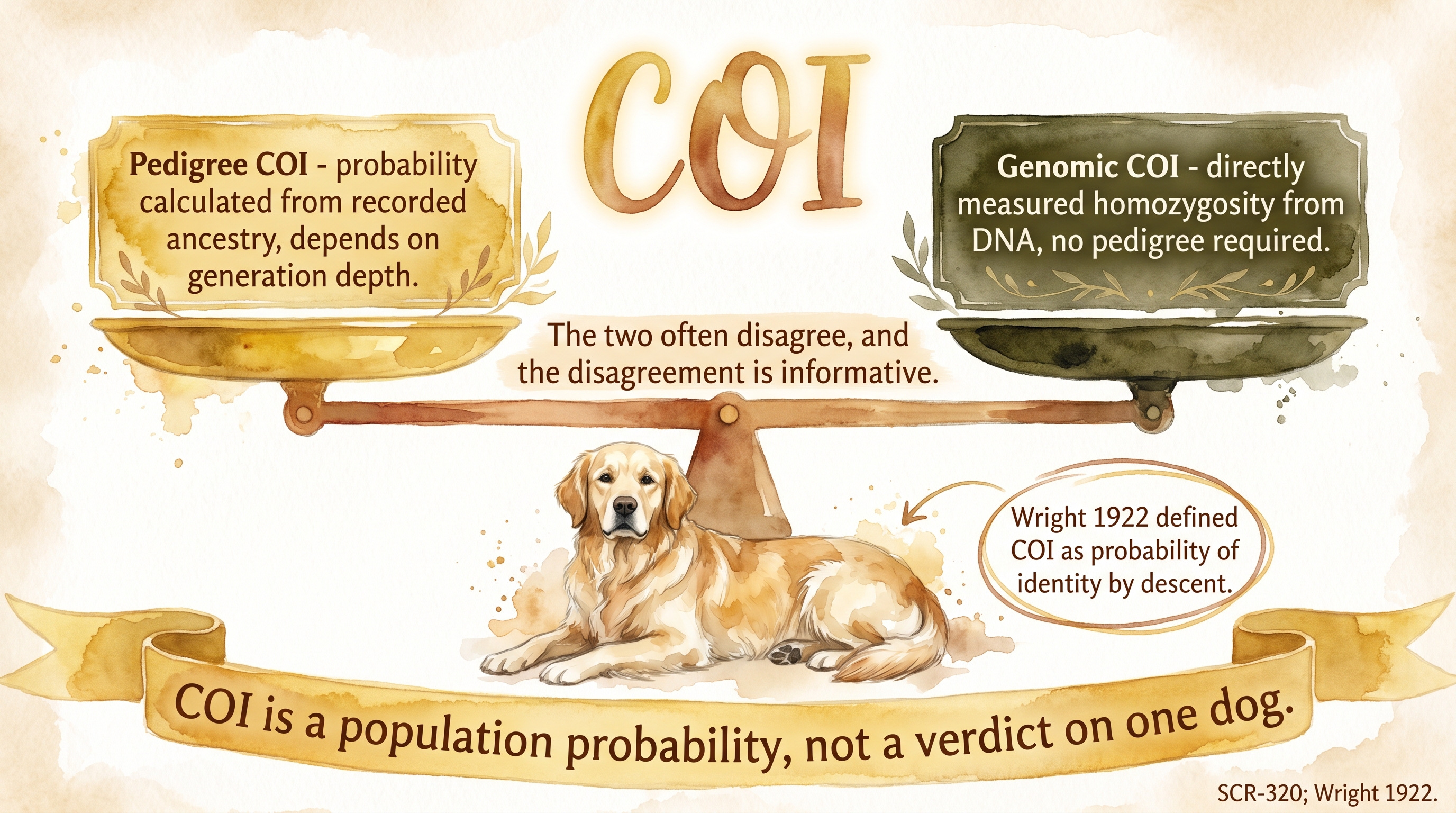
COI is a population probability, not a verdict on one dog.
Key Takeaways
- COI is a probability statement about identity by descent, not a personal label attached to a dog.
- Pedigree COI estimates what shared ancestry predicts, while genomic COI measures what the dog actually inherited.
- Short pedigree COI can underestimate true background relatedness in closed breeds with deep historical bottlenecks.
- COI is useful for tracking long-term diversity, but it cannot substitute for direct health screening or predict one puppy's fate.
- COI is a continuum, not a pass-fail threshold, and should be read alongside line knowledge and phenotypic screening.
The Evidence
- Wright and later population-genetics literaturegeneral population genetics
COI is the probability that two alleles at a locus are identical by descent from a common ancestor. - Canine pedigree and genomic studiesdogs
Pedigree COI is an expected value derived from known ancestry, while genomic COI measures realized homozygosity directly from inherited DNA. - Golden Retriever diversity studiesGolden Retrievers
Shallow pedigree COI only weakly tracks realized genomic relatedness in the breed, making short-generation pedigree COI an incomplete proxy for true genomic inbreeding.
- Canine inbreeding and diversity literaturedogs
COI describes expected homozygosity and long-term diversity risk at the population level, but it does not deterministically predict health or phenotype in one dog. - Runs-of-homozygosity methodology literaturedogs and livestock
Realized genomic homozygosity captures deeper ancestral structure than shallow pedigree calculations can, which is why genomic and pedigree COI often disagree in well-established closed breeds.
No study has specifically compared COI predictions at individual-puppy level against actual long-term health outcomes in Golden Retrievers controlling for environment, screening, and other diversity management variables.
SCR References
Sources
- Wright S. (1922). Coefficients of Inbreeding and Relationship. The American Naturalist, 56(645), 330-338. doi:10.1086/279872
- Meuwissen T.H.E. & Luo Z. (1992). Computing inbreeding coefficients in large populations. Genetics Selection Evolution, 24(4), 305-313. doi:10.1186/1297-9686-24-4-305
- Hill W.G. & Weir B.S. (2011). Variation in actual relationship as a consequence of Mendelian sampling and linkage. Genetics Research, 93(1), 47-64.
- Keller M.C., Visscher P.M., & Goddard M.E. (2011). Quantification of inbreeding due to distant ancestors and its detection using SNP data. Genetics, 189(1), 237-249.
- Calboli F.C.F., Sampson J., Fretwell N., & Balding D.J. (2008). Population structure and inbreeding from pedigree analysis of purebred dogs. Genetics, 179(1), 593-601. doi:10.1534/genetics.107.084954
- Dreger D.L., Rimbault M., Davis B.W., Bhatnagar A., Parker H.G., & Ostrander E.A. (2016). Whole-genome sequence, SNP chips and pedigree structure: building demographic profiles in domestic dog breeds to optimize genetic-trait mapping. Disease Models & Mechanisms, 9(12), 1445-1460. doi:10.1242/dmm.027037
- Chu E.T., Cullen K.L., Castelhano M.G., Goldstein O., Brush G.S., & Coates J.R. (2019). Inbreeding depression causes reduced fecundity in Golden Retrievers. Mammalian Genome, 30(5-6), 166-172. doi:10.1007/s00335-019-09805-4