Effective Population Size (Ne) in Dog Breeds
Compound evidence detail1 SCR / 2 parts
- Documentedpopulation-genetics research on effective population size and its consequences for breed-level genetic health
- HeuristicJB application of effective-population-size considerations to breeding decisions within the program
Effective population size, written Ne, is one of the most revealing numbers in breed population genetics because it answers a harder question than "how many dogs exist?" It asks how large the population behaves genetically once uneven breeding use, sex-ratio imbalance, overlapping generations, and popular-sire dynamics are accounted for. In purebred dogs, Ne is almost always much smaller than the census count, and that gap matters more to the long-term health of the breed than the raw headcount ever will. Mixed Evidence
What It Means
The formal definition
Ne is the size of an idealized population that would experience the same rate of genetic drift as the real population being studied.
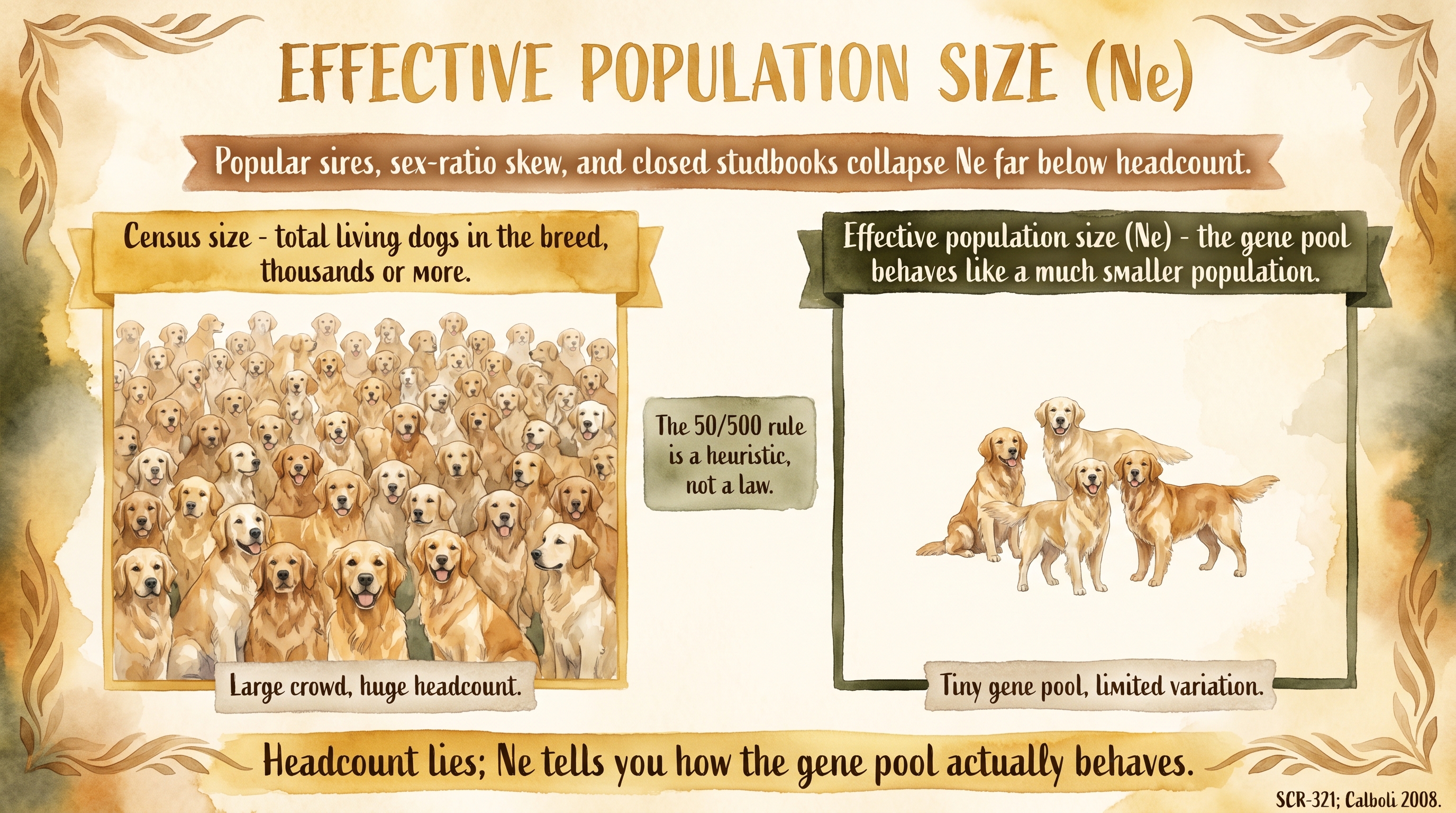
That wording sounds abstract, but the practical idea is simple. Imagine two populations with the same number of living dogs. One uses many unrelated males and females roughly evenly across generations. The other relies heavily on a handful of fashionable sires, a narrower female base, and repeated line concentration. The census count could look similar, but the second population behaves genetically like a much smaller one. Its Ne is lower, sometimes dramatically so, and the long-term consequences follow from that effective size rather than from the body count.
The idealized population in the definition is a bookkeeping fiction. It assumes equal sex ratio, random mating, non-overlapping generations, constant size, and equal reproductive contribution from every individual. No real dog breed has ever satisfied those assumptions. But the idealization is useful precisely because it lets researchers translate messy real-world breeding structures into a single number that summarizes how quickly drift and inbreeding are expected to accumulate inside the gene pool. Ne is, in effect, the answer to the question "if we smoothed away all the structural biases in this breed and kept the same drift rate, how many individuals would it take?"
Census size versus effective size
That is why census size and effective population size must be separated, even though popular writing routinely confuses them.
Census size counts bodies. Effective size describes genetic behavior. A breed can have tens of thousands of living dogs and still have an Ne in the low hundreds or even below one hundred. The ratio of Ne to census size is often called Ne/N, and in wild populations it commonly lands somewhere between 0.1 and 0.5. In purebred dog populations the ratio can be much lower still because the structural biases are stronger. Every force that makes some dogs contribute more offspring than others, or that concentrates reproduction in time, or that splits the breed into reproductively semi-isolated subpopulations, pushes Ne/N further below one.
Several forces pull Ne downward in dogs specifically: unequal reproductive contribution between individuals, skewed use of males versus females with a small number of males over-represented, overlapping generations with long reproductive lifespans for popular stud dogs, internal substructure within the breed with show lines, field lines, and regional clusters partially isolated, and repeated use of the same influential ancestors across multiple breeders and multiple decades. Documented
The popular-sire effect is the clearest example and usually the most numerically dominant. A breed may register many thousands of puppies in a year, but if a narrow set of males contributes disproportionately to the next generation, allele frequencies drift faster, rare alleles are lost faster, and relatedness accumulates faster than the census count would suggest. One influential male used heavily for a few years can reshape the gene pool of a breed for decades afterward because his alleles become the background against which every subsequent outcross has to be evaluated.
This is why popular breeds are not automatically genetically secure. Popularity can mask fragility if reproduction is concentrated. The number of dogs registered each year is not the same as the number of dogs whose genes are actually flowing into the next generation.
What the canine literature actually reports
Published canine estimates make that point forcefully. Across breeds, Ne is often far below what a casual reader would expect from registration counts alone. Many well-established breeds with global populations in the hundreds of thousands report effective population sizes below 100. Some report effective sizes in the low tens. The effective number of ancestors, which is a related but different statistic, is often smaller still because a small number of founder lines disproportionately shape the current gene pool.
Golden Retriever analyses have produced concerning figures depending on method and reference pedigree. Across several peer-reviewed demographic datasets, Golden Retriever Ne estimates have landed well below 100, and in some datasets in the 40 to 80 range when calculated from linkage-disequilibrium decay or pedigree-based methods. Estimated The exact number varies by method and dataset, but the overall message does not: the breed behaves genetically like a much smaller population than its public popularity suggests. A dog breed that produces tens of thousands of puppies per year worldwide is still a small genetic pool if a narrow set of lines is doing most of the contributing.
Why low Ne is a direction, not a fate
That matters because Ne links directly to drift, allele loss, and inbreeding accumulation. Smaller effective populations lose rare alleles faster. They fix neutral alleles more quickly by chance. They accumulate relatedness more rapidly between any two randomly chosen dogs. They have less room to absorb recessive disease discoveries without narrowing the gene pool further. In other words, low Ne is not just a descriptive number. It is a directional warning about how the gene pool will travel if management does not change.
The good news is that Ne is a direction, not a destiny. A breed community that recognizes the problem can reverse course by deliberately broadening which lines are used, avoiding the worst of the popular-sire dynamics, and using imported or rediscovered bloodlines where the breed structure allows it. The timescale for recovery is measured in generations rather than litters, but the trajectory is responsive to choice. Breeds that have committed to diversity-aware stewardship programs have measurably improved their Ne estimates over time, and breeds that have ignored the problem have measurably worsened. Neither outcome is automatic.
The 50/500 rule, and why it has to be handled carefully
The most famous threshold language in this area is the 50/500 rule. The old conservation-genetics shorthand proposed that an Ne of around 50 might help avoid severe short-term inbreeding depression, while an Ne of around 500 might be needed to preserve longer-term adaptive potential. That framing became influential because it was simple, memorable, and useful as a rhetorical anchor when talking to non-specialists about why very small populations are dangerous.
But the simplicity is exactly why it has to be handled carefully.
The 50/500 rule is not a law of nature. It is a heuristic from conservation genetics, later debated, revised, defended, and criticized in the literature. Heuristic Franklin proposed the original framing in 1980. Frankham and colleagues have defended and updated it across several decades of conservation synthesis. Jamieson and Allendorf have argued that the long-term threshold may need to be substantially higher under realistic assumptions. Other authors have pushed back. The debate is ongoing because the thresholds depend on which fitness component you are trying to preserve, what timescale you care about, and whether you are talking about the additive genetic variance that supports adaptive change or the deleterious recessive load that produces short-term inbreeding depression.
What matters for this wiki is not picking a camp rhetorically. What matters is being honest that threshold talk in this area is contested and method-dependent. A breed with an Ne of 40 is genuinely in a concerning place regardless of which camp is right about 50/500. A breed with an Ne of 500 is in meaningfully better shape than one with an Ne of 50. The concept is useful directionally. The specific numbers are useful as anchors for conversation. Neither the concept nor the numbers are a binary pass-fail test.
So the safe interpretation is that the concept of Ne is well documented, that low Ne is genuinely concerning in purebred dogs and is empirically associated with rising homozygosity and recurring recessive disease, and that hard threshold rules are heuristic rather than scripture. That distinction is essential for breeder writing because threshold language is easily turned into false certainty in one direction or moral theater in the other.
How Ne is actually estimated in dogs
A family reading a breeder's claim about effective population size has a right to know where such a number comes from. Two broad estimation approaches appear in the canine literature.
Pedigree-based Ne estimates trace ancestry through registration records and compute how quickly average kinship is increasing per generation. The faster kinship rises, the smaller the effective population is behaving. This approach depends heavily on pedigree depth and completeness, and it typically understates the true genetic constriction in breeds with shallow or incomplete records because it cannot see relatedness that predates the documented founders. Observed-JB
Linkage-disequilibrium-based Ne estimates use dense genomic marker data to infer how recombination has broken down historical associations between nearby loci. The slower that breakdown, the smaller the historical effective population. This approach can reach deeper into the ancestry of a breed than pedigree methods because it reads the structure directly from the dogs' own DNA rather than relying on paper records.
Both methods have limitations, and both have produced estimates on the same breeds that differ in the details while agreeing on the direction. The honest summary is that Ne in Golden Retrievers and most established breeds is much lower than the census count would suggest, and the exact figure should always be reported alongside the method that produced it.
Why It Matters for Your Dog
What This Cannot Predict
Ne cannot tell you whether one kennel is responsible for the whole breed's diversity problem. The phenomenon is emergent from many breeders' individual decisions compounded across decades.
It cannot tell you whether one litter will be healthy or unhealthy. Ne is a population-level diagnostic. It shapes the background risk the litter is born into; it does not script the outcome of any particular breeding.
It cannot tell you that a breed above one numeric threshold is "safe" or below another is "doomed." The thresholds are heuristics, and the biology is continuous.
And it cannot be used as a one-number substitute for thoughtful population stewardship. A breeder who tracks Ne but ignores disease phenotypes, temperament, or structural soundness is still making an incomplete program. Ne is one of several numbers worth watching, not the single master number.
That matters because Ne is sometimes weaponized in exactly the same way COI is oversimplified. The number becomes a slogan. But Ne is a breed-level or population-level diagnostic, not a personal verdict on one breeder or one dog. Using it as a moral score for individual programs misreads the scale at which the statistic lives.
Families usually encounter Ne indirectly rather than by name. They see the downstream effects without having a label for them: the same influential dogs repeated across pedigrees, the same disease patterns recurring in a breed, the tension between eliminating disease alleles and preserving diversity, and the uncomfortable fact that a very popular breed can still have a thin genetic buffer. Documented All of those observations are Ne showing up in everyday life.
Understanding Ne helps families ask better questions. A breeder who thinks only in terms of "we have lots of Goldens" is thinking at the census level. A breeder who thinks about how many lines are actually contributing to the next generation, how their own program sits inside that structure, and whether their mate choices are narrowing or broadening the pool is thinking at the effective-population level. Those are very different modes of program management, and the difference compounds across generations of breeding decisions even when any single litter looks indistinguishable.
For JB specifically, this matters because the goal is not just to produce a good litter now. It is to take part in a breed responsibly over time. That means caring about the structure of the population behind the individual dogs rather than treating each mating as if it were isolated from the larger gene pool. Ne is one of the best single concepts for understanding that structure because it translates many different structural biases into one directionally honest number. It does not substitute for any of the other tools, but it frames the long arc that all of them are working inside.
The practical takeaway for families is simple. If a breeder talks fluently about where their program sits inside the breed's broader diversity picture, that is a sign of stewardship thinking. If a breeder reduces breed health to a single statistic in either direction (dismissing Ne as irrelevant or waving it around as a moral trump card), that is usually a sign the bigger picture has been flattened into marketing.
Headcount lies; Ne tells you how the gene pool actually behaves.
Key Takeaways
- Effective population size asks how large a breed behaves genetically, not how many dogs exist on paper.
- In purebred dogs, Ne is usually much smaller than census size because reproduction is uneven and structured.
- Low Ne accelerates drift, allele loss, and long-term narrowing of the gene pool.
- Threshold rules like 50/500 are useful heuristics for conversation, but they are not uncontested laws of dog breeding.
- Ne is a direction, not a destiny; breed communities that manage diversity intentionally can measurably improve it over generations.
The Evidence
This entry uses observed claim-level tags beyond the dedicated EvidenceBlocks below. These tags mark JB program observation or practice-derived claims that need dedicated EvidenceBlock coverage in a later content pass.
This entry uses estimated claim-level tags beyond the dedicated EvidenceBlocks below. These tags mark approximate ranges or timing claims that should remain bounded by the cited sources.
This entry uses heuristic claim-level tags beyond the dedicated EvidenceBlocks below. These tags mark JB interpretive application rather than direct study findings.
This entry uses mixed-evidence claim-level tags beyond the dedicated EvidenceBlocks below. These tags mark claims that combine documented findings with observed practice, heuristic application, or unresolved gaps.
- Population-genetics and conservation literaturegeneral population genetics
Effective population size is the size of an idealized population that would experience the same rate of genetic drift as the observed population. - Canine demographic studiesdogs and Golden Retrievers
Across purebred dogs, effective population size is usually far smaller than census size because breeding contribution is uneven and highly structured. - Golden Retriever demographic analysesGolden Retrievers
Published Golden Retriever datasets report concerningly small effective population sizes despite the breed's public popularity, often in ranges well below what the census count suggests.
- Franklin, Frankham, Jamieson, and Allendorf debateconservation genetics
Numeric threshold rules such as 50/500 remain influential but contested, and they should be treated as heuristics for interpretation rather than settled laws directly validated in every dog breed. - Method-comparison literaturedogs and livestock
Pedigree-based and linkage-disequilibrium-based estimates of effective population size often disagree in their exact values while agreeing on direction, underscoring that Ne should always be reported with its method.
No longitudinal study in a single dog breed has measured whether sustained increases in Ne above a specific threshold actually prevent deleterious drift outcomes over defined timescales in the way conservation genetics threshold language predicts.
SCR References
Sources
- Calboli F.C.F., Sampson J., Fretwell N., & Balding D.J. (2008). Population structure and inbreeding from pedigree analysis of purebred dogs. Genetics, 179(1), 593-601. doi:10.1534/genetics.107.084954
- Dreger D.L., Rimbault M., Davis B.W., Bhatnagar A., Parker H.G., & Ostrander E.A. (2016). Whole-genome sequence, SNP chips and pedigree structure: building demographic profiles in domestic dog breeds to optimize genetic-trait mapping. Disease Models & Mechanisms, 9(12), 1445-1460. doi:10.1242/dmm.027037
- Vasiliadis D., Feugier A., Mariani C., & Leroy G. (2020). Demographic assessment of the Dalmatian dog - effective population size, linkage disequilibrium and inbreeding coefficients. Canine Medicine and Genetics, 7, 3. doi:10.1186/s40575-020-00082-y
- Pfahler S., Distl O., & ARCA Members. (2015). Effective Population Size, Extended Linkage Disequilibrium and Runs of Homozygosity in the Norwegian Lundehund. PLoS ONE, 10(4), e0122680. doi:10.1371/journal.pone.0122680
- Wijnrocx K., Bekaert M., Georges M., & Leroy G. (2016). Half of 23 Belgian dog breeds has a compromised genetic diversity, as revealed by genealogical and molecular data analysis. Journal of Animal Breeding and Genetics, 133(5), 375-383. doi:10.1111/jbg.12203
- Leroy G. (2011). Genetic diversity, inbreeding and breeding practices in dogs: Results from pedigree analyses. The Veterinary Journal, 189(2), 177-182. doi:10.1016/j.tvjl.2011.06.016
- Frankham R., Bradshaw C.J.A., & Brook B.W. (2014). Genetics in conservation management: revised recommendations for the 50/500 rules, Red List criteria and population viability analyses. Biological Conservation, 170, 56-63. doi:10.1016/j.biocon.2013.12.012