Mendelian vs Polygenic Inheritance in Dogs
The most important split in canine genetics is not "good genes" versus "bad genes." It is whether a trait behaves like a single-locus Mendelian trait or like a polygenic trait shaped by many loci and the environment together. That distinction determines what a DNA test can actually tell you, what breeding language is valid, and what kind of certainty is honest. Get the architecture wrong and every downstream claim about the dog drifts out of alignment with the biology. Documented
What It Means
Mendelian inheritance, in plain terms
Mendelian inheritance is the classical genetics most people learn first in a high-school biology class. One locus matters. Different alleles at that locus combine in predictable ways. If the disease is autosomal recessive, two copies are needed for expression. If it is autosomal dominant, one copy is enough. Ratios like 1:2:1 or 3:1 belong to this world and hold reliably when the assumptions of single-locus inheritance are actually met.
In dogs, a clear example is progressive retinal atrophy caused by a known causal mutation. For a condition like prcd-PRA, the test is answering a discrete question about one locus. A dog can be clear, carrier, or affected at that locus, and the breeding consequences follow directly from that fact. That is why Mendelian disease testing can be so powerful when the variant is truly causal and well validated in the relevant breed. A carrier-to-clear mating will not produce affected puppies. A carrier-to-carrier mating will produce affected puppies at classical 25 percent ratios. The math is straightforward and the predictions are reliable at a litter scale.
The same simplicity applies to Golden Retriever ichthyosis through the PNPLA1 mutation identified by Grall and colleagues in 2012, to Golden Retriever muscular dystrophy through the X-linked dystrophin mutation, and to a short list of other well-validated single-gene disease alleles. Documented In each case, the genetics is simple enough that testing and planning can be handled with real confidence.
Polygenic inheritance, and why most traits live there
Polygenic inheritance is different. Instead of one decisive locus, many loci each contribute small effects. Those effects add together, sometimes interact with each other, and are then filtered through the environment. The visible trait is not a set of clean bins; it is a continuous distribution. In the simplest polygenic models, each locus adds a tiny amount of liability for a given outcome, and the overall probability of expression depends on how many liability alleles a dog inherits across many loci combined with environmental inputs across development. Documented
That is the world most breeder-relevant traits actually live in.
Hip dysplasia is polygenic. Elbow dysplasia is polygenic. Cancer susceptibility is polygenic and multifactorial. Temperament is polygenic across every trait dimension studied. Longevity is polygenic. Body size and conformation are polygenic with a few major-effect loci identified. Even traits that look simple from a distance almost always become genetically messy when studied carefully at scale, because the underlying biology of growth, development, and behavior draws on many genes operating together across time.
This difference explains why so much popular genetics language misfires. People want to say "the gene for temperament" or "the gene for hip dysplasia" because the single-gene story is easy to tell and easy to market. But in most cases the truer phrase is "a gene associated with variation in this trait in a specific population" or "a genomic region contributing some amount of risk under these measurement conditions." That is less tidy, but it is more faithful to the science and it prevents the reader from building false expectations into a breeder contract.
Three reasons polygenic traits behave differently
Polygenic traits behave differently from single-gene traits for three interlocking reasons.
First, effect sizes are usually distributed across many loci. In a well-powered genome-wide association study of a complex canine trait, the largest individual effect might explain a few percent of the observed variance. Documented Most loci explain less than one percent each. No single marker explains most of the trait because there is no one master switch to find.
Second, environmental inputs matter, and they matter in ways that interact with the underlying genetic architecture rather than simply adding or subtracting from it. Growth rate, body condition, maternal effects, early stress exposure, nutrition, injury history, and management all influence how a polygenic predisposition actually expresses in the living dog. A genetically high-liability hip can stay clinically acceptable under careful growth management. A genetically lower-liability hip can be driven into dysplasia by the wrong combination of rapid growth, overfeeding, and repetitive high-impact exercise before skeletal maturity.
Third, the output is usually quantitative rather than binary. There is not a clean border between "has it" and "does not have it" in the way carrier testing works for a single recessive disease. Hip scores live on a continuum. Elbow scoring uses a graded system with several levels of severity. Temperament measures in the canine behavior literature are almost always dimensional scores rather than dichotomous categories. The quantitative nature of the output is not a measurement failure; it is an honest reflection of the underlying biology.
Why "carrier language" does not apply to polygenic traits
That is why carrier language belongs to Mendelian disease alleles and not to most complex traits. A dog is not a "carrier for hip dysplasia" in the same sense that it can be a carrier for a recessive retinal mutation. The category itself is wrong. A dog can have a higher or lower inherited liability for a polygenic trait, but the words clear, carrier, and affected do not map cleanly onto that biology.
This is not a semantic complaint. It matters practically. A breeder who describes a dog as "clear of hip dysplasia" because of a DNA panel result is making a claim the biology cannot support. The panel may have checked a short list of loci associated with dysplasia risk in a reference population, but the real hip liability of the dog depends on hundreds of additional variants not included in the panel plus the entire environmental trajectory that will shape joint development from the whelping box onward. "Clear" is a single-gene word. It should not travel into polygenic territory.
The role of phenotypic testing
This also explains the central role of phenotypic testing in complex-trait breeding. When a trait is polygenic and expressed through anatomy or physiology, the phenotype often remains the more clinically useful measurement because it is the actual biological outcome you care about rather than an estimate of the outcome derived from a partial marker panel.
Hip evaluation is the obvious example. A DNA-based risk score might eventually contribute useful probabilistic information about hips, and some preliminary work in this direction is being published. It does not replace looking at the joint itself. Radiographic or imaging-based evaluation measures the trait's actual bodily expression in the dog being considered for breeding. A polygenic DNA score estimates liability in an abstract way. Those are not the same thing, and pretending they are collapses the science.
The same logic applies to cardiac screening, ocular screening, and orthopedic screening more broadly. Documented DNA work is useful where the mutation is known and causal. Phenotypic work is useful everywhere the biology expresses as continuous variation in a measurable structure. The honest breeder uses both tools where they apply and does not let one substitute for the other.
The family-facing translation
The family-facing rule is simple: if someone claims to have DNA-tested a dog "for hip dysplasia" as though that settles the matter, the statement is oversimplified at best and misleading at worst. At best, the test is reporting a risk model built from associated loci. It is not diagnosing the dog's hips. The diagnosis still requires looking at the joints.
The same caution applies to cancer and behavior. It is perfectly fair to study genomic regions associated with hemangiosarcoma susceptibility, fearfulness, sociability, or working traits. Documented It is not fair to market a small set of markers as if they can read one puppy's destiny. The gap between "population-level association finding" and "individual-puppy prediction" is large, and a responsible breeder does not ask families to ignore it.
Why It Matters for Your Dog
What This Cannot Predict
Knowing that a trait is Mendelian does not automatically tell you everything important about it. Penetrance, age of onset, mutation heterogeneity, and modifier genes still matter. A dog can test clear for one mutation and still not be "cleared" against every possible disease in that phenotype family, because another mutation at another locus might produce the same clinical picture. Documented Progressive retinal atrophy is a good example here: clearing a dog for the three identified Golden Retriever PRA mutations does not promise the dog will never develop any retinal disease, only that the dog does not carry those three specific variants.
Knowing that a trait is polygenic also does not mean genetics are irrelevant. Polygenic does not mean random. It means distributed, probabilistic, and harder to summarize honestly. The breed-level response of hip dysplasia prevalence to decades of phenotypic selection is a clear demonstration that polygenic traits respond to selection when breeders commit to consistent screening over long arcs. The tool just has to match the architecture.
The main thing this distinction cannot justify is false certainty in either direction. Single-gene thinking should not be forced onto complex traits because it makes breeder marketing simpler. And the existence of polygenic complexity should not be used to imply that nothing genetic can be known at all. The reality is in the middle: some loci can be known with high confidence, many important traits remain polygenic, and the interpretive language has to match the architecture of the trait in question.
This page matters because families hear genetic claims before they have the vocabulary to sort them, and the sorting rule turns out to be simple once it is named explicitly.
If a breeder says, "We test for PRA," that may be a valid single-locus statement depending on the mutation and the breed context. The claim is checkable, the test is meaningful, and the breeding math is clean. If someone says, "We tested for hips by DNA," the interpretation has to be different. One claim may be close to binary. The other is necessarily probabilistic. Both statements may be made in good faith. They carry very different levels of predictive weight.
That difference protects buyers from two common mistakes:
- assuming every DNA result carries the same level of certainty because all tests look similar on paper
- assuming a complex trait has been fully explained because one marker or one panel mentioned it
It also protects buyers from a third mistake that lives in the opposite direction: assuming that because hip dysplasia is polygenic, the breeder's hip work does not really matter. It does. Breed-wide hip prevalence has responded measurably to consistent phenotypic selection over decades in populations where screening has been taken seriously. Polygenic means harder, not hopeless.
For breeders, the stakes are even higher. Mendelian disease alleles can often be managed precisely through carrier-to-clear strategies without losing good dogs from the gene pool. Polygenic traits require slower, population-level progress through phenotyping, careful mate selection, long-term record keeping, and humility about what cannot yet be measured directly. A breeder who understands the difference can use both tools well. A breeder who conflates them will either over-sell the Mendelian certainty or under-use the polygenic levers that really do move the breed over time.
For JB specifically, this matters because the breeding program is selecting for a dog that can actually live the philosophy. Temperament is part of that target, but temperament is not a single switch. It is a polygenic and developmental trait. That means good breeding helps shift the odds in the right direction across generations, while raising still matters enormously within any individual dog's lifetime. The two layers reinforce each other. Neither substitutes for the other.
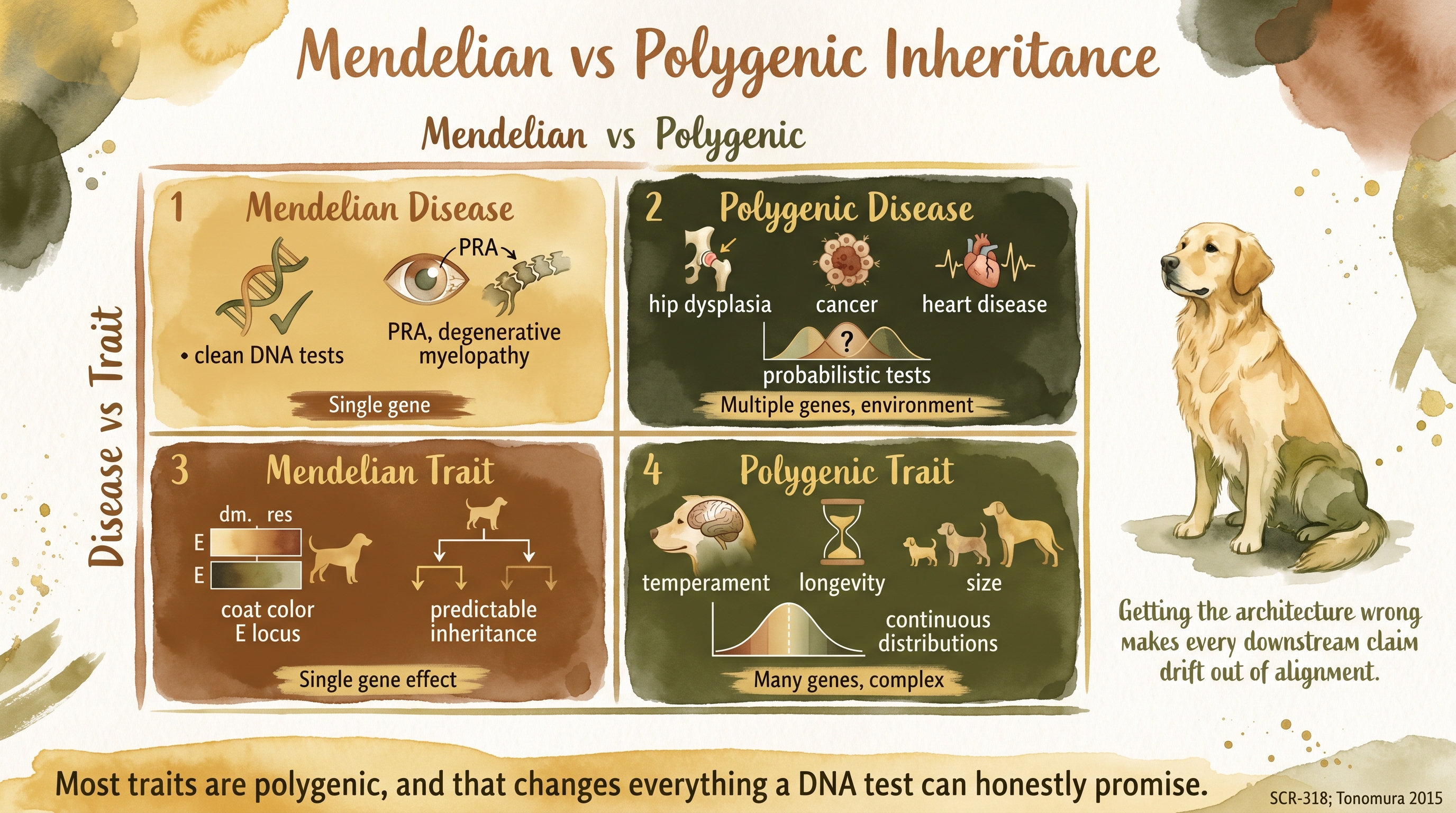
Most traits are polygenic, and that changes everything a DNA test can honestly promise.
Key Takeaways
- Mendelian traits are driven mainly by one locus and can often be tested with high confidence when the causal mutation is known.
- Most breeder-relevant traits in dogs, including hips, cancer susceptibility, and temperament, are polygenic rather than single-gene traits.
- Carrier and clear language belongs to validated Mendelian disease loci, not to polygenic conditions.
- A DNA result for a complex trait is usually a probability statement, not a diagnosis or guarantee.
- Polygenic traits still respond to selection, but the tool is phenotyping and long-arc population work, not single-marker testing.
The Evidence
- Canine inherited-disease genetics literaturedogs and Golden Retrievers
Some canine diseases, including named retinal degenerations in Golden Retrievers, follow classical Mendelian inheritance and are tractable to direct mutation testing. - Canine diversity and complex-trait literaturedogs
Most breeder-relevant traits such as hip dysplasia, cancer susceptibility, and behavior are polygenic and influenced by many loci with environmental modulation. - Quantitative-trait genetics frameworkgeneral genetics and dogs
Polygenic traits produce continuous variation and are not appropriately described with simple carrier-versus-affected language.
- Canine disease-testing and phenotyping literaturedogs
For complex orthopedic traits, DNA-based association data can estimate risk but do not replace direct phenotypic evaluation of the joints themselves. - Canine polygenic response-to-selection datadogs
Decades of phenotypic hip screening in breeds with consistent programs have produced measurable reductions in dysplasia prevalence, demonstrating that polygenic traits respond to selection on long arcs.
No comprehensive Golden Retriever study has decomposed temperament or behavioral traits into known-heritability versus additional hidden variance to quantify how much polygenic architecture remains unmapped.
SCR References
Sources
- Ginja M., Gaspar A.R., & Ginja C. (2015). Emerging insights into the genetic basis of canine hip dysplasia. Veterinary Medicine: Research and Reports, 6, 193-202. doi:10.2147/VMRR.S63536
- Tonomura N., Elvers I., Thomas R., Megquier K., Turner-Maier J., Howald C., et al. (2015). Genome-wide Association Study Identifies Shared Risk Loci Common to Two Malignancies in Golden Retrievers. PLOS Genetics, 11(2), e1004922. doi:10.1371/journal.pgen.1004922
- Labadie J., Swafford B., DePena M., Tietje K., Page R., & Patterson-Kane J. (2022). Cohort profile: The Golden Retriever Lifetime Study (GRLS). PLOS ONE, 17(6), e0269425. doi:10.1371/journal.pone.0269425
- Shaffer L.G., Sundin K., Geretschlaeger A., Segert J., Swinburne J.E., Royal R., Loechel R., Ramirez C.J., & Ballif B.C. (2018). Standards and guidelines for canine clinical genetic testing laboratories. Human Genetics, 138(5), 493-499. doi:10.1007/s00439-018-1954-4
- Farrell L.L., Schoenebeck J.J., Wiener P., Clements D.N., & Summers K.M. (2015). The challenges of pedigree dog health: approaches to combating inherited disease. Canine Genetics and Epidemiology, 2, 3. doi:10.1186/s40575-015-0014-9
- Awano T., Johnson G.S., Wade C.M., Katz M.L., Johnson G.C., Taylor J.F., Perloski M., Biagi T., Baranowska I., Long S., March P.A., Olby N.J., Shelton G.D., Khan S., O'Brien D.P., Lindblad-Toh K., & Coates J.R. (2009). Genome-wide association analysis reveals a SOD1 mutation in canine degenerative myelopathy that resembles amyotrophic lateral sclerosis. Proceedings of the National Academy of Sciences, 106(8), 2794-2799. doi:10.1073/pnas.0812297106