Maternal Effects and Developmental Programming in Dogs
Compound evidence detail1 SCR / 2 parts
- Documentedpeer-reviewed research on maternal effects and prenatal/perinatal developmental programming in mammals and dogs
- HeuristicJB application of maternal-effects research to whelping practice, early-life environment, and the breeder-side raising phase
Mothers pass on more than genes. In biology, maternal effects are the influences a mother has on offspring phenotype that are not explained solely by the DNA she contributes. In dogs, that includes the prenatal hormonal environment, placental and nutritional conditions, early care, and the quality of postnatal maternal behavior. This is one of the key reasons a puppy's story starts before the family ever meets it, and why evaluating a breeder by puppy outputs alone misses a major part of the biological work that actually shapes how those puppies arrive in the world. The dam is not just a genetic contributor; she is a developmental environment in her own right, and the quality of that environment matters. Mixed Evidence
What It Means
The formal definition
Maternal effects are formally defined as maternal influences on offspring phenotype that are not reducible to the genes directly inherited from the mother. The distinction is important because it separates two different ways a dam can shape her puppies. The genetic contribution is the half of the puppy's nuclear DNA she provides through the egg cell. Any effect on the puppy that depends only on that DNA counts as genetic inheritance in the usual sense. Maternal effects, by contrast, are everything else she contributes through her body and behavior that shapes the puppy without being written directly into the puppy's DNA sequence.
The category covers a range of biological mechanisms operating at different developmental stages. In dogs, those influences can include the prenatal hormonal conditions inside the uterus (which vary based on the dam's own physiology and stress state), the uterine and placental environment during gestation (including blood flow, oxygen delivery, and exposure to any circulating maternal factors), fetal nutrition during the development window when organ systems including the nervous system are being laid down, colostrum quality during the first hours after birth (which affects immune programming), milk composition and quantity during nursing, nursing style and the dam's regulation of feeding and cleaning routines, and maternal responsiveness and regulation after birth as the dam mediates the puppies' sensory and social early experience. Documented
This matters because maternal effects sit between genetics and later environment. They are one of the ways biology becomes developmental rather than purely inherited in a simple Mendelian sense, and they operate during a window when the puppy is most sensitive to upstream influences that will help shape how later learning and experience are processed.
The dam's two roles
The dam's role therefore has at least two layers that need to stay distinct in any honest breeder conversation.
One layer is genetic. She contributes half the puppy's nuclear DNA, which means her own genetic profile (including any disease-relevant alleles she carries) is directly transmitted to the next generation through normal inheritance. This is the layer that standard pedigree and DNA-testing tools are designed to track.
The second layer is developmental. She shapes the early environment in which that genetic blueprint begins expressing, from the moment of conception through weaning and beyond. Documented This is the layer that pedigrees cannot see and that DNA tests do not measure, and it can have consequences that persist into adulthood even though the dam contributed nothing to the dog's genome beyond the half that would have been present in any case.
Both layers matter. A genetically sound dam who is also a poor developmental environment is only partly contributing what she could contribute to her puppies. A genetically modest dam who is an excellent developmental environment may produce puppies who outperform what the pedigree alone would predict because the developmental contribution compensates for some of the genetic limitations.
Cross-species foundations
Cross-species work made this principle hard to ignore and is where the strongest mechanistic evidence lives. In mammals, maternal behavior and early-life conditions can alter offspring stress responses, exploration behavior, emotional regulation, and later resilience in ways that persist long after the direct maternal care has ended. The classic rodent work by Michael Meaney and colleagues on maternal licking and grooming showed that variations in this simple caregiving behavior produced measurable differences in adult stress physiology and behavior of the offspring, mediated through documented epigenetic changes in stress-response loci. Frances Champagne's work extended the findings across additional developmental and transgenerational contexts. Primate work has extended the principles to more socially complex species and longer developmental timelines.
Canine work does not mirror every detail of that literature, and direct canine molecular studies are still catching up to the rodent work in specificity and statistical power. Documented But the canine literature that does exist points in the same general direction strongly enough that responsible breeders should take maternal quality seriously as more than a cosmetic trait. Observational studies of canine maternal care quality have documented associations with later puppy behavioral outcomes, and the broader mammalian literature provides a mechanistic framework for understanding why those associations would exist.
The correct rhetorical ceiling
This does not mean maternal effects overpower genetics. They do not. A calm dam cannot create a temperament the puppy's genes do not support, and no amount of excellent maternal care can compensate for severe genetic liability on a given trait. Maternal effects are one input among several, and they work within the constraints of the genetic material they are acting on.
But maternal effects can influence how that genetic potential gets launched into development. Two puppies with similar genetic profiles can arrive at very different starting points for later learning depending on the upstream maternal environment, and those starting points can matter for how the puppies engage with subsequent developmental experiences. Documented A puppy launched from a calm, well-regulated maternal environment may be better positioned to benefit from early socialization opportunities than a puppy launched from a chaotic or stressed maternal environment, even if their genes are otherwise similar. The effect size in any individual case is hard to measure, but the direction of the effect is consistent with the broader developmental literature.
Why breeding programs watch maternal quality
That is why serious breeding programs watch more than test results and titles on paper. They also watch how dams carry pregnancy (including whether the dam is calm or anxious through gestation, how she eats, how she moves, whether she is physiologically stable), how they behave with puppies once the litter arrives (including attentiveness, cleaning, feeding coordination, and handling of disturbances), how orderly and attentive their maternal care is across the weeks that follow birth, and what kind of early physiologic tone they help create in the whelping environment.
None of those observations replace standard health testing. They add a layer of information that standard testing cannot capture. A dam who passes every DNA panel but shows poor maternal behavior is a warning about the developmental layer of her contribution even when her genetic layer looks clean. Documented A dam who is steady, attentive, and well-regulated with her puppies is contributing something real that the testing panels will never show.
Maternal effects are also one reason breeder-level stewardship has such long reach into the lives of the families who eventually receive the puppies. By the time a puppy enters the family home at eight or ten weeks of age, part of its regulatory story has already been shaped by the dam and the early environment she helped create. The family's work with the puppy is happening on top of that foundation, not starting from zero. A good foundation gives the family more to build on; a poor foundation creates friction the family will spend months or years working around. This is not a moral judgment about breeders; it is a description of how developmental programming works, and it is one of the reasons breeder selection matters as much as training skill in determining long-term outcomes.
What maternal effects are not
A careful treatment of maternal effects also has to name what the category does not include, because the term is sometimes stretched to cover ideas it does not support. Maternal effects are not transgenerational epigenetic inheritance of trauma, which is a separate and much more speculative claim (covered in the epigenetics entry). They are not a mystical life-force transmission, a common language in some breeder subcultures that dresses up intuition in scientific-sounding vocabulary. And they are not a catch-all explanation for every temperament outcome, because genetics, later experience, training, and individual variation all continue to shape the dog across its entire developmental arc.
Keeping the category tight matters because it is only useful as a category when it refers to well-defined biological mechanisms. Stretched beyond those boundaries, maternal effects become a rhetorical device rather than a scientific concept.
Why It Matters for Your Dog
What This Cannot Predict
Maternal effects cannot guarantee adult temperament. They influence the launch conditions, not the entire developmental trajectory, and many other factors continue to shape the dog after weaning.
They cannot override severe genetic liability. A puppy with a serious genetic predisposition will express that predisposition regardless of the quality of maternal care, even though the expression may be modulated by developmental context. Documented
They cannot justify blaming every later problem on one imperfect maternal variable. Development is multifactorial, and attributing specific adult outcomes to specific prenatal or early-life conditions in retrospect is almost always oversimplified.
And they cannot substitute for the broader raising work that happens after the puppy leaves the dam. The family's role in shaping the adolescent and adult dog is substantial, and good maternal effects do not eliminate the need for attentive continued development.
The correct interpretation is layered. Maternal effects are real and meaningful. They are one contributor among many. They matter because they are upstream in the developmental sequence, not because they are absolute determinants of later outcomes.
This page matters because families often evaluate breeders mainly by the visible outputs: titles earned by prior dogs, health tests completed on the parents, pedigree names in the background, and the appearance of the puppies on pick-up day. Maternal effects remind us that the dam herself is part of the evidence a family should be looking at, and that her behavior and care quality during the litter's early weeks are load-bearing variables for the eventual outcome.
Questions that matter for families evaluating a breeder include what kind of adult dog the mother actually is in her normal life (not just on the day of a meet-and-greet), how she handles stress when the environment presents challenges, what her behavior with the litter looks like when she does not know she is being observed, and what kind of early environment she is helping create for the puppies in their first few weeks. A breeder who welcomes these questions and can answer them in detail is engaged with the developmental layer of their work. A breeder who deflects the questions or treats them as intrusive is missing or hiding something that matters.
For JB, this matters deeply because the program's entire developmental philosophy depends on the maternal-effects layer being healthy. The emphasis on calmness, structured social exposure, and legible early life is not decorative or marketing-driven. A steady, attentive dam is part of the biological and relational foundation of the puppies in a way that cannot be manufactured later by training or family attention, and the program's ability to deliver the outcomes it promises depends on that foundation being in place from the beginning. The strongest direct canine evidence supports the importance of maternal care quality in later outcomes, and the broader mammalian literature strengthens the logic further. The exact size of effect in every breeder setting remains variable across studies and contexts, but the principle is no longer optional for any program that claims to care about developmental outcomes rather than just phenotype on the day of placement.
The practical takeaway for families is that a puppy's story does not start at eight weeks when they bring it home. It starts before conception and runs through every week of the dam's pregnancy and the litter's early care. A family choosing a breeder is also choosing a developmental environment for those critical early weeks, and the quality of that environment is one of the variables that will shape the next decade or more of the dog's life. Asking about maternal effects is not being picky. It is evaluating the part of the breeding work that most directly shapes the puppy you are about to raise.
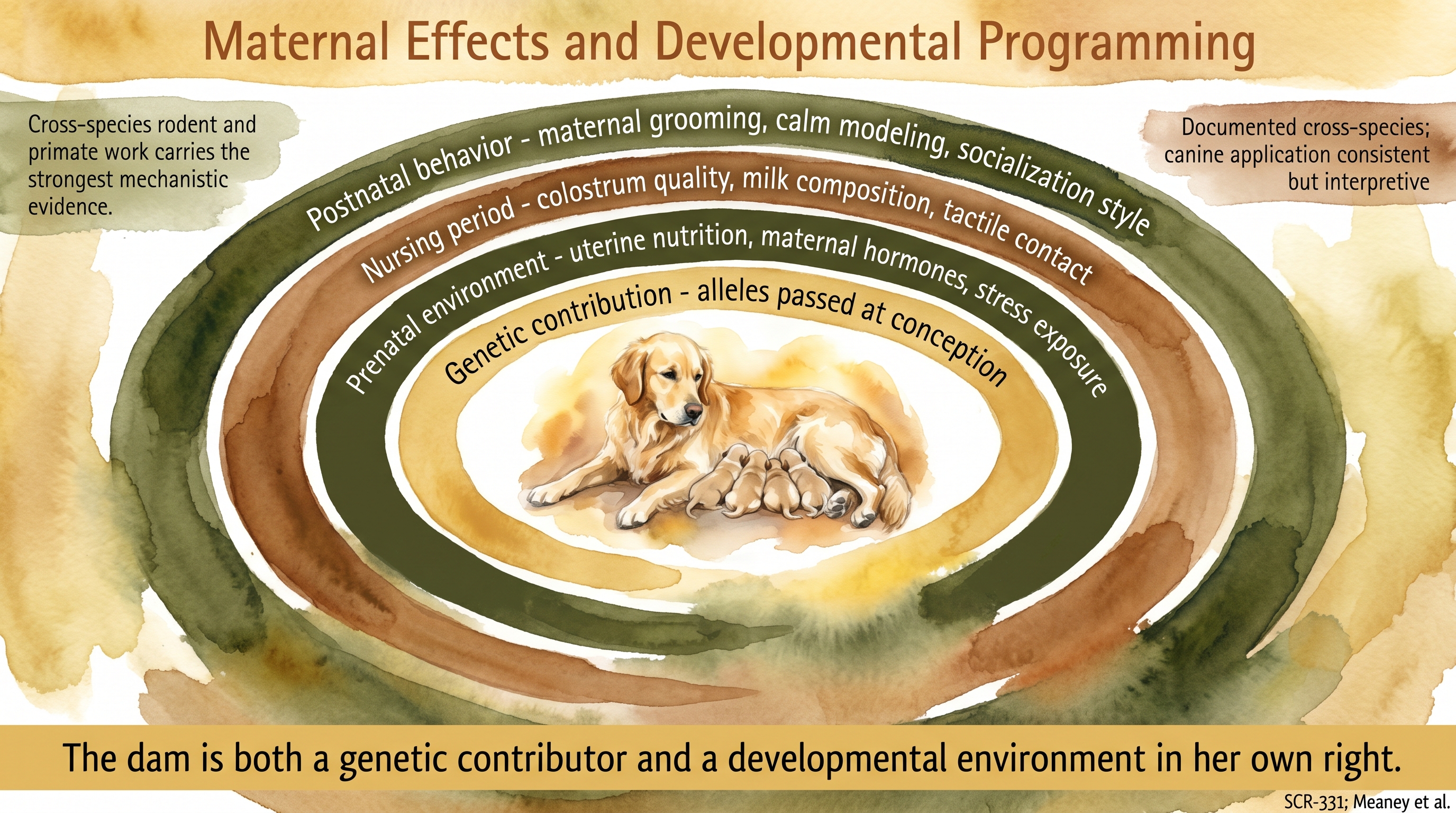
The dam is both a genetic contributor and a developmental environment in her own right.
Key Takeaways
- Maternal effects are influences a mother has on offspring phenotype beyond the genes she directly passes on.
- In dogs, those effects can include prenatal environment, early nutrition, and the quality of maternal behavior after birth.
- Cross-species and canine literature both support the importance of maternal effects, even though exact effect sizes vary by context.
- Maternal effects matter because they are upstream influences on development, not because they override genetics or determine every later outcome.
- The dam is both a genetic contributor and a developmental environment, and evaluating her quality requires looking at both layers.
The Evidence
This entry uses mixed-evidence claim-level tags beyond the dedicated EvidenceBlocks below. These tags mark claims that combine documented findings with observed practice, heuristic application, or unresolved gaps.
- Meaney, Champagne, and related mammalian maternal-care workrats, primates, and humans
Maternal behavior and prenatal environment can shape offspring stress regulation and later developmental outcomes through durable biologic pathways. - Developmental programming literaturemultiple mammals
Prenatal nutrition, stress hormones, and maternal physiology can shape offspring phenotype in ways that persist beyond the direct maternal influence.
- Canine maternal behavior studiesdogs
Canine research supports meaningful associations between maternal care quality, early environment, and later puppy behavioral outcomes, even if the full causal architecture remains complex. - Canine developmental source synthesisdogs
Maternal effects in dogs include prenatal conditions, nursing and caregiving behavior, and the quality of early postnatal regulation provided by the dam.
- JB breeding interpretationdogs
The claim that a calm, attentive dam forms part of the foundation for the puppy's later composure and social stability is consistent with the literature, but the full JB philosophical framing remains an interpretive application rather than a closed canine proof.
No prospective study has quantified the long-term behavioral effect size of specific dam-behavior variables in puppies raised under controlled conditions, with adult measurements separated from continued family environment effects.
SCR References
Sources
Sources pending: a dedicated source doc for this topic is queued for the next research cycle. The entry's factual claims draw on the broader JB Knowledgebase synthesis; peer-reviewed citations will be added when the source doc is built. This note will be replaced during the next audit pass.