Epigenetics in Canine Inheritance
Compound evidence detail1 SCR / 2 parts
- Documentedpeer-reviewed research on epigenetic inheritance mechanisms in dogs and other mammals
- HeuristicJB integration of epigenetic considerations into the breeding program selection and raising practices
Epigenetics is the study of changes in gene expression that occur without altering the DNA sequence itself. It matters because biology is not controlled only by which genes a dog carries. It is also shaped by which genes are turned up, turned down, or regulated differently in response to development and environment. But epigenetics is also one of the easiest topics to overclaim, so the evidence boundaries matter a great deal here. More nonsense has been written about epigenetics in the popular dog-behavior press over the last decade than about almost any other area of canine science, and a page on the topic that does not enforce discipline is worse than no page at all. Mixed Evidence
What It Means
The basic concept
The simplest way to think about epigenetics is that the genome is not a static script read at identical volume in every context. Cells regulate gene activity using multiple mechanisms that sit on top of the DNA sequence without changing the sequence itself, which means the same underlying genome can behave differently in different cells, at different developmental stages, and under different environmental conditions.
The main mechanisms include DNA methylation, in which small chemical groups are attached to specific DNA positions (most often cytosine residues in CpG dinucleotides) in ways that typically reduce gene expression at those positions; histone modification, in which the proteins that DNA wraps around can be chemically altered to either open or close local chromatin structure and therefore make genes more or less accessible; and non-coding RNA signaling, in which small regulatory RNAs produced from parts of the genome that do not encode proteins modulate the activity of protein-coding genes through various mechanisms. There are additional mechanisms beyond these three, but these are the ones that appear most frequently in the mammalian developmental literature.
These mechanisms can alter how strongly genes are expressed without changing the underlying letter sequence of the DNA. A dog and its littermates share a parental genome but can end up with different methylation patterns at specific loci based on developmental and environmental inputs, and those differences can translate into different gene-expression profiles and therefore different phenotypes even though the DNA sequence is essentially identical.
Why epigenetics matters for breeding and development
That is why epigenetics matters for breeding and early development as a topic worth understanding. A dog can inherit one DNA sequence and still show different patterns of expression depending on prenatal conditions, maternal care during the nursing period, developmental stress exposure, nutrition, and later life history. Documented The genome sets the starting menu of possibilities; the epigenome helps determine which items on the menu are actually being read at which volumes across the dog's life. Two puppies with identical DNA raised in very different early environments could end up with measurably different stress-response profiles, immune regulation, or behavioral tendencies because the same underlying genes are being expressed differently.
This framing supports the broader intuition that early life is biologically consequential rather than cosmetically preferable. A calm whelping environment is not just nicer for the puppies in the moment. It may be shaping biological regulation in ways that persist beyond the immediate experience, because the epigenetic mechanisms that respond to environmental input are most active during developmental windows when many regulatory patterns are being laid down for the first time.
Where the rhetoric outruns the evidence
The idea is scientifically important, but it needs discipline applied to it. Epigenetics does not mean every experience leaves a permanent multigenerational scar. It does not mean vague notions like "trauma is inherited" should be repeated as settled science. It does not mean that every developmental preference a breeder holds can be justified by gesturing toward epigenetic mechanisms as if the gesture itself constituted evidence. Documented The field is real. The rhetoric around it often outruns the evidence by an order of magnitude, and the result is a popular literature that treats epigenetics as a catch-all explanation for whatever the writer wanted to claim.
Cross-species work established much of the conceptual foundation and is where the strongest mechanistic evidence actually lives. Rodent and primate studies showed that early care, stress exposure, and maternal behavior can influence later stress physiology and gene-expression regulation through documented epigenetic pathways. The classic work by Michael Meaney and colleagues on maternal licking and grooming in rats showed that variations in maternal care influenced methylation patterns at specific stress-related loci in the offspring, which in turn shaped their adult stress-response profiles. Frances Champagne's work extended these findings to additional pathways and developmental contexts. Primate work added social and environmental dimensions. Those studies are highly influential because they identify plausible biological pathways by which early environment shapes later phenotype, and because the methylation changes they document are measurable, replicable, and mechanistically coherent with the observed behavioral differences.
The transfer to dogs must remain careful
The transfer to dogs, however, must remain careful and explicit about what has and has not been shown. There is growing canine evidence that developmental environment and gene-expression patterns are linked in meaningful ways. Some canine studies have documented methylation differences associated with behavioral variation, breed background, or developmental history. The direction of the canine literature is consistent with the cross-species mechanism story, and nothing in the canine data contradicts the mammalian framework.
But the canine literature is still smaller, more heterogeneous, and far less definitive than many popular summaries imply. In dogs, direct causal epigenetic claims about specific breeder practices remain much thinner than the general mammalian mechanism literature. Most of the strong claims circulating in the breeder and trainer world are cross-species extrapolations dressed up as canine-specific findings, and the extrapolations are plausible but not the same thing as direct canine evidence.
That means two layers have to stay separate in any honest presentation of the topic. The mechanism is real and well established across mammals, including humans and the rodent models that dominate the foundational literature. The exact magnitude and persistence of specific canine breeder-level effects (how much a particular whelping-room practice changes which methylation pattern in which puppies, with what behavioral consequences, over what time horizon) are still being worked out and should not be presented with the confidence that applies to the mechanism layer.
Prenatal and early-life implications for breeder practice
This distinction is especially important for prenatal calm, whelping-room environment, and early-life social handling, which are areas where epigenetic reasoning is frequently invoked in breeder writing. It is biologically coherent to think these upstream conditions matter. The cross-species literature supports the idea that prenatal and early-life environments shape developmental programming through epigenetic and other mechanisms. The general principle is not controversial among developmental biologists.
The stronger causal claims about exactly how specific breeder practices become stable canine epigenetic outcomes should still be phrased cautiously unless direct canine evidence exists at that level of specificity. A breeder saying "prenatal calm and a low-stress whelping environment likely support healthier developmental regulation because that is what the broader mammalian literature suggests" is making a responsible statement. A breeder saying "we know our practices produce specific epigenetic changes that permanently rewire the stress response of our puppies" is overclaiming unless they can point to canine studies that specifically tested those claims, which in most cases they cannot.
The rhetorical test is whether the breeder's language respects the gap between "mechanism is real in mammals" and "this specific practice has been shown to work this way in dogs." Ambiguous Programs that respect that gap can still credibly argue for their developmental practices on the basis of biological plausibility, cross-species mechanism evidence, and observational alignment. They just cannot pretend the argument is a settled canine proof when it is a cross-species extrapolation backed by coherent but still-developing canine data.
Transgenerational epigenetic inheritance
One of the most frequently overclaimed subtopics within epigenetics is transgenerational inheritance, meaning the transmission of epigenetic marks from parents to offspring beyond what is carried in the DNA sequence. In mammals, transgenerational epigenetic inheritance is harder to establish than intragenerational or in-utero programming because the epigenetic marks on germ cells are largely (though not entirely) reset during early embryonic development. Documented Some cases of apparent transmission have been documented, especially in plants and certain invertebrates, and the mammalian evidence for specific well-characterized transgenerational effects exists but is narrower than popular summaries suggest.
In dogs, direct evidence for robust transgenerational epigenetic inheritance of behavioral traits is limited and should not be treated as settled. The question is scientifically interesting and actively studied, but it is not the kind of claim a breeder can lean on without overstating the evidence. When someone says "this dog's anxiety was inherited epigenetically from its grandmother's stressful early life," they are making a claim that the current canine literature cannot support at that level of specificity, and the claim should be recognized as speculation even when it is speculation consistent with interesting ongoing research directions.
Why It Matters for Your Dog
What This Cannot Predict
Epigenetics cannot tell you that one stressful event permanently rewrote a puppy. Developmental systems are more resilient and more context-dependent than that, and a single event's long-term impact depends on many factors the mechanism vocabulary cannot predict in advance.
It cannot justify the blanket phrase "trauma is inherited" as though the science were simple and universal. The phrase collapses too many distinct ideas into a slogan and almost always overstates the evidence base.
It cannot be used to inflate a biologically plausible breeder practice into a fully proven canine causal mechanism when the supporting evidence remains cross-species or preliminary. Plausibility is a reason to take a practice seriously; it is not the same thing as proof.
And it cannot substitute for the other layers of what makes early-life environment matter. Epigenetic mechanisms are one part of how development works; neural circuit maturation, learning, attachment, and many other processes are also shaping the puppy in parallel, and the behavioral outcomes the breeder cares about emerge from all of them together rather than from epigenetic programming alone.
This is the load-bearing discipline point of the page. Epigenetics is real. Epigenetic overstatement is also real. Honest writing requires distinguishing them clearly rather than collapsing the distinction for rhetorical convenience.
Families do not need to master molecular biology, but they do need the right frame for thinking about how environment and genetics interact in their puppy's development.
The right frame is not that genes are destiny, because gene expression is responsive to environment in ways that matter. The right frame is also not that environment is everything, because genes set the menu of possibilities the environment is working within. The better frame is that environment can shape gene expression, especially early in development, and that early life therefore matters biologically as well as behaviorally. A calm, attentive, low-chaos early environment is not just comfortable for the puppy in the moment; it is a plausible contributor to how the puppy's regulatory biology develops over the longer term, even if the exact mechanisms and magnitudes in dogs specifically are still being mapped in the scientific literature.
That supports JB's broader intuition that calm, low-chaos, attentive early environments are upstream interventions rather than cosmetic preferences. The intuition is biologically coherent with the broader mammalian developmental literature, and that coherence is meaningful even when the canine-specific evidence is still catching up. But the honest rhetorical ceiling is important and worth repeating: the mammalian mechanism is well documented; the exact JB-specific translation into canine long-term outcomes remains partly heuristic and should not be marketed as settled canine science. A thoughtful breeder can explain this distinction to families without undermining the program's developmental principles, because the principles do not depend on overclaiming the evidence. They depend on coherent biological reasoning combined with observational experience, and that combination is a legitimate basis for practice even when the underlying canine molecular work is still developing.
That is not weakness. It is evidence honesty, and evidence honesty is one of the things that distinguishes a serious program from a marketing story.
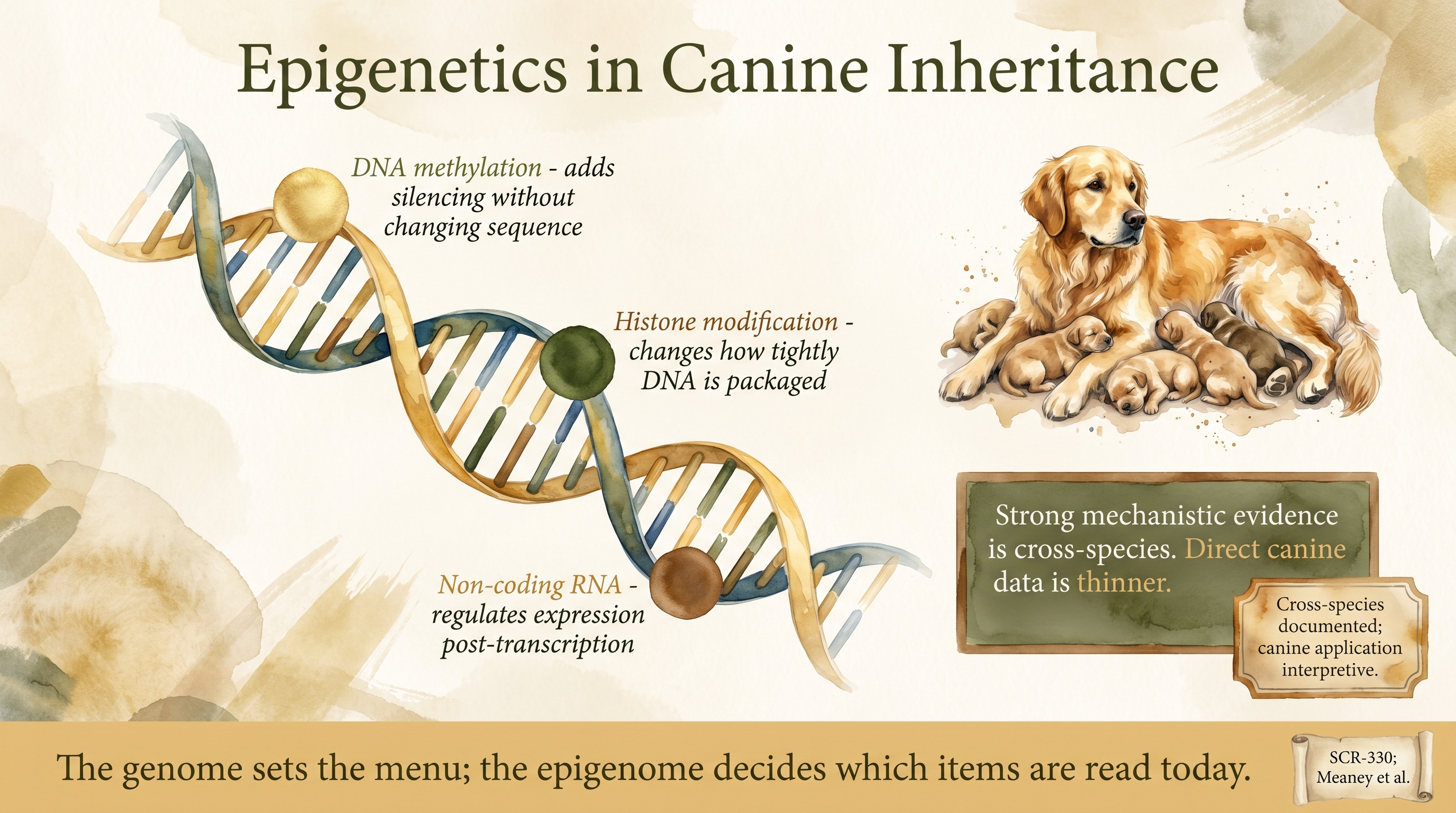
The genome sets the menu; the epigenome decides which items are read today.
Key Takeaways
- Epigenetics describes changes in gene expression that occur without altering the DNA sequence itself.
- Cross-species research strongly supports the idea that early environment can shape later physiology and behavior through epigenetic mechanisms.
- Canine evidence is growing, but breeder-level epigenetic claims in dogs still require more caution than popular writing usually gives them.
- Epigenetics is a useful mechanism vocabulary, not a license to turn every developmental intuition into settled science.
- Transgenerational epigenetic inheritance of behavior in dogs is not established at the level casual claims often suggest.
The Evidence
This entry uses ambiguous claim-level tags beyond the dedicated EvidenceBlocks below. These tags mark claims where the literature remains unsettled or multiple interpretations coexist.
This entry uses mixed-evidence claim-level tags beyond the dedicated EvidenceBlocks below. These tags mark claims that combine documented findings with observed practice, heuristic application, or unresolved gaps.
- Meaney, Champagne, and related mammalian workrats, primates, and humans
Early caregiving and developmental stress can alter later stress physiology and gene-expression regulation through epigenetic mechanisms such as DNA methylation. - Developmental epigenetics literaturemultiple mammals
Prenatal and early-life environments can shape expression patterns without changing DNA sequence, especially in neuroendocrine and stress-related pathways.
- Canine behavior and epigenetic source synthesisdogs
Direct canine evidence increasingly supports the relevance of developmental environment to later behavioral and physiologic outcomes, but the specific epigenetic pathways and effect sizes remain less fully mapped than in rodent models. - Transgenerational epigenetic inheritance literaturemammals and dogs
Robust transgenerational epigenetic inheritance of behavioral traits in dogs has not been established at the level often claimed in popular summaries, and the broader mammalian literature urges caution on this specific mechanism.
- JB developmental interpretationdogs
The claim that prenatal calm and an orderly early environment help shape later regulation in puppies is biologically coherent and consistent with mammalian epigenetic principles, but the full JB-specific causal framing remains interpretive rather than fully settled canine science.
No controlled longitudinal study has directly measured which specific breeder-level epigenetic interventions in dogs produce measurable methylation changes that persist to adulthood with behavioral consequences across independent replicated samples.
SCR References
Sources
Sources pending: a dedicated source doc for this topic is queued for the next research cycle. The entry's factual claims draw on the broader JB Knowledgebase synthesis; peer-reviewed citations will be added when the source doc is built. This note will be replaced during the next audit pass.