Lymphoma Heritability in Golden Retrievers
Lymphoma is one of the cancers that makes the Golden Retriever breed burden impossible to dismiss as anecdote or selection bias. The breed is repeatedly enriched for lymphoma relative to many other dogs across multiple datasets, and the line-level pattern strongly suggests inherited liability is part of the explanation rather than a random distribution across the population. But like hemangiosarcoma, lymphoma risk in Goldens is not currently reducible to a clean one-gene screening rule, and the gap between the recognizable pattern and the clinically useful predictive test is wide enough that honest breeder communication has to acknowledge both sides simultaneously. Documented
What It Means
Lymphoma as a category
Lymphoma is a cancer of lymphoid cells, meaning it originates in the cells of the lymphatic system that are central to the dog's immune function. The phrase "cancer of lymphoid cells" is accurate but hides more biological complexity than it reveals, because different lymphoma subtypes behave differently at the molecular, clinical, and prognostic levels. The two main broad categories are B-cell lymphomas and T-cell lymphomas, defined by which type of lymphocyte the cancer originated from, and within those categories there are further subtypes distinguished by histological appearance, anatomical distribution, and molecular features.
B-cell lymphomas are generally more common in dogs and often have a somewhat better prognosis than T-cell lymphomas when treated with standard chemotherapy protocols, though "better" in this context means longer median survival rather than cure. T-cell lymphomas tend to be more aggressive in dogs, with shorter median survival and a more challenging treatment picture. Different subtypes can also present in different anatomical locations, including the multicentric form (involving peripheral lymph nodes throughout the body, which is the most common presentation), the mediastinal form (involving lymphoid tissue in the chest), the alimentary form (involving the gastrointestinal tract), and the cutaneous form (involving the skin).
That complexity matters because it reminds us that "lymphoma" is partly a category of related cancers rather than one single molecular entity, and breed predispositions can vary by subtype in ways that matter for both research and clinical interpretation. Documented A Golden Retriever with B-cell multicentric lymphoma and a Golden Retriever with T-cell cutaneous lymphoma have technically both been diagnosed with lymphoma, but the biological events that produced each case may be quite different, and lumping them together in heritability analysis can obscure real structure in the underlying data.
Why Goldens stand out
Even with that biological complexity, Goldens stand out clearly in the breed-level cancer literature. The breed shows enough enrichment (meaning higher incidence than would be expected by chance) and recurring line pattern (meaning that certain pedigrees repeatedly produce lymphoma-affected dogs at rates above the breed average) that inherited liability is not reasonably in doubt. Multiple studies examining cause of death and cancer incidence in Golden Retrievers have identified lymphoma as one of the major contributors to the breed's cancer burden, and the consistency of that finding across different methodologies supports the conclusion rather than suggesting it is an artifact of any one study design.
The current challenge is not whether heredity matters. That question is reasonably settled by the existing evidence. The challenge is how to translate partial molecular insight and line history into responsible breeding decisions without claiming more certainty than the science can support, and that translation problem is genuinely difficult because the available tools are not yet precise enough to deliver the kind of individual-level guidance families sometimes hope for.
Overlapping cancer risk pathways
Some associated loci for lymphoma risk in Goldens appear to overlap partly with other cancer-risk pathways in the breed, and that overlap is interesting for both scientific and practical reasons. Documented It suggests shared or interacting genetic architecture rather than one isolated lymphoma switch, meaning that some of the genetic variation contributing to lymphoma risk may also contribute to other cancer types like hemangiosarcoma in ways that reflect broader immunological or cellular vulnerabilities rather than cancer-specific mutations.
If that interpretation is correct, then managing cancer risk in Goldens may involve attending to the broader architecture rather than treating each cancer type as a separate breeding problem. A line with heavy hemangiosarcoma history may also be at elevated risk for lymphoma through shared genetic contributions, and a breeder who notices a pattern in one cancer should be attentive to the possibility that related patterns may appear in others. This kind of integrated view is harder to implement than a disease-by-disease approach, but it may be closer to how the underlying biology actually works.
It also reinforces the broader point that cancer liability in Goldens is distributed and polygenic rather than localized to any single causal pathway. The disease is the output of many interacting factors, and the failure to find a clean single-gene explanation is not a research failure but a reflection of how complex traits behave in mammals generally. Documented
Why the inherited contribution does not yield a clean test
The polygenic and multifactorial architecture of lymphoma risk in Goldens means that the same limitations described for hemangiosarcoma apply here as well. Research has identified some genomic regions associated with lymphoma risk in the breed, and those findings are scientifically valuable for understanding the biology of the disease. But association at the population level is not equivalent to predictive utility at the individual level, and families who encounter breeder language suggesting otherwise are receiving an overstated version of what the evidence actually shows.
Current lymphoma-risk information is useful for informing line-level breeding decisions, for identifying families within the breed that carry unusual burdens, and for contributing to ongoing research that may eventually produce more precise tools. Documented It is not useful for predicting the fate of any specific puppy with the kind of confidence that would let a breeder guarantee outcomes or let a family make decisions as if the test had resolved the question.
The long-term picture
Lymphoma research in dogs is active, and the picture may improve over time as canine genomic databases grow, as more cases are characterized at the molecular level, and as polygenic prediction methods develop the statistical power needed to produce meaningful individual-level scores. Documented The Golden Retriever Lifetime Study and similar initiatives are accumulating the kind of data that future analyses may be able to leverage, and responsible breeders should stay engaged with emerging science rather than assuming the current state is the permanent state.
In the meantime, the practical tools remain line tracking, diversity preservation, and honest communication with families about what is and is not known. These are slower tools than a validated test would be, but they are real contributions to managing risk under conditions of genuine uncertainty, and they are what responsible Golden Retriever breeding currently has to work with.
Why It Matters for Your Dog
Families often hear "cancer runs in the breed" and feel either overwhelmed by the scope of the problem or tempted to dismiss the whole subject as too vague to influence their breeder choice in any meaningful way. Neither response is right, and both leave families worse equipped to make the decision they are trying to make.
The more useful response is to ask specific questions about how the breeder engages with the cancer topic rather than whether they engage with it at all. Does the breeder track lymphoma and other major cancers honestly in the pedigree, with specific knowledge of which dogs in the extended family have been affected and at what ages. Does the breeder preserve diversity instead of narrowing the population further through tight linebreeding that could concentrate polygenic risk. Does the breeder talk about cancer risk as a real but probabilistic burden that requires ongoing stewardship, or as a problem to be managed through reassuring language that papers over the actual complexity.
A breeder who engages seriously with these questions, who can name specific dogs in their own lines affected by cancer and speak honestly about what they are doing in response, is offering the level of transparency the breed requires. A breeder who deflects the questions or produces generic reassurance is either not tracking the information carefully or not willing to share it honestly, and either failure should factor into the family's decision.
For JB, this matters because breeding for health in Goldens cannot skip the hardest problem just because the tools are weaker than Mendelian testing would provide. Lymphoma belongs in the conversation precisely because it is difficult, and the program's willingness to hold it in view rather than avoid it is part of what a serious approach to the breed looks like. The responsibility is not to promise that any line will be lymphoma-free but to demonstrate that the program is managing the risk thoughtfully within the limits of what current knowledge allows.
Why It Matters for Your Dog
What This Cannot Predict
No current lymphoma-risk information can tell a breeder that one puppy will or will not develop lymphoma, because the polygenic architecture leaves substantial individual variation around any line-level estimate.
No apparently favorable risk picture makes a line immune, because cancer biology includes stochastic and environmental components that cannot be fully controlled by breeding decisions alone.
And no associated genomic region should be marketed as if it answers the disease in a simple binary way, because the statistical associations found in research studies are about population-level risk elevation rather than individual-level prediction.
The population-level rule matters here just as much as in every other polygenic page. Inherited lymphoma risk changes probabilities in the breed and in lines, and careful stewardship can shift those probabilities favorably over generations. It does not predict one dog's future with certainty, and breeders who present it as doing so are overclaiming what the science actually supports.
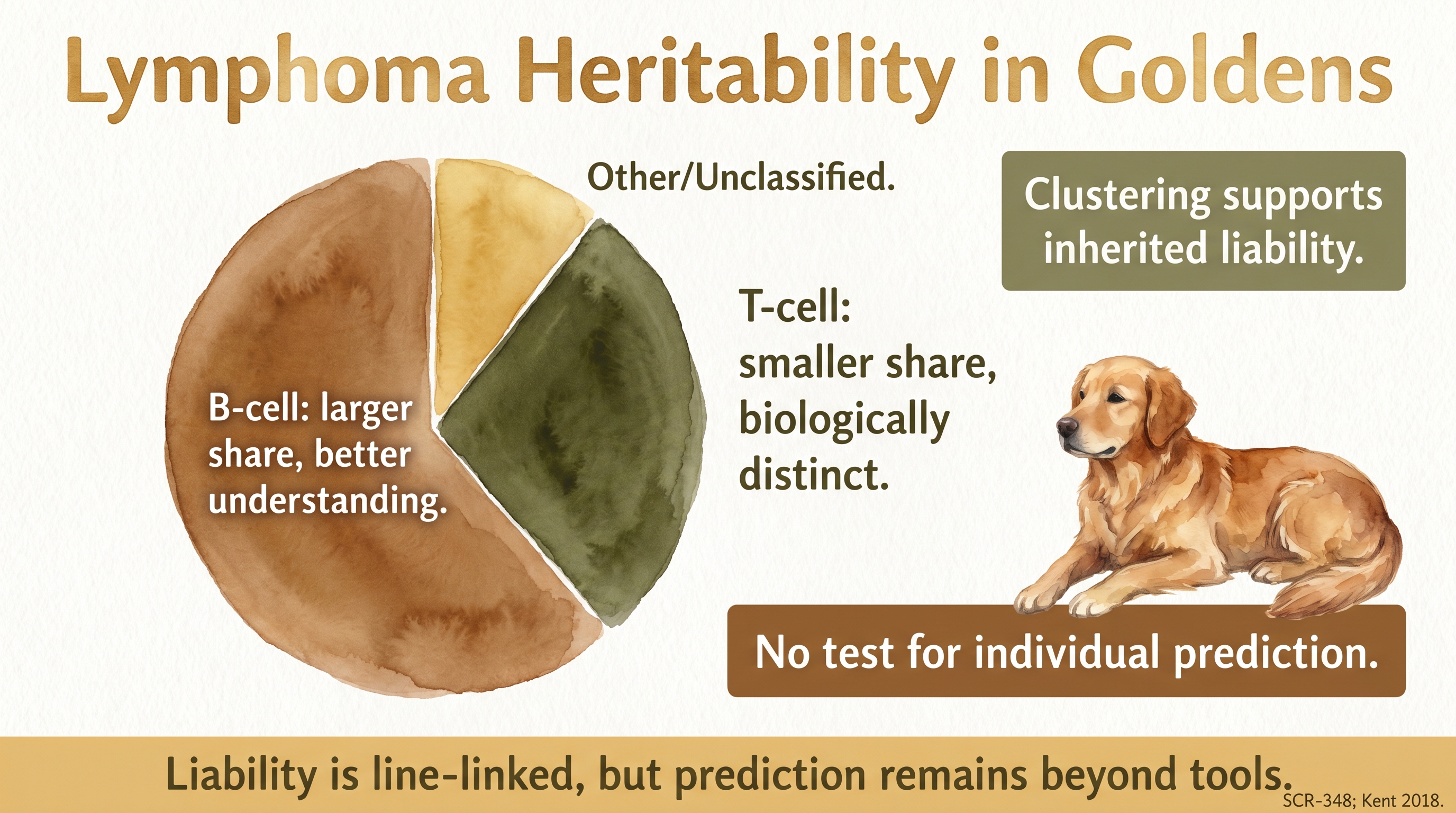
Lymphoma liability is real and line-linked, but individual prediction remains beyond current tools.
Key Takeaways
- Lymphoma is a major part of the Golden Retriever cancer burden and has a real inherited component.
- The disease is genetically complex and does not currently reduce to one decisive predictive test.
- Line history still matters because inherited risk shows up in pedigree patterning as well as in molecular work.
- Good breeder communication treats lymphoma as a real but probabilistic population problem rather than a solved genetic equation.
- Shared genetic architecture across cancer types suggests integrated stewardship is more useful than disease-by-disease management.
The Evidence
- Golden Retriever cancer epidemiology literatureGolden Retrievers
Lymphoma is one of the major cancers contributing to Golden Retriever mortality and appears enriched relative to many other canine populations. - Golden Retriever oncology genetics literatureGolden Retrievers
The inherited component of lymphoma risk is supported by line-level clustering and associated genomic findings, but the disease remains polygenic and complex.
- Canine oncology interpretation literaturedogs and Golden Retrievers
Current lymphoma-risk information is useful for population and line-level planning but does not allow deterministic prediction for any individual dog.
No published study has produced a validated polygenic risk score for lymphoma in Golden Retrievers that would allow individual-level prediction from genotype.
SCR References
Sources
- Kent M.S., Burton J.H., Dank G., Bannasch D.L., & Rebhun R.B. (2018). Association of cancer-related mortality, age and gonadectomy in golden retriever dogs at a veterinary academic center (1989-2016). PLOS ONE, 13(2), e0192578. doi:10.1371/journal.pone.0192578
- Torres de la Riva G., Hart B.L., Farver T.B., Oberbauer A.M., Messam L.L., Willits N., & Hart L.A. (2013). Neutering dogs: effects on joint disorders and cancers in golden retrievers. PLOS ONE, 8(2), e55937. doi:10.1371/journal.pone.0055937
- Bonnett B.N., Egenvall A., Hedhammar Ã…., & Olson P. (2005). Mortality in over 350,000 insured Swedish dogs from 1995-2000: I. Breed-, gender-, age- and cause-specific rates. Acta Veterinaria Scandinavica, 46(3), 105-120. doi:10.1186/1751-0147-46-105
- Tonomura N., Elvers I., Thomas R., Megquier K., Turner-Maier J., Howald C., et al. (2015). Genome-wide Association Study Identifies Shared Risk Loci Common to Two Malignancies in Golden Retrievers. PLOS Genetics, 11(2), e1004922. doi:10.1371/journal.pgen.1004922
- Luethcke K.R., Trepanier L.A., Tindle A.N., Labadie J.D., et al. (2022). Environmental exposures and lymphoma risk: a nested case-control study using the Golden Retriever Lifetime Study cohort. Canine Medicine and Genetics, 9, 9. doi:10.1186/s40575-022-00122-9