Hemangiosarcoma Heritability in Golden Retrievers
Hemangiosarcoma is one of the defining cancers of the Golden Retriever breed burden, and any honest conversation about inherited cancer risk in the breed has to address it directly rather than treat it as one item on a longer list. The literature supports that inherited liability is part of the story, with both pedigree clustering and associated genomic regions pointing in the same direction. But inherited liability is not the same thing as individual prediction, and that distinction is where most public discussion needs more discipline than it currently shows. Breeders and families who conflate the two end up either overclaiming what genetic information can tell them or dismissing the real contribution inherited factors make to risk, and neither extreme serves the breed well. Documented
What It Means
What hemangiosarcoma is
Hemangiosarcoma is an aggressive cancer of vascular endothelial origin, meaning it arises from the cells that form the inner lining of blood vessels. Because vascular endothelium is present throughout the body, hemangiosarcoma can arise in many locations, but in dogs it most commonly involves the spleen, the heart (particularly the right atrium), the liver, and the skin. Splenic hemangiosarcoma is probably the form most familiar to Golden Retriever families because of its devastating clinical presentation: a dog that seemed fine yesterday suddenly collapses from internal hemorrhage as a tumor ruptures and bleeds into the abdomen, and the time from first symptom to death is often measured in hours rather than days.
Cardiac hemangiosarcoma is similarly devastating, often presenting with pericardial effusion (fluid accumulating around the heart) that compromises cardiac function until the tumor is identified or the dog collapses. Cutaneous hemangiosarcoma, affecting the skin, tends to have a somewhat better prognosis when caught early because surface tumors can sometimes be removed before metastasis occurs, but the more common visceral forms carry a grave prognosis even with aggressive treatment, and long-term survival past a year after diagnosis is uncommon.
That clinical profile is why hemangiosarcoma occupies an outsized place in Golden Retriever families' fears. It is not only common in the breed; it is also particularly cruel in its presentation, often giving little warning before producing catastrophic consequences. Caregivers who have lost a previous Golden to hemangiosarcoma frequently carry the memory forward into their next dog's life, and the emotional weight of the disease is real and deserves to be treated with care in any breeder conversation. Documented
Why the inherited component is credible
In Goldens, hemangiosarcoma appears often enough and clusters strongly enough to justify treating inherited risk as a real breeding concern. The clustering happens at both the breed level (Goldens show higher hemangiosarcoma incidence than many other breeds in comparable environments) and at the line level within the breed (certain pedigrees show disproportionate hemangiosarcoma burden compared with others). Both of these patterns are consistent with inherited liability as part of the explanation, and neither is easily explained by environmental or stochastic factors alone.
Additionally, research efforts to identify specific genomic regions associated with hemangiosarcoma risk in Goldens have produced candidate loci that are statistically linked to disease incidence. Documented These associations support the polygenic picture by showing that there are places in the genome where risk appears concentrated, even though the effect sizes at individual loci are not large enough to make any single variant a practical predictor. The accumulation of such findings across studies strengthens the case that the inherited component is real, distributed across multiple contributing factors, and at least partly mappable to the genome.
The polygenic architecture
That inherited risk does not behave like a single dominant mutation or a recessive retinal disease, and expecting it to behave that way is one of the most common sources of confusion in public discussions. The better-supported picture is polygenic: multiple loci likely contribute small to modest effects, the total genetic contribution to any individual dog's risk is distributed across many genomic regions rather than concentrated at one place, effect sizes are probabilistic rather than absolute (meaning that carrying a risk-associated variant increases probability without determining outcome), and environment and stochastic biology still matter alongside the genetic component.
This polygenic architecture has important implications for what genetic information can and cannot deliver. A single-locus test cannot provide a meaningful risk prediction because no single locus carries enough weight. A polygenic risk score approach that aggregates many small-effect variants could in principle produce a useful relative-risk estimate, but the current state of the science has not yet validated such scores for Golden Retriever hemangiosarcoma with the robustness that would support confident individual-dog predictions. Documented Research is ongoing, and the tools may improve, but breeders who claim access to such predictive power today are overclaiming what the literature actually supports.
Why risk-associated loci are important without being magic
This is why associated risk loci are important but not magic. Studies identifying Golden-associated regions linked to hemangiosarcoma risk help show that the inherited component is real and help point toward the biological mechanisms that may be driving the breed's unusual burden. They are useful scientific progress and may eventually contribute to validated predictive tools. They do not, however, create a clean yes-no test that can tell a breeder exactly what will happen to one dog, and families who encounter marketing language suggesting otherwise should be appropriately skeptical.
The distinction between "this locus is statistically associated with increased risk in the population" and "this locus predicts your dog's fate" is one of the most important mental moves in interpreting cancer genetics, and it applies equally to human and canine medicine. Documented Association is not prediction, risk elevation is not destiny, and statistical significance in a study is not the same as clinical utility for an individual case.
Pedigree clustering as practical information
Pedigree clustering matters here too, and in some ways matters more than the molecular work for current practical breeding decisions. Even before molecular work becomes precise enough to drive individual-level decisions, line concentration can reveal inherited patterning that responsible breeders can act on. If certain lineages repeatedly show disproportionate hemangiosarcoma burden across multiple generations, that is meaningful breeding information even when the exact causal architecture remains incomplete. A breeder who has tracked the cancer histories of their own dogs and their relatives over many years has access to information that no current DNA test can match for that particular line, and the accumulated knowledge of line-level burden is one of the most valuable things a long-running breeding program can offer.
Families evaluating breeders should understand that this kind of long-term tracking is labor-intensive, often emotionally difficult (because it requires keeping in touch with families whose dogs have died), and absolutely central to meaningful cancer stewardship in a breed where molecular tools are not yet mature. A breeder who can speak in specific terms about cancer rates in their own lines across generations is doing real work that the scientific tools cannot currently substitute for.
Why It Matters for Your Dog
For families, the practical lesson is that breeder honesty around cancer line history matters as much as any single genetic claim, and possibly more. A breeder who knows their own lines deeply, who has tracked outcomes across generations, and who is willing to discuss the difficult realities without either minimization or dramatization is offering a kind of value that no currently available genetic test can substitute for.
If a breeder can discuss hemangiosarcoma in terms of line burden observed over multiple generations, selection choices made in response to that burden including which dogs were removed from the breeding program, uncertainty about how much any one generation's outcome will predict future generations, and the limits of current tools for individual-level prediction, that is usually a sign of seriousness rather than weakness. Observed-JB A breeder who waves off the topic or offers confident predictions about individual dogs is not engaging with the science the way responsible cancer stewardship requires.
For JB, the implication is population stewardship held to the standard the breed deserves. The program cannot pretend current cancer genetics is as clean as PRA testing, because it is not, and families who ask should receive the honest version rather than a marketing substitute. The responsible response is slower and more honest than the test-and-done model families sometimes hope for: track the lines carefully, preserve diversity so that polygenic risk is not concentrated through narrow breeding, keep the burden visible in program communication rather than hiding it for cosmetic reasons, and participate in ongoing research efforts when appropriate so that the tools may eventually improve for the breed as a whole. That integrated approach is less satisfying than a single test result would be, but it is what the current evidence actually supports.
What This Cannot Predict
A higher inherited liability to hemangiosarcoma cannot tell you that one dog will get the disease, because polygenic risk is expressed as probability elevation rather than deterministic outcome.
A lower liability cannot tell you one dog is safe, because environmental factors, stochastic biology, and genetic contributions not captured by current screening can still produce disease in dogs from lower-risk backgrounds.
And a risk-associated locus cannot be marketed as if it were a diagnosis, because the gap between statistical association in a study population and confident individual prediction is wide enough to matter in every clinical decision a family will make. Ambiguous
The population-level rule has to be stated clearly: hemangiosarcoma heritability changes the odds landscape in the breed and in individual lines, and line-level stewardship can move those odds meaningfully. It does not let anyone predict the fate of an individual dog with certainty, and breeders who present it that way are failing the family they are speaking to.
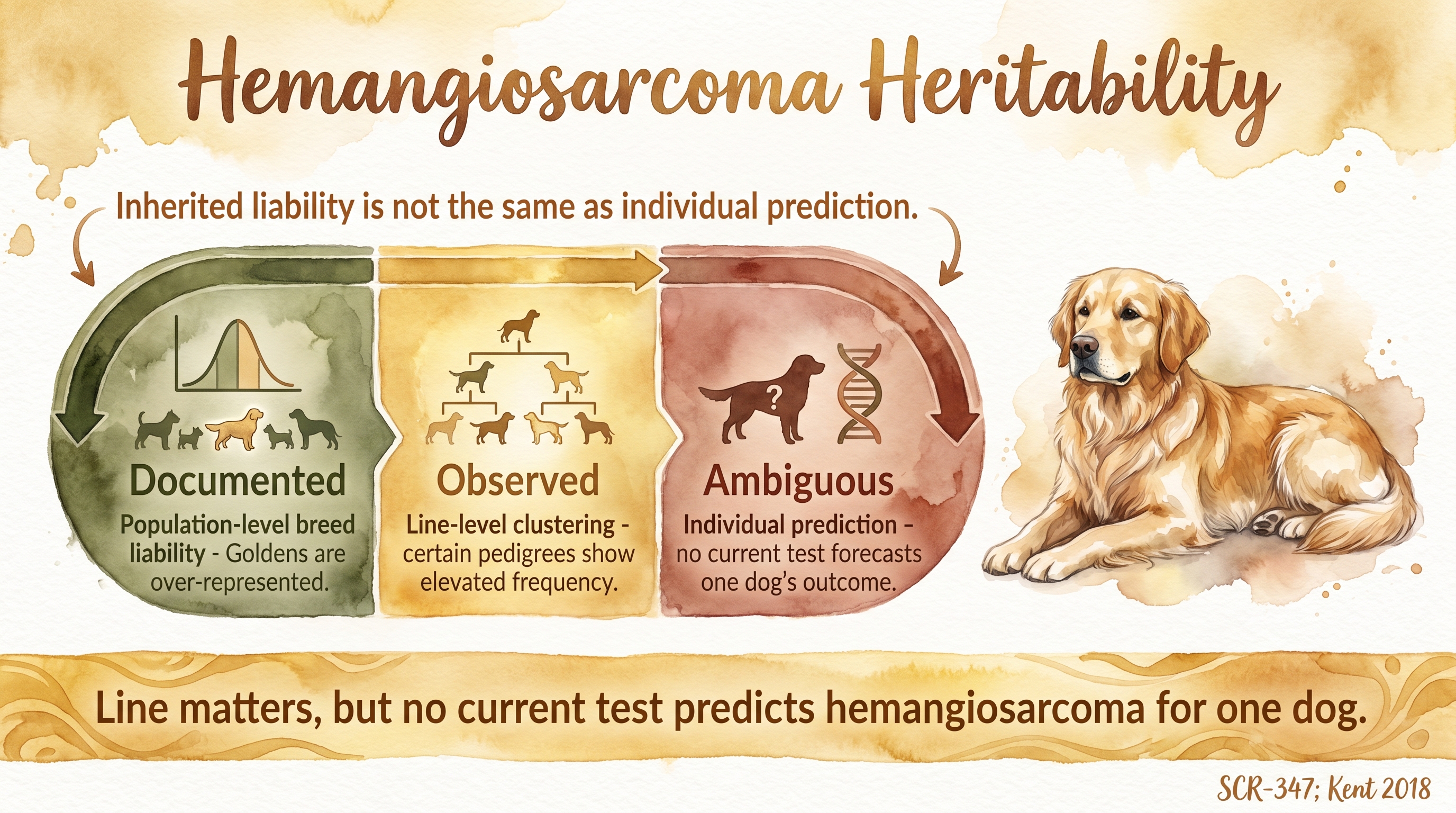
Line matters, but no current test predicts hemangiosarcoma for one dog.
Key Takeaways
- Hemangiosarcoma is one of the main cancers contributing to Golden Retriever breed burden.
- The inherited component is real, supported by both line clustering and associated genomic regions.
- Risk-associated loci for hemangiosarcoma are probability tools, not diagnoses.
- Responsible breeding relies on long-term line knowledge and population management rather than pretending current tools can guarantee outcomes.
- Pedigree-level cancer tracking over generations remains one of the most valuable stewardship practices available to breeders today.
The Evidence
This entry uses observed claim-level tags beyond the dedicated EvidenceBlocks below. These tags mark JB program observation or practice-derived claims that need dedicated EvidenceBlock coverage in a later content pass.
This entry uses ambiguous claim-level tags beyond the dedicated EvidenceBlocks below. These tags mark claims where the literature remains unsettled or multiple interpretations coexist.
- Golden Retriever oncology genetics literatureGolden Retrievers
Golden Retriever hemangiosarcoma shows line-level clustering and associated genomic regions, supporting a real inherited liability rather than a purely random disease distribution. - Golden cancer source synthesisGolden Retrievers
Published loci associated with hemangiosarcoma risk are useful as evidence of inherited structure but remain probabilistic markers rather than deterministic predictors.
- Canine oncology interpretation literaturedogs and Golden Retrievers
Cancer-associated loci change risk probabilities and line-level planning but do not predict whether any one dog will or will not develop hemangiosarcoma.
No prospective long-term study has followed dogs with known hemangiosarcoma risk loci versus baseline-risk controls across their lifespans to quantify the actual predictive validity of current genetic markers.
SCR References
Sources
- Kent M.S., Burton J.H., Dank G., Bannasch D.L., & Rebhun R.B. (2018). Association of cancer-related mortality, age and gonadectomy in golden retriever dogs at a veterinary academic center (1989-2016). PLOS ONE, 13(2), e0192578. doi:10.1371/journal.pone.0192578
- Torres de la Riva G., Hart B.L., Farver T.B., Oberbauer A.M., Messam L.L., Willits N., & Hart L.A. (2013). Neutering dogs: effects on joint disorders and cancers in golden retrievers. PLOS ONE, 8(2), e55937. doi:10.1371/journal.pone.0055937
- Bonnett B.N., Egenvall A., Hedhammar Ã…., & Olson P. (2005). Mortality in over 350,000 insured Swedish dogs from 1995-2000: I. Breed-, gender-, age- and cause-specific rates. Acta Veterinaria Scandinavica, 46(3), 105-120. doi:10.1186/1751-0147-46-105
- Tonomura N., Elvers I., Thomas R., Megquier K., Turner-Maier J., Howald C., et al. (2015). Genome-wide Association Study Identifies Shared Risk Loci Common to Two Malignancies in Golden Retrievers. PLOS Genetics, 11(2), e1004922. doi:10.1371/journal.pgen.1004922