Inbreeding Depression in Dogs
Inbreeding depression is the measurable decline in fitness traits that can appear as homozygosity rises in a population. In dogs, that may show up in litter size, fertility, survival, longevity, and other broad indicators of biological robustness. The concept matters because it shifts the conversation away from aesthetics and toward function: what happens to the population as relatedness accumulates over time, and what that accumulation costs the breed in biological performance rather than in pedigree-chart appearances. Documented
What It Means
The mechanism in plain terms
The phrase sounds dramatic, but the underlying logic is straightforward. When related dogs are bred, homozygosity at many loci increases. As homozygosity increases, recessive deleterious alleles that were previously hidden in heterozygous carriers are more likely to become homozygous and express in the offspring. The alleles themselves are not new. They were already in the population, carried quietly by dogs who had one functional copy to mask them. Inbreeding brings them into the open by making it more likely that two copies of the same recessive variant land in the same individual.
That is the main mechanistic explanation favored in modern population genetics, and it is usually called the partial-dominance hypothesis. The idea is that most deleterious variants are at least partially recessive, meaning they cause little or no phenotypic harm in heterozygous form but become problematic when homozygous. A healthy outbred population carries many such variants at low frequency because heterozygous carriers pay no fitness cost for harboring them. When mating becomes concentrated, the probability that two copies of the same variant end up together increases, and the cumulative fitness cost of many mildly harmful recessives expressing simultaneously produces the pattern called inbreeding depression.
There is also an older alternative explanation, the overdominance hypothesis, which emphasizes the loss of heterozygote advantage at some loci. In this view, some loci have genotypes where the heterozygote actually outperforms either homozygote, and inbreeding reduces the frequency of those advantageous heterozygote combinations. Overdominance is real at specific loci in specific systems (the classic textbook example is sickle-cell heterozygosity in humans, which has nothing to do with dogs but illustrates the principle), but it is usually treated as a secondary explanation rather than the main driver of inbreeding depression in mammals generally. The partial-dominance framework does most of the explanatory work in the canine literature.
What traits inbreeding depression affects
The key fitness traits involved are population traits rather than one-disease traits. Litter size, conception rate, early survival, longevity, immune robustness, and general physiologic resilience are the outcomes most often cited in the inbreeding-depression literature, and they share a common feature: each of them is the downstream product of many biological processes layered on top of each other, which is exactly the kind of trait that many low-effect deleterious recessives can collectively depress. Observed-JB
This is important because inbreeding depression is broader than "more recessive disease." It is not just about specific named conditions becoming more frequent. It is about the overall erosion of biological performance as homozygosity rises. A population experiencing inbreeding depression may not show any single dramatic disease increase. Documented Instead, it may show gradually shrinking litters, lower conception rates, more neonatal losses, subtly shortened lifespans, and a vague sense that the line "just isn't as robust as it used to be" without any one diagnosable cause. That broad-front biological decline is the signature of the phenomenon, and it is easier to miss than a specific disease outbreak precisely because it is diffuse.
Dog studies support that framing, though the effect sizes and exact traits vary by breed and dataset. Documented In some canine populations, rising inbreeding is associated with smaller litter sizes, sometimes with statistically significant effects visible across generational comparisons. In others, reduced fertility or shortened lifespan becomes easier to detect because those outcomes have been measured more systematically. Golden Retriever evidence is meaningful but still requires care in interpretation because not every fitness outcome has been equally studied within the breed, and the published effect sizes differ across methodological approaches.
Why the pattern is easy to miss
That breed-level nuance matters. Inbreeding depression is well documented as a general biological phenomenon across many species, including mammals of various sizes and life histories. The exact way it shows up in one breed at one time depends on what deleterious alleles are segregating in that specific gene pool, how the population has been managed, and which outcomes researchers measured carefully enough to detect. Two studies on the same breed using different methods or different fitness metrics can produce apparently contradictory results when in fact they are measuring different facets of the same underlying process.
This is one reason breeder record keeping matters so much in the real world. Population-level fitness decline is often easiest to see not in one dramatic case but in the accumulated pattern across many litters and many years. Litter sizes gradually drifting downward across a program's history. Reproductive ease changing over time in ways that are only obvious in retrospect. More subtle health fragility showing up in heavily concentrated lines that look fine on paper but seem to keep producing puppies with minor physiological issues. None of these observations constitute proof on their own. In aggregate, across careful breeder records, they are exactly the signal the inbreeding-depression literature would predict.
The pattern is also often invisible to families evaluating one litter or one puppy. A family seeing one healthy puppy from a concentrated pairing has no way to know whether that litter's average litter size was smaller than it would have been in a less concentrated mating, or whether the line's longevity has shifted downward across the last decade. These are statistics that only emerge across many dogs and many years, and they are the kind of thing a good breeder should be tracking even when no individual puppy tells the story.
Relationship to COI and Ne
The concept is closely tied to COI and effective population size, but it is not identical to either. COI is a probability measure of expected homozygosity from shared ancestry. Ne is a population-size descriptor of how the gene pool is behaving genetically. Inbreeding depression is one of the biological consequences that can emerge as those structural metrics worsen. A population with rising average COI and falling Ne is a population where inbreeding depression becomes increasingly likely to show up in measurable fitness traits, but the presence of the structural risk is not the same as the presence of the biological outcome. The gap between the two is where individual variation lives, which is why even a concerning structural profile does not automatically produce a sick puppy. Ambiguous
This is also why managing inbreeding depression is not just a matter of setting a numerical COI target. It requires thinking about the gene pool structurally (through Ne, founder contribution balance, and diversity-aware mate selection) while also watching the biological output traits (fertility, litter size, longevity, resilience) across generations. The structural metrics are leading indicators; the fitness traits are lagging indicators; and both layers of information are necessary for honest management of the problem.
Why It Matters for Your Dog
What This Cannot Predict
Inbreeding depression does not mean every high-COI puppy is sick. Individual outcomes in any one litter depend on which specific recessive variants the two parents happen to share and whether any of those variants actually become homozygous in any given puppy. Some heavily linebred dogs are robust across their entire lives.
It does not mean one moderately concentrated mating will obviously produce a disaster. The effects of inbreeding depression accumulate across many such decisions and across many generations. A single pairing cannot be judged in isolation against the concept.
And it does not let anyone look at one dog and claim certainty about its future fitness. The phenomenon lives at the population level, and individual variation is large enough to produce counterexamples in both directions.
This is one of the most important interpretation boundaries in the whole category. Inbreeding depression is a population-level rise in risk and decline in average fitness. Individual dogs still vary. Some heavily linebred dogs appear robust. Some relatively outcrossed dogs still become ill. The concept works statistically across populations and generations, not as a prophecy for one animal, and presenting it as an individual-level prediction oversells the science.
It also does not prove that any particular line has crossed a threshold of unacceptable risk. There is no clean numerical boundary where inbreeding depression suddenly switches on. The effect is gradient, the magnitude depends on which recessive variants are segregating in the specific population, and the thresholds used in different studies are not directly interchangeable. Documented
Families often hear about inbreeding only as a moral slogan attached to words like "backyard" or "puppy mill." The more useful frame is biological. The question is not whether a pedigree "sounds close" to a family reading names on a chart. The question is whether the breeding population is being managed in a way that preserves long-term biological robustness in the traits that matter for a dog's actual life.
That matters because the traits affected by inbreeding depression often overlap with what families care about most but cannot easily screen for in one moment. Fertility in breeding stock matters because it tells you the program can continue producing healthy litters. Durability across the lifespan matters because it determines how many good years the dog will have after the puppy stage. Background resilience matters because it buffers the dog against minor illnesses and stressors that a less robust dog would struggle more with. None of those traits show up on a standard DNA disease panel. They emerge only from careful management of the gene pool over time.
For breeders, the implication is that line concentration can bring predictability in type but also long-term cost if used without discipline. A breeder who only ever line-breeds is producing more uniform puppies in the short term while gradually accumulating the recessive-exposure risk that inbreeding depression describes. A breeder who rotates through different lines, broadens where possible, and watches fertility and longevity trends is doing the harder but more sustainable work. Neither approach is automatically wrong for a single litter. The question is which pattern a breeder is applying across decades.
For families, the implication is that breeder quality cannot be judged only by a list of disease tests. Population stewardship matters too. A breeder with an impressive disease-testing panel but no diversity awareness is solving half the problem. The other half requires thinking about what the gene pool will look like in ten and twenty years, not just what this litter's OFA results say today.
For JB specifically, this page matters because raising depends on a dog having the biological stability to benefit from raising. A dog that is struggling physiologically is a dog whose developmental window is being used up by managing subclinical health issues rather than by learning the social and behavioral patterns the Five Pillars are designed to build. Inbreeding depression is one of the reasons population stewardship is not separate from philosophy. It affects the physical substrate the raising program is working with, and a narrower gene pool means less biological margin for the developmental work to unfold cleanly.
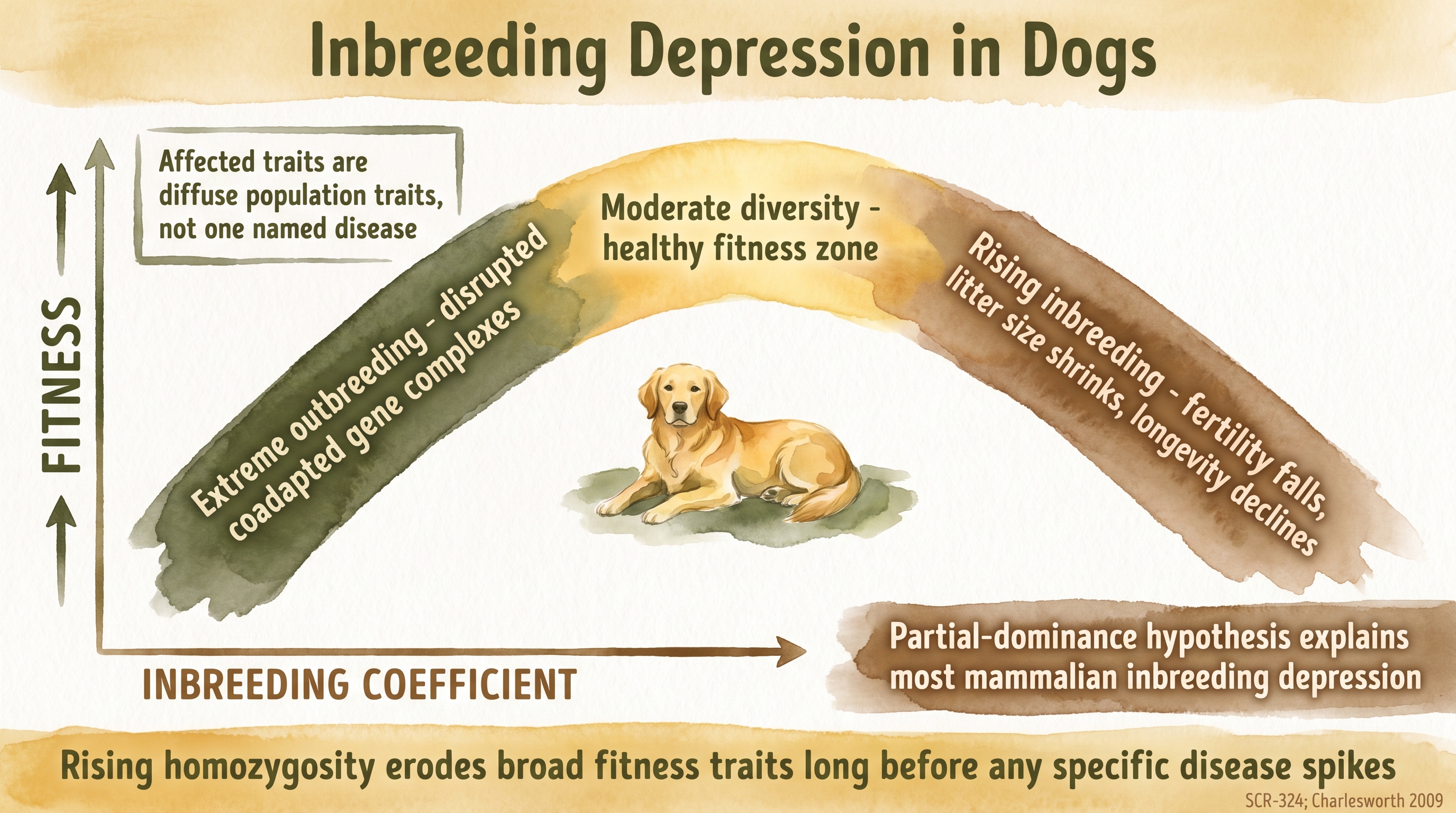
Rising homozygosity erodes broad fitness traits long before any specific disease spikes.
Key Takeaways
- Inbreeding depression is the population-level decline in fitness traits that can occur as homozygosity rises.
- The leading explanation is that inbreeding exposes deleterious recessive alleles that were previously hidden in carriers.
- In dogs, the effects can involve fertility, litter size, longevity, and other broad indicators of biological robustness.
- Inbreeding depression is real and measurable at the population level, but it does not predict one dog's fate with certainty.
- Managing the risk requires watching both structural metrics like COI and Ne and biological output traits like fertility and longevity across generations.
The Evidence
This entry uses observed claim-level tags beyond the dedicated EvidenceBlocks below. These tags mark JB program observation or practice-derived claims that need dedicated EvidenceBlock coverage in a later content pass.
This entry uses ambiguous claim-level tags beyond the dedicated EvidenceBlocks below. These tags mark claims where the literature remains unsettled or multiple interpretations coexist.
- Population-genetics frameworkgeneral genetics
Inbreeding depression is best explained primarily by the exposure of deleterious recessive variants as homozygosity rises, with heterozygote-loss mechanisms also discussed in the literature. - Canine reproductive and diversity studiesdogs
Dog populations with higher inbreeding show measurable declines in fitness traits such as litter size, fertility, and other broad indicators of biologic performance. - Golden Retriever and breed-specific diversity workGolden Retrievers
Golden-specific evidence is strongest for some reproductive and diversity outcomes, while other fitness effects remain suggestive rather than fully quantified in the breed.
- Canine population-health literaturedogs
Inbreeding depression describes a rise in population-level probability of reduced fitness, not a deterministic verdict about the health of every individual dog from a more related mating. - Comparative mammalian inbreeding literaturemammals and dogs
Inbreeding depression effects are typically diffuse across many fitness traits rather than concentrated in any single diagnosable outcome, which is why the pattern is easier to see across many litters than in any one case.
No prospective study has directly measured the effect size of inbreeding depression on specific fitness traits in Golden Retrievers at defined COI levels with long-term individual dog follow-up.
SCR References
Sources
- Charlesworth B. & Charlesworth D. (1999). The genetic basis of inbreeding depression. Genetical Research, 74(3), 329-340. doi:10.1017/s0016672399004152
- Charlesworth D. & Willis J.H. (2009). The genetics of inbreeding depression. Nature Reviews Genetics, 10(11), 783-796. doi:10.1038/nrg2664
- Leroy G., Phocas F., Hedan B., Verrier E., Elsen J.M., & Mangin B. (2015). Inbreeding impact on litter size and survival in selected canine breeds. The Veterinary Journal, 203(1), 74-78. doi:10.1016/j.tvjl.2014.11.008
- Bannasch D., Famula T., Donner J., Anderson H., Honkanen L., Batcher K., Safra N., Thomasy S., & Rebhun R. (2021). The effect of inbreeding, body size and morphology on health in dog breeds. Canine Medicine and Genetics, 8(1), 12. doi:10.1186/s40575-021-00111-4
- Chu E.T., Cullen K.L., Castelhano M.G., Goldstein O., Brush G.S., & Coates J.R. (2019). Inbreeding depression causes reduced fecundity in Golden Retrievers. Mammalian Genome, 30(5-6), 166-172. doi:10.1007/s00335-019-09805-4
- Yordy J., Kraus C., Hayward J.J., White M.E., Shannon L.M., Creevy K.E., Promislow D.E.L., & Boyko A.R. (2020). Body size, inbreeding, and lifespan in domestic dogs. Conservation Genetics, 21(1), 137-148. doi:10.1007/s10592-019-01240-x
- Wildt D.E., Bush M., Goodrowe K.L., Packer C., Pusey A.E., Brown J.L., & O'Brien S.J. (1987). Reproductive and genetic consequences of founding isolated lion populations. Nature, 329(6137), 328-331.