Hybrid Vigor and Outcrossing in Dogs
Compound evidence detail1 SCR / 2 parts
- Documentedpopulation-genetics research on heterozygosity, hybrid vigor, and the outcomes of strategic outcrossing in dogs
- HeuristicJB position on the role of strategic outcrossing within the breeding program and its relation to long-term breed health
Hybrid vigor, also called heterosis, is the mirror image of inbreeding depression in the public imagination. The concept is real and well documented in the broader genetics literature, but in dogs it is often pushed far beyond what the science can honestly support. Heterosis can improve some population-level fitness outcomes when genetically divergent parents are crossed. It does not mean every crossbred puppy is automatically healthier, simpler, or free of inherited risk, and the slippage between those two framings is one of the most commercially exploited confusions in the entire dog-breeding marketplace. Mixed Evidence
What It Means
The biological concept
Heterosis refers to improved biological performance in offspring produced from genetically divergent parents. The classic mechanisms are the masking of deleterious recessive alleles (because each parent is unlikely to carry the same specific variants at the same loci), the restoration of heterozygosity across many loci, and possible heterozygote advantage at some specific loci where the heterozygous genotype outperforms either homozygote.
The first mechanism is the most important one in practice, and it is essentially the inverse of inbreeding depression. Inbreeding depression works by exposing hidden recessive load as homozygosity rises. Heterosis works by hiding that recessive load again when two divergent populations are crossed, because each population tends to carry its own unique set of deleterious variants, and the cross combines one functional copy from each parent at most loci where either parent was homozygous for a harmful variant. The offspring inherit the functional allele from the other parent and the harmful allele stays masked.
The concept is extremely well documented in agriculture. Maize breeding is the textbook case: hybrid maize lines produced by deliberately crossing genetically distinct inbred parent lines dramatically outperform either parent line in yield and vigor, and modern commercial corn seed is almost entirely hybrid for this reason. Livestock systems have used heterosis deliberately for decades too, crossing breeds or lines specifically to produce commercial offspring with improved growth rates, fertility, or carcass traits. The gains can be substantial and measurable at scale, and agricultural heterosis is not controversial among geneticists.
Why dogs are not maize
Dogs are not maize, and that difference matters more than the marketing usually admits.
Agricultural heterosis works so cleanly because the parent lines are often highly inbred in the first place, with large amounts of homozygous deleterious load that the cross can mask. Modern dog breeds, while more concentrated than an outbred population, are not nearly as inbred as commercial maize parent lines. The potential ceiling for heterosis gain is correspondingly smaller. Agricultural heterosis also targets specific, measurable commercial traits like yield or growth rate, where even modest percentage gains are economically meaningful across millions of individuals. Mixed Evidence Dog buyers are typically not looking for a few percent improvement in some single output metric; they are looking for a healthy companion, and "healthy" is a much more diffuse outcome than "bushels per acre."
The logic of heterosis still applies to dogs at a broad population level, just with smaller and less predictable effect sizes than the maize case might suggest. Mixed Evidence Crossing two genetically distinct populations can reduce the chance that the same breed-specific recessive allele will meet itself in the offspring. If one breed carries a high frequency of a recessive disease variant and the other does not, first-generation offspring may benefit from that masking effect at that specific locus. This is a real biological phenomenon, not a marketing invention.
Where the marketing goes wrong
But that truth gets abused in the marketplace, and the abuse takes a consistent form. The most common slippage is to turn "heterosis can exist and may help at specific loci" into "these puppies will be healthier." That jump skips too many steps to be honest. A first-generation cross does not eliminate inherited risk. It combines the genetic backgrounds of both parent breeds, with all the health realities each breed brings to the combination. If both breeds have important disease burdens, the offspring inherit exposure to both landscapes, not the absence of either.
Consider the concrete example of a Golden Retriever crossed with another breed. The cross does not stop being influenced by Golden Retriever cancer risk, orthopedic liability, ocular risks, or other relevant breed-level concerns simply because the other parent belongs to a different breed. Documented Goldens are polygenic for cancer susceptibility, and those polygenic risk alleles are still present in the offspring at roughly half the rate of a full-Golden puppy. Some recessive problems may indeed become less likely to express in the F1 because the other breed does not carry the same breed-specific variants. Other risks remain fully in play. Some new ones may enter from the second breed, because the second breed has its own set of variants and its own disease predispositions that the Golden side of the cross will not mask.
The net health picture of a cross depends on the specific health profiles of both parent breeds, the specific parents chosen, and the specific pairings made. Mixed Evidence It is not resolvable at the level of "crossbred is healthier than purebred" as a blanket claim. In some specific cases a cross may be advantageous at specific loci; in other cases it may combine the worst of both worlds if both parent breeds happen to carry risk at overlapping loci or if neither parent was screened against the risks their breed actually has.
The F1 versus later generations
Another important detail that marketing almost always omits is that heterosis is strongest in the first filial generation (F1) and erodes in subsequent generations when F1 crosses are bred to each other or back to either parent breed. The clean mask-across-loci effect that gives F1 crosses their advantage partially breaks down in F2 and later generations because recombination allows homozygous combinations of each parent breed's recessives to reappear. This is not an obscure detail. It is central to how agricultural hybrid programs actually work, which is why commercial corn growers buy new hybrid seed every year rather than saving seed from their previous crop.
In dogs, this matters because multigenerational crossbreeds (F2, F3, and backcrosses) are often marketed with the same heterosis rhetoric as F1 crosses even though the biology does not support it. The further a crossbreed program moves from the F1 generation, the less the simple heterosis story applies, and the more the resulting population starts to look like a new breed with its own emerging inbreeding and diversity concerns. The marketing label stays constant while the underlying genetics have moved on.
Outcrossing within a breed
That is why outcrossing within a breed matters as a separate concept. Breeders do not need to leave the breed entirely to benefit from greater genetic distance between parents. Using less-related lines inside the breed can restore some heterozygosity at the level of individual matings and reduce the rate at which relatedness accumulates in the program without making grand claims about "hybrid vigor" in a marketing sense.
Within-breed outcrossing is usually the better-targeted tool for most purebred breeders because it addresses the actual structural problem (narrow line concentration inside a closed gene pool) without introducing a completely new disease architecture from a second breed. A Golden breeder who deliberately works with less-related Golden lines, watches founder contribution balance in their program, and avoids repeatedly using the same popular sires is doing diversity management at the level where the concept actually applies cleanly to their situation.
The rule is the same in both cases: genetic distance between parents can be useful as one input into breeding decisions, but only when paired with actual health knowledge about the specific dogs being crossed. Outcrossing is a tool, not a cure, and its benefits are specific and conditional rather than universal and automatic.
Why It Matters for Your Dog
What This Cannot Predict
Hybrid vigor cannot honestly support the blanket claim that first-generation designer crosses are healthier by default. The claim skips over too much specificity in both the biological mechanism and the actual disease architecture of the breeds involved.
It cannot erase the combined disease burden of both parent breeds. Whatever risks each breed brings to the cross remain relevant to the offspring; they are rearranged, not eliminated.
It cannot substitute for phenotypic, orthopedic, ocular, cardiac, or disease-locus screening. Documented All of the same testing that would be important for a purebred litter remains important for a crossbred litter, possibly more so because the parent populations may not have the same screening infrastructure.
And it cannot tell you that one individual puppy will outperform a well-bred purebred from a carefully managed line. Within-breed stewardship done well can produce outcomes that no generic "designer cross" story can match, and the comparison has to be between specific programs rather than between broad categories.
Those are exactly the claims that need discipline here. The concept is real. The marketing around it is often inflated well beyond the science that supports it.
Families are often sold a simple story: purebreds are inbred and sick, crosses are healthier. The truth is more conditional than that. Crossing can reduce expression of some breed-specific recessive diseases at specific loci in F1 offspring. Crossing does not remove the need to understand the health realities of both breeds involved, and it does not automatically justify the higher prices that designer crosses often command on the market.
That means the correct family question is not "Is this a cross?" but "What are the known health burdens of both parent populations, and what evidence supports the breeder's health claims?" A breeder who says "hybrid vigor" without being able to discuss the specific disease risks of both parent breeds is relying on marketing rather than biology. A breeder who can explain which risks the cross might mitigate, which risks remain active, and what testing has been done on the parents is doing honest work regardless of whether the result is a purebred litter or a crossbred one.
For breeders, the lesson is just as important. Outcrossing within a breed or, in rare strategic contexts, across populations may help preserve or restore diversity. But those moves only become responsible when matched with disciplined health interpretation and honest communication about what has and has not been improved. Using "hybrid vigor" as a marketing shortcut that allows reduced health testing or inflated claims is exactly the kind of slippage families should be filtering out.
For JB, the practical lesson is humility about the limits of any one tool. Genetic distance can help at the level of specific loci and specific breeding decisions. It cannot be marketed as magic, and it does not substitute for the structured health and raising work that defines a good program. The Five Pillars describe the developmental and relational layer of a good dog; the health layer underneath that still requires the same disciplined breeding work regardless of whether the pairings are within-breed or across-breed, and heterosis does not provide a shortcut around that work.
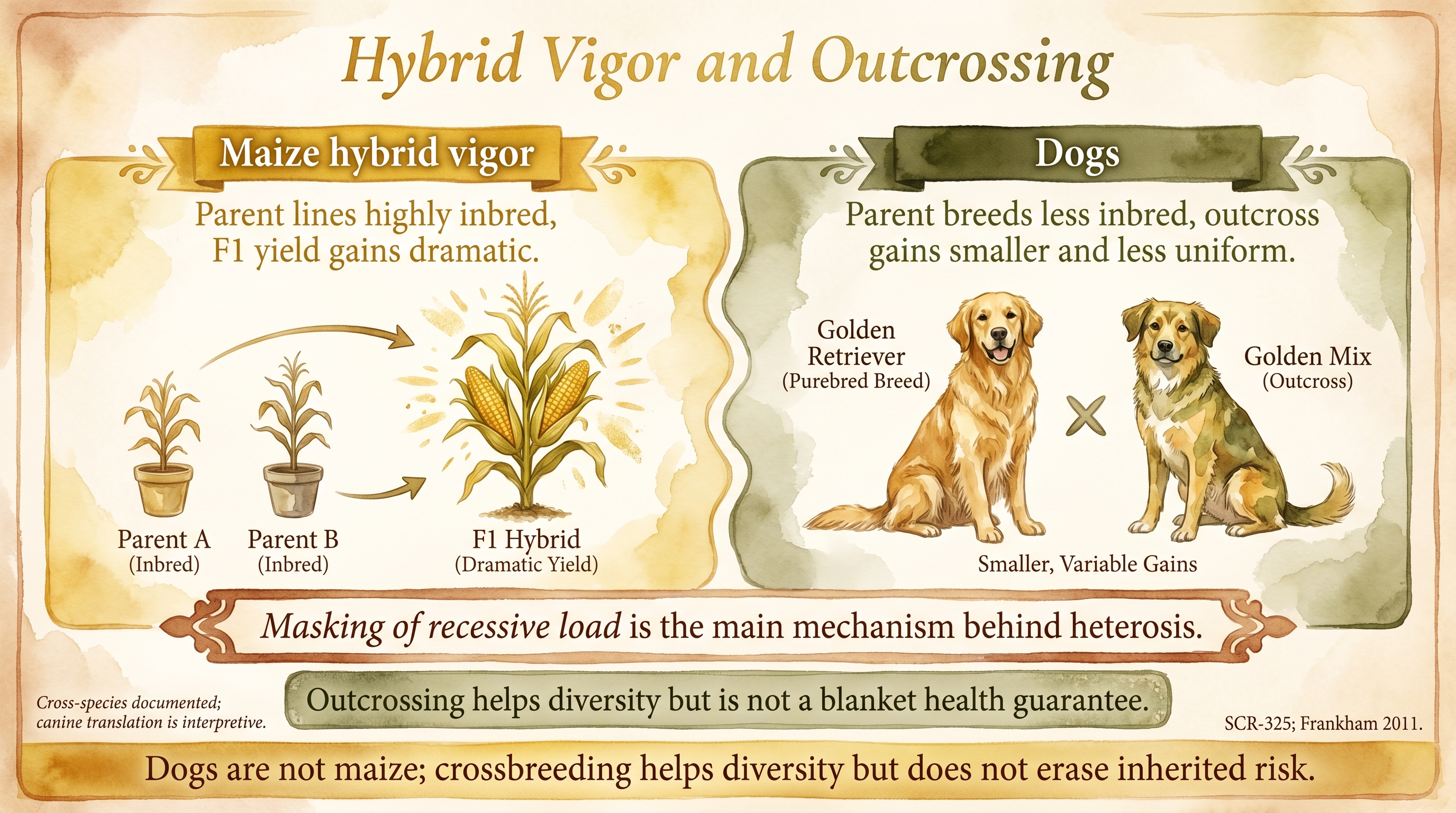
Dogs are not maize; crossbreeding helps diversity but does not erase inherited risk.
Key Takeaways
- Hybrid vigor is a real population-genetics concept, not a marketing myth, but it applies at the level of probabilities rather than guarantees.
- Crossing can reduce expression of some breed-specific recessive diseases by restoring heterozygosity at specific loci.
- A crossbred puppy still inherits the combined health landscape of both parent breeds, including polygenic risks.
- Heterosis effects are strongest in F1 offspring and erode in later generations of crossbreeding programs.
- Outcrossing is a diversity tool that still requires the same rigor, testing, and honesty as any other breeding decision.
The Evidence
This entry uses mixed-evidence claim-level tags beyond the dedicated EvidenceBlocks below. These tags mark claims that combine documented findings with observed practice, heuristic application, or unresolved gaps.
- Agricultural and conservation genetics literaturemultiple species
Hybrid vigor is a documented phenomenon in which offspring from genetically divergent parents can show improved fitness through masking of deleterious recessives and restoration of heterozygosity. - Canine diversity literaturedogs
In dogs, crossbreeding can reduce expression of some breed-specific recessive conditions when the second parent population carries those alleles at different frequencies. - Quantitative-genetics heterosis literaturegeneral genetics
Heterosis is typically strongest in the first filial generation and erodes in subsequent generations as recombination reassorts parental alleles.
- Canine inherited-disease and breed-risk literaturedogs
Crossbred dogs may avoid some recessive pairings, but they still inherit the combined disease-risk architecture of both parent populations, making blanket health guarantees scientifically unjustified.
No randomized long-term study has directly compared health outcomes across lifespan between F1 crosses of specific breed pairs and well-bred purebreds from both parent breeds, controlling for environmental and screening variables.
SCR References
Sources
- Frankham R., Bradshaw C.J.A., & Brook B.W. (2011). Predicting the probability of outbreeding depression. Conservation Biology, 25(3), 465-475. doi:10.1111/j.1523-1739.2011.01662.x
- Frankham R., Bradshaw C.J.A., & Brook B.W. (2014). Genetics in conservation management: revised recommendations for the 50/500 rules, Red List criteria and population viability analyses. Biological Conservation, 170, 56-63. doi:10.1016/j.biocon.2013.12.012
- Windig J.J. & Doekes H.P. (2018). Limits to genetic rescue by outcross in pedigree dogs. Journal of Animal Breeding and Genetics, 135(3), 238-248. doi:10.1111/jbg.12330
- Nicholas F.W. (2016). Hybrid vigour in dogs. The Veterinary Journal, 207, 1-2.
- Melis C., Castelli M., Scandura M., Scaltritti E., Pietrasanta A., & Mattiello S. (2022). Genetic Rescue of the Highly Inbred Norwegian Lundehund. Genes, 13(1), 163. doi:10.3390/genes13010163
- Charlesworth D. & Willis J.H. (2009). The genetics of inbreeding depression. Nature Reviews Genetics, 10(11), 783-796. doi:10.1038/nrg2664