Genetic Drift in Closed Dog Populations
Genetic drift is what happens when chance keeps changing allele frequencies generation after generation simply because populations are finite. In dog breeds, drift matters because closed populations do not preserve themselves automatically. Even without a dramatic disease event or a strong selection decision, alleles can still be lost, fixed, or distorted by the mathematics of sampling alone, and the cumulative effect across many generations can reshape a breed's gene pool in ways no single breeder ever consciously decided. Documented
What It Means
The core idea
Every generation is a genetic sample of the one before it. Each puppy inherits half its genome from its sire and half from its dam, and which specific alleles get passed on at each locus is partly determined by meiotic chance. Documented If the population were infinite, sampling noise at one locus would be averaged out across many parallel meioses in many individuals, and allele frequencies would remain stable from one generation to the next in the absence of selection. But real populations are finite, so chance matters, and the smaller the population the more the chance-driven fluctuations can accumulate into meaningful allele-frequency changes.
That chance-driven fluctuation in allele frequencies is genetic drift. It is one of the four classical forces of evolution in the Wright and Fisher framework, alongside mutation, migration, and selection. Unlike the others, drift does not have a direction. It is pure sampling noise, and it operates continuously as long as a population is finite and reproducing.
Why drift is strongest in small populations
Drift is strongest in smaller effective populations, and this is where the concept connects directly to everything else in the category. If relatively few dogs are doing most of the breeding, the next generation is carrying only a narrow sample of the previous generation's variation. Some alleles become more common by luck because the dogs that happened to carry them were the ones who happened to reproduce heavily. Others become rarer because their carriers reproduced less. Some disappear entirely because no carrier ended up in the breeding pool at all in a given generation.
A useful mental image is a bag of colored marbles. If you have a bag of ten thousand marbles in ten colors and you randomly grab a hundred to build the next generation, the color proportions in your sample will be roughly similar to the bag as a whole. If you only grab ten marbles, the sample proportions will deviate much more from the bag proportions just by luck, and rare colors have a meaningful chance of not being in your sample at all. Real breeding populations are closer to the small-sample case than to the large-sample one, especially when popular-sire dynamics concentrate reproduction in a narrow subset of available dogs.
Drift is not selection
This is not selection. Selection is directional. Selection favors a trait or genotype because it improves reproductive success under the chosen breeding regime or environment, and over generations it pushes allele frequencies in a consistent direction toward the favored outcome. Drift is blind. It does not care whether an allele is useful, neutral, or unhelpful. It changes frequencies because finite populations cannot sample all possibilities evenly.
Distinguishing drift from selection matters because the two forces produce similar-looking outcomes in the short run but require very different management. A rising allele frequency could be the result of selection (meaning the allele is being favored) or of drift (meaning it happened to get lucky). If breeders assume every frequency change reflects selection, they will misattribute random outcomes to their own breeding choices and will convince themselves their decisions are driving changes they did not cause. If they assume every change is drift, they will miss real selection pressures they are applying without noticing. Both mistakes are common, and honest population management requires being able to recognize when each force is doing the work.
Drift and selection also interact. In small populations, drift can overwhelm weak selection pressures. An allele that is mildly advantageous in a large population may still be lost to drift in a small one because the random sampling variation exceeds the selective advantage. This is one of the reasons small closed populations are harder to improve through selection alone than the simple narrow-sense heritability formulas would suggest. The math assumes large-population conditions that closed dog breeds rarely satisfy.
How drift actually operates in closed breeds
Closed dog breeds are particularly vulnerable to drift because several reinforcing conditions are already in place. The breeding pool is finite and often smaller in effective terms than the census count suggests. The population is reproductively structured rather than random, with popular sires and line concentration adding further unevenness to reproductive contribution. Outside gene flow is limited or absent because the studbook is closed, so no new alleles are entering the pool to counterbalance the ones being lost. Some dogs contribute much more than others across their reproductive lives, which amplifies sampling variance at the level of whose alleles actually reach the next generation. Documented
That combination means drift is always running in the background of every closed breed. Even in years when breeders believe they are "just maintaining the breed" without making any dramatic changes, the gene pool is still changing because drift does not stop just because no one is making deliberate decisions. The changes may be small in any one year but they compound across generations, and breed-level diversity can drift downward over decades even if every individual breeder in every individual year was trying to keep things stable.
Rare-allele loss and neutral fixation
One of drift's most important effects is rare-allele loss. Rare variants are the easiest to lose by chance because they are already present at low frequencies, and losing a few carriers in any given generation can eliminate them from the pool entirely. Once lost in a closed population, they do not simply reappear when someone later realizes they would have been useful. Mutation is far too slow to recreate them on a breeder-relevant timescale, and migration is blocked by the closed studbook.
This matters for breed health because rare alleles are sometimes the ones that do important biological work. Not every rare allele is junk. Some are components of complex pathways that have simply never become common because they were one option among many in the ancestral population. When drift eliminates them from a closed breed, the breed permanently loses whatever contribution those alleles were making, and nobody can tell in advance which losses will matter and which will not. The precautionary lesson is to slow rare-allele loss in general rather than to try to identify specific alleles worth preserving after the fact.
Drift can also fix neutral alleles for no good reason other than luck, meaning that one version of the allele reaches 100 percent frequency while all alternatives are lost. Documented That is part of why breed populations can become surprisingly homogeneous in certain genomic regions even when nobody deliberately selected those specific regions. Dense genomic marker data across breeds often reveals long stretches of fixed homozygosity that have no obvious adaptive explanation; those stretches are usually the fingerprint of drift rather than selection, and they represent diversity the breed has already lost without anyone having decided to lose it.
Drift, Ne, and breeder management
This is also why effective population size matters so much to drift. Ne is the denominator that helps predict how strong drift will be, and the relationship is simple and directional: smaller Ne means stronger drift, larger Ne buffers drift more effectively. A breed with an Ne of 50 is losing diversity to drift many times faster than one with an Ne of 500, and the rate at which rare alleles disappear follows the same pattern.
That link between Ne and drift is what makes the Ne estimates in the canine literature so concerning. A breed with a population-genetics Ne below 100 is not just an abstract statistic. It is a breed in which drift is actively running hard against diversity preservation every generation, and the direction of travel is toward further narrowing unless the breeding community does something to counteract it. The something is usually not heroic. It is broader sire use, more careful mate selection, resistance to popular-sire dynamics, and deliberate rotation across less-related lines. None of those moves feel dramatic in any single litter, but compounded across generations they are the only way a closed breed can slow the rate at which drift keeps removing options from the pool.
Breeders sometimes imagine the threat to diversity comes only from bad decisions. Drift shows why that framing is incomplete. Doing nothing is not neutral in a finite population. In a closed population, doing nothing still means generations pass, rare alleles are sampled unevenly, and the gene pool changes. Passive management is not the same as preservation; it is a slow form of loss that looks stable in any one year and compounds invisibly across decades.
Why It Matters for Your Dog
What This Cannot Predict
Drift does not tell you which exact allele will be lost next. It is a statistical phenomenon, not a predictive one at the level of specific variants. You can know that a closed population with low Ne is losing diversity to drift without being able to forecast which particular alleles are next on the list.
It does not mean every breed change is random, because selection and drift often operate at the same time in the same population. A rising allele frequency may be driven by selection, drift, or some combination of both, and distinguishing them usually requires statistical tools applied to substantial datasets.
And it does not make breeders powerless. Drift is always present, but its strength can be moderated by broader sire use, line diversity, avoidance of popular-sire concentration, and more thoughtful population management. A breeder who actively resists drift cannot stop it entirely but can meaningfully slow it down, and that slowdown is real even though it is measured across generations rather than within any single litter.
The correct lesson is not fatalism. It is vigilance about how a closed population actually behaves when nobody is watching.
Families rarely hear the word drift, but they do see its consequences in the long run without having a label for what they are noticing. Narrowing pedigree variety, the repeat appearance of the same ancestor names across many programs, shrinking room for flexible breeding decisions, and increasing difficulty preserving diversity while also managing disease are all downstream effects of drift operating in a closed population over decades. Documented
Drift explains why good breeders talk about preserving options. Once a breed loses too many alleles, later decisions become harder because the menu of possible matings is smaller and the structural concentration is higher. The breeder may still produce nice dogs, and individual puppies may still be excellent, but the population has less room to maneuver when new disease challenges or diversity questions arise. Documented The loss is not always visible in any one generation. It is visible in what becomes increasingly difficult to do across many generations.
The practical family takeaway is to prefer breeders who think about their program as part of a population rather than as a standalone unit. A breeder who can discuss how their mate choices are affecting line contribution, how they think about avoiding concentration, and how they relate their program to the broader breed gene pool is engaged with drift whether they use the word or not. A breeder who treats each litter as isolated and never mentions the population context is letting drift run unchecked in their program, even if every individual pairing looks reasonable.
For JB, that matters because stewardship is active, not passive. The population does not hold steady on its own. If a breeder wants the next generation to retain resilience, they have to work against drift by widening contribution where possible and resisting needless concentration. The Five Pillars operate on the developmental and relational layer of a good dog, but they cannot do their work if the biological substrate has been allowed to narrow too far through passive drift. Active population stewardship is part of what keeps the substrate available for the raising program to shape.
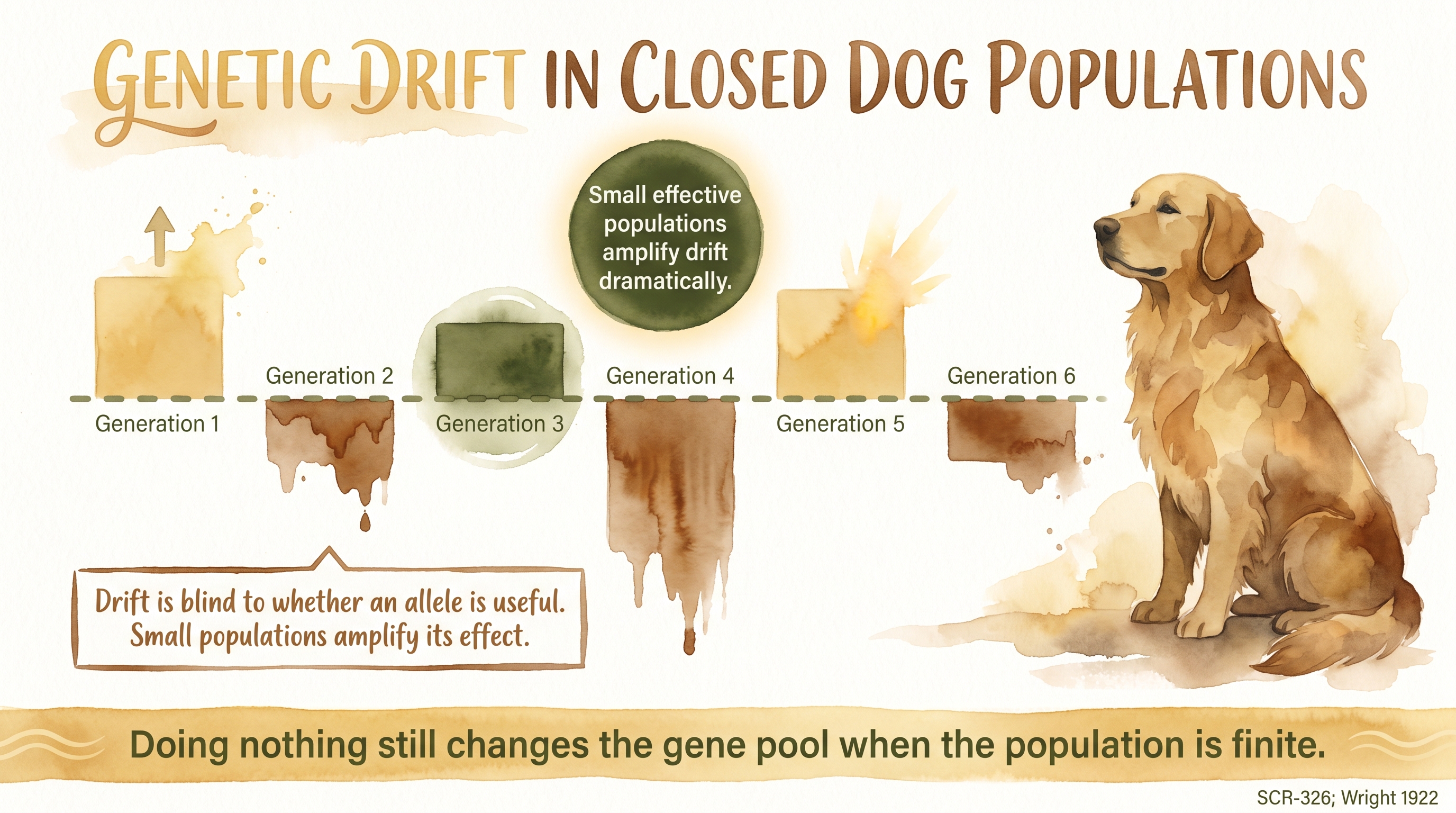
Doing nothing still changes the gene pool when the population is finite.
Key Takeaways
- Genetic drift is random allele-frequency change caused by finite population size, not purposeful selection.
- Drift is stronger when effective population size is small, which is common in closed dog breeds.
- Rare alleles are especially vulnerable to being lost by drift and cannot be recovered easily in closed populations.
- Doing nothing does not preserve a breed gene pool; drift keeps changing it unless breeders actively manage diversity.
- Drift and selection can operate simultaneously, which is why attributing every frequency change to breeder intent overstates how much control any one program has.
The Evidence
- Population-genetics frameworkgeneral population genetics
Genetic drift is the random change in allele frequencies caused by finite population sampling from one generation to the next. - Canine diversity literaturedogs
Closed dog populations are structurally vulnerable to drift because their effective population sizes are limited and gene flow is restricted. - Canine demographic studiesdogs
As effective population size declines, rare alleles are lost more quickly and the breed gene pool narrows even in the absence of a dramatic selection event.
- Population-genetics interpretation literaturegeneral population genetics and dogs
Selection drives directional change at favored loci, while drift changes allele frequencies randomly; both can operate simultaneously in dog breeds. - Canine genomic homozygosity literaturedogs
Long stretches of fixed homozygosity in closed breeds often reflect drift rather than selection, representing diversity losses that occurred without deliberate intent.
No controlled comparison study has directly measured how much allele loss in a specific dog breed is attributable to drift versus active selection by quantifying both forces simultaneously across known generations.
SCR References
Sources
- Wright S. (1922). Coefficients of Inbreeding and Relationship. The American Naturalist, 56(645), 330-338. doi:10.1086/279872
- Calboli F.C.F., Sampson J., Fretwell N., & Balding D.J. (2008). Population structure and inbreeding from pedigree analysis of purebred dogs. Genetics, 179(1), 593-601. doi:10.1534/genetics.107.084954
- Dreger D.L., Rimbault M., Davis B.W., Bhatnagar A., Parker H.G., & Ostrander E.A. (2016). Whole-genome sequence, SNP chips and pedigree structure: building demographic profiles in domestic dog breeds to optimize genetic-trait mapping. Disease Models & Mechanisms, 9(12), 1445-1460. doi:10.1242/dmm.027037
- Leroy G. (2011). Genetic diversity, inbreeding and breeding practices in dogs: Results from pedigree analyses. The Veterinary Journal, 189(2), 177-182. doi:10.1016/j.tvjl.2011.06.016
- Pfahler S., Distl O., & ARCA Members. (2015). Effective Population Size, Extended Linkage Disequilibrium and Runs of Homozygosity in the Norwegian Lundehund. PLoS ONE, 10(4), e0122680. doi:10.1371/journal.pone.0122680
- Frankham R., Bradshaw C.J.A., & Brook B.W. (2014). Genetics in conservation management: revised recommendations for the 50/500 rules, Red List criteria and population viability analyses. Biological Conservation, 170, 56-63. doi:10.1016/j.biocon.2013.12.012