Founder Effects in Dog Breed Formation
Every modern pure breed begins with a mathematical limitation: the founding population was small. That starting narrowness matters because it sets the first ceiling on how much variation the breed can carry forward. Founder effects are not a side issue in dog breeding. They are part of the structural origin story of every closed breed population, and their fingerprints are still visible in the disease landscape and diversity architecture of modern breeds decades or centuries after the founding event itself. Documented
What It Means
The core mechanism
A founder effect happens when a new population is established by a relatively small number of individuals. The new population carries only the alleles those founders happened to bring with them. Anything absent at the start is absent unless later introduced from outside.
That sentence is doing a lot of work and it deserves unpacking. Imagine the full ancestral population that existed before a breed was split off. That population contained some allele pool at every locus across its genome. The ancestral pool had common alleles, rare alleles, and extremely rare alleles that only a few individuals carried. When a new population is created from a small founder group, the founders bring a sample of that allele pool with them. Sampling is not neutral when the sample is small. By chance alone, some variants are overrepresented, some are underrepresented, and some are lost before the breed even fully stabilizes. Rare alleles are particularly vulnerable to loss because any given rare allele might simply not be present in the dozen or so founders who built the breed, and once it is gone from a closed population there is no mechanism to recover it except mutation, which operates far too slowly to matter on breeder timescales.
That is the essence of a founder effect. A new population is not a faithful miniature of the ancestral population. It is a biased sample, and the bias becomes permanent the moment the studbook closes.
How dog breeds were actually assembled
Modern dog breeds were built exactly this way. A breed does not arise from an unlimited, randomly mating canine population. It is assembled through repeated breeding of a relatively small founder group that matched the type early breeders wanted to preserve. Once the breed closes, that starting snapshot becomes the long-term genetic base. Every puppy born into the breed from that point forward is drawing from the founder allele pool filtered through whatever selection, drift, and reproductive skew have operated in the intervening generations. Documented
The founding narrative varies across breeds. Some breeds emerged from a deliberate and well-documented project involving a handful of named dogs. Documented Others coalesced more gradually from regional types before being formalized into registries. Still others were rebuilt after historical disruptions like the world wars, which produced secondary bottlenecks on top of the original founding. But the structural pattern is consistent: a relatively small founder group, a type standard, and a closed or near-closed studbook that prevents genetic input from outside. That formula is what makes a breed a breed in the modern kennel-club sense, and it is what makes founder effects universal across the purebred world.
Golden Retrievers provide a useful illustrative case. The historical record is unusually rich, and the origin story is often retold as a point of pride. But from a population-genetics perspective, the most important fact is not the romance of the narrative. It is the limited number of dogs contributing to the new breed. A small set of early dogs provided the initial allele pool from which later generations were built, and a few particularly influential individuals contributed disproportionately to that pool because of how frequently they or their immediate descendants were used. Documented That kind of early skew is common across breed histories and is one of the primary mechanisms by which certain alleles become breed-defining features while others are silently lost.
Founder effects and disease landscapes
This is why founder effects are such a powerful explanation for breed-specific disease landscapes. The condition does not have to arise from a modern breeder "causing" a mutation. Sometimes the mutation was already present in the early population and simply became enriched through descent, line concentration, and time.
If a recessive disease allele was present in a founder and that founder became highly influential, the allele could spread widely even if it was initially rare. A few generations later, what started as a variant carried by one dog may appear in carrier form across a meaningful percentage of the breed. Documented Modern carrier testing then reveals a pattern that looks like a disease "in the breed" even though the variant was functionally present from the beginning. This is not a failure of modern breeders. It is the founder event still casting its shadow decades or centuries later.
The reverse pattern matters just as much. If useful protective variation was absent in the founder group, later breeders cannot recover it from inside the closed population. A variant that confers resistance to some disease pressure, or that buffers an important developmental pathway, or that contributes to longevity in ways nobody has yet mapped, simply will not exist in the breed if it was not carried by the founders. The founder set therefore defines both what the breed has and what it lacks, and the "what it lacks" column is often harder to think about because you cannot see the variants that never made it into the gene pool in the first place.
Why founder effects are stubborn
Founder effects also help explain why some breed problems are stubborn even under conscientious management. Once the breed starts from a narrow base, every later diversity decision is happening inside a population that already carries historical constraints. Breeders are not working with infinite options. They are working inside a gene pool that was bounded long before they arrived, and within that bounded pool they can only reshuffle the allele frequencies that already exist. They cannot conjure variation that was never there.
This is why purely internal breeding strategies can only go so far in reversing founder-era narrowness. Careful mate selection, popular-sire restraint, and rotation across less-used lines can slow the rate at which diversity is lost and can even modestly rebalance which founder contributions dominate. But none of those techniques creates new alleles. The only processes that do are mutation, which is far too slow on breeder timescales, and migration, which in closed breeds is blocked by definition unless the registry opens the studbook for a specific approved outcross. That is why serious long-term breed-recovery programs sometimes involve carefully managed outcrossing to related breeds or to landrace populations that share ancestral variation the founder population happened to lose. Those programs are rare, controversial, and always politically difficult, but they exist precisely because the founder-effect problem cannot always be solved from inside the original gene pool alone.
A structural problem, not a moral one
That does not mean breed formation was a mistake. It means breed formation has consequences. The moment a type becomes a closed or mostly closed population, population genetics begins exerting long-term pressure on the future health landscape. Understanding that pressure is the first step toward managing it honestly rather than either panicking about it or pretending it does not exist.
It also reframes the common conversation about purebred dog health. The pattern is not that "modern breeders ruined a once-healthy breed." In many cases, the disease alleles were present at founding and simply became more visible as the breed concentrated and as diagnostic tools improved. The pattern is also not that "nothing is anyone's fault and we should stop worrying." Modern breeding decisions still matter enormously for whether founder-era constraints get worse or slowly improve over generations. Both framings miss the structural reality, which is that founder effects set the starting conditions and every subsequent generation either compounds or counteracts them.
Why It Matters for Your Dog
What This Cannot Predict
Founder effects do not mean every founder was unhealthy. Most of them were, by definition, the dogs that early breeders considered worth propagating, and many of them were excellent animals for the roles the breed was being developed to fill. The constraint is about diversity, not about individual quality.
They do not mean every modern disease problem can be blamed on one historical dog. Disease landscapes emerge from many alleles at many loci combined with many subsequent generations of breeding decisions. Tracing one condition back to "the founder that caused it" is usually an oversimplification.
They do not mean modern breeders are personally at fault for the fact that closed breeds began from narrow ancestral pools. Founder effects predate any living breeder and are a property of how breeds form rather than of how individual programs run.
And they do not mean the breed is doomed. Founder effects are a starting condition, not a prognosis. What the breed does with that starting condition depends on the decisions made by many breeders across many generations, and those decisions can slow, neutralize, or in some cases partially reverse the worst of the founder-era narrowing.
The point is structural, not moral. Founder effects explain why variation is limited and why some disease alleles can become disproportionately influential over time. They are a property of how breeds form, not a verdict on one breeder's motives.
Families often think of inherited disease as something a breeder either prevented or failed to prevent in the immediate pairing. Observed-JB Founder effects widen that frame considerably. Some risk patterns exist because the breed as a whole began from a narrow pool and has been carrying those historical constraints ever since. No individual breeder can erase that history by themselves. What individual breeders can do is manage the current gene pool responsibly so that the founder-era constraints are not made worse by modern decisions.
That matters for breeder evaluation because it rewards humility. A thoughtful breeder understands that responsible breeding is not just about avoiding obvious mistakes in the present. It is also about managing the legacy of a population that started narrow and stayed closed. A breeder who speaks fluently about where their lines sit inside the broader breed history, which founder contributions are over-represented in their program, and how they think about diversity over decade timescales is engaging with the actual problem. A breeder who treats each litter as an isolated event disconnected from the breed's history is missing the frame.
For families, the practical filter is whether the breeder understands that they inherited a gene pool rather than created one, and whether their decisions reflect stewardship of that inheritance. You are not looking for a breeder who claims to have solved founder effects. You are looking for one who knows they exist and is thinking about them honestly.
For JB specifically, this matters because health stewardship has to be historically literate. The Golden Retriever did not emerge from a limitless background population. It emerged from a founder event and later breed consolidation, and those events continue to shape the disease and diversity landscape the breed is working inside today. That means diversity preservation now is partly a response to a structural narrowing that was baked in at the start, and it means that the long arc of breed health requires understanding that the past is still exerting pressure on the present rather than pretending the slate was clean when each modern breeder arrived.
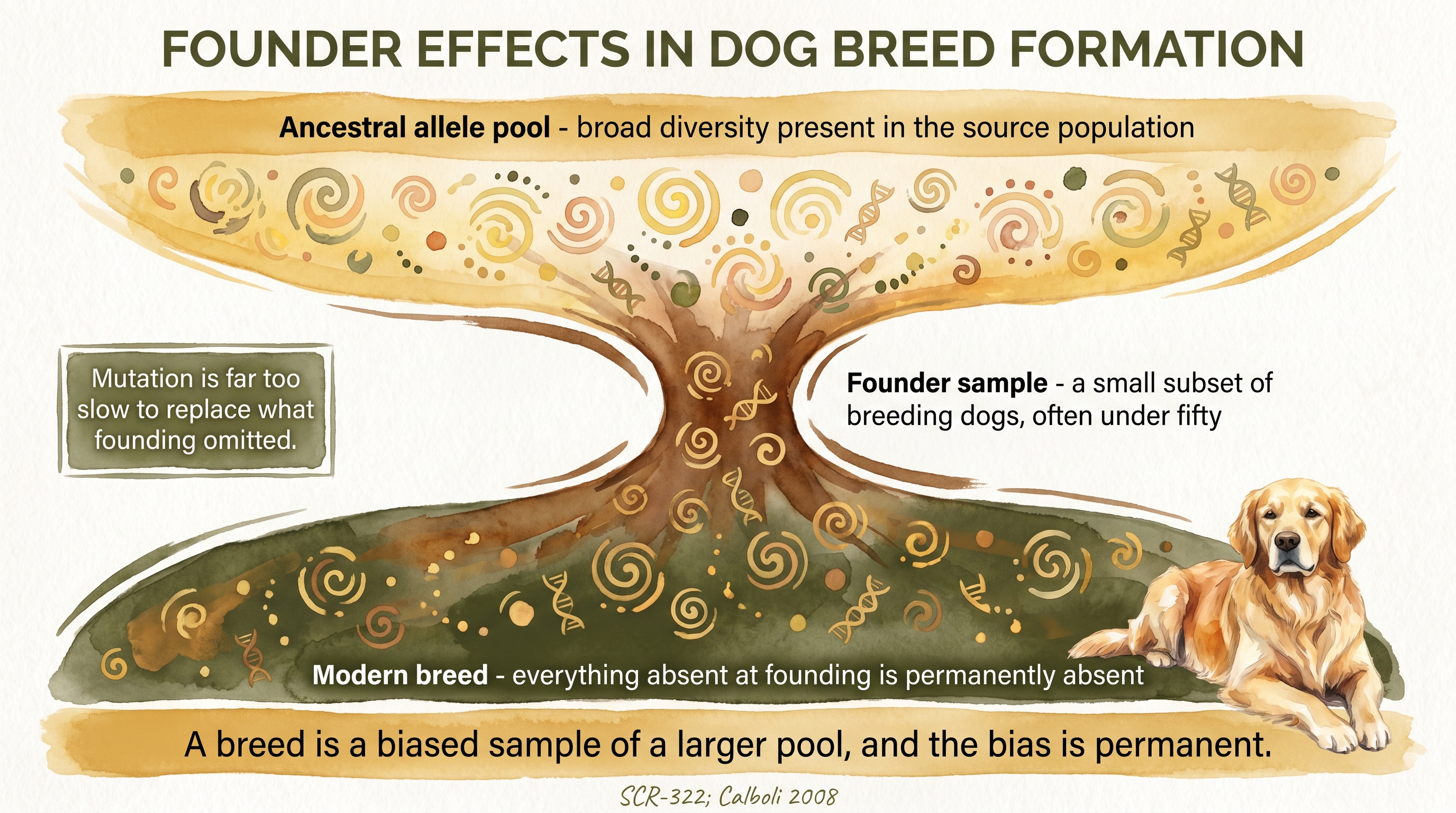
A breed is a biased sample of a larger pool, and the bias is permanent.
Key Takeaways
- Founder effects happen when a breed starts from a small founding population rather than the full variation of a larger ancestral population.
- That starting narrowness permanently shapes what alleles the breed carries and what variation it lacks.
- Founder effects help explain why some inherited-disease risks become concentrated within a breed over time.
- Founder effects are a structural feature of breed formation, not a simple moral failure by modern breeders.
- Current breeders cannot erase founder history, but their decisions determine whether its constraints are compounded or slowly counteracted.
The Evidence
This entry uses observed claim-level tags beyond the dedicated EvidenceBlocks below. These tags mark JB program observation or practice-derived claims that need dedicated EvidenceBlock coverage in a later content pass.
- Population-genetics frameworkgeneral population genetics
Founder effects occur when a new population is established by a small number of individuals, causing immediate loss and distortion of genetic variation relative to the ancestral population. - Canine breed-history literaturedogs
Modern pure breeds were created from limited founder groups and later closed through selective breeding, making founder effects a structural feature of breed formation. - Golden Retriever historical and diversity sourcesGolden Retrievers
The Golden Retriever originated from a finite set of early dogs, meaning the initial breed population could transmit only the variation present in that founder group.
- Canine inherited-disease and diversity literaturedogs
Founder effects can enrich recessive disease alleles and permanently constrain available diversity unless outside variation is later introduced. - Closed-population genetics literaturedogs and livestock
In closed breed populations, variation not present in the founder group cannot be recovered through mutation alone on any breeder-relevant timescale.
No prospective study has measured how much of a breed's current disease variation could be traced to specific founder contributions versus later drift and selection, which would quantify the relative responsibility of founder-era narrowness versus modern breeding decisions.
SCR References
Sources
- Calboli F.C.F., Sampson J., Fretwell N., & Balding D.J. (2008). Population structure and inbreeding from pedigree analysis of purebred dogs. Genetics, 179(1), 593-601. doi:10.1534/genetics.107.084954
- Dreger D.L., Rimbault M., Davis B.W., Bhatnagar A., Parker H.G., & Ostrander E.A. (2016). Whole-genome sequence, SNP chips and pedigree structure: building demographic profiles in domestic dog breeds to optimize genetic-trait mapping. Disease Models & Mechanisms, 9(12), 1445-1460. doi:10.1242/dmm.027037
- Leroy G. (2011). Genetic diversity, inbreeding and breeding practices in dogs: Results from pedigree analyses. The Veterinary Journal, 189(2), 177-182. doi:10.1016/j.tvjl.2011.06.016
- Wijnrocx K., Bekaert M., Georges M., & Leroy G. (2016). Half of 23 Belgian dog breeds has a compromised genetic diversity, as revealed by genealogical and molecular data analysis. Journal of Animal Breeding and Genetics, 133(5), 375-383. doi:10.1111/jbg.12203
- Pfahler S., Distl O., & ARCA Members. (2015). Effective Population Size, Extended Linkage Disequilibrium and Runs of Homozygosity in the Norwegian Lundehund. PLoS ONE, 10(4), e0122680. doi:10.1371/journal.pone.0122680
- Ontiveros E.S., Hughes S., Penedo M.C.T., Grahn R.A., & Stern J.A. (2019). Genetic heterogeneity and diversity of North American golden retrievers using a low density STR marker panel. PLoS ONE, 14(2), e0212171. doi:10.1371/journal.pone.0212171