Genetic Bottlenecks in Dog Breed History
A founder effect describes how a breed begins. A bottleneck describes what happens when a population shrinks sharply and later rebuilds from the survivors. Dog breeds often experience both, and sometimes more than once. That matters because every contraction strips away alleles, increases relatedness, and narrows the set of genetic options available for the future. The modern gene pool of any long-established breed is the cumulative record of every bottleneck the breed has passed through, whether those contractions were driven by war, fashion, disease, registry closure, or simple demographic accident. Documented
What It Means
Bottleneck as a distinct mechanism
A genetic bottleneck occurs when a population goes through a major reduction in numbers and then expands again from the reduced set of survivors. The critical point is not merely that the population got smaller. It is that the later population descends from a narrowed subset of the earlier one. Whatever variation was present in the dogs that did not contribute to the recovery is gone from the gene pool, and unless it is reintroduced from outside, it stays gone. Documented
That distinction matters because it separates bottlenecks from two neighboring concepts that are often confused with them. A founder effect describes the narrowness of a population when it is first created. A bottleneck describes the narrowness introduced when an existing population contracts and recovers. Drift describes the continuous random allele-frequency changes that keep happening inside a small population afterward. All three mechanisms narrow diversity, but they operate at different stages and through different processes. Understanding which one is doing the work in a particular breed's history is essential for interpreting its modern disease landscape honestly.
Many breeds have more than one narrowing event in their history. The founder effect is the first narrowing. Later wars, registry closures, line fads, regional crashes, or heavy concentration on particular ancestors can create additional bottlenecks layered on top of that founding event. Each new bottleneck starts from the already-reduced pool left behind by the previous one, which is why the effects compound across generations rather than simply adding linearly.
What a bottleneck actually does to the gene pool
Each bottleneck removes diversity through two linked processes. Documented First, some alleles disappear permanently because none of the survivors happened to carry them. A rare allele present in only a small percentage of the pre-contraction population has a meaningful chance of not making it through a sharp numerical reduction simply because the dogs carrying it were not among the breeders who produced the next generation. Once lost, the allele does not come back on any breeder-relevant timescale because mutation is far too slow. Second, the alleles that do survive become more common in relative terms, not because they were selected for anything, but because the baseline has shrunk. Every surviving variant occupies a larger share of a smaller pool.
The rebuilt population may look numerically healthy years later, sometimes with tens of thousands of registered dogs worldwide. But genetically it is carrying the memory of that contraction in its allele frequencies, in the length of its linkage-disequilibrium blocks, and in the distribution of its runs of homozygosity across the genome. Dense genomic marker data can actually recover the timing and severity of historical bottlenecks by reading those patterns in modern dogs' DNA, which is how much of the canine bottleneck literature has been reconstructed from living samples rather than from historical records alone.
Real canine examples
Dog-breed history is full of these episodes. European breeds were heavily disrupted during the world wars, when food scarcity, blockade conditions, and the collapse of breeding infrastructure caused sharp reductions in working breed populations. Some breeds came close to disappearing and were later rebuilt from a handful of remaining dogs, which constitutes a textbook bottleneck on top of whatever founder effects existed from the breed's original formation. Other breeds did not experience such dramatic crashes but were still shaped by less visible contractions like regional epidemics, the collapse of the working contexts that had sustained them, or the retirement and dispersal of influential kennels.
Registry closures and the codification of breed standards in the late nineteenth and early twentieth centuries created another layer of contraction for many breeds. The moment a studbook closes, the breed's effective pool is capped at whatever variation existed in the dogs registered on or before that date. Any additional variation sitting in unregistered relatives of the breed is structurally cut off from contributing. That is not quite the same as a classical bottleneck, but it produces similar downstream effects because it permanently reduces the pool available for future mating decisions.
Some working populations were also split from show populations over time, reducing interbreeding and effectively creating separate internal subpopulations within the same nominal breed. Documented This split behaves bottleneck-like because each subpopulation then draws from a narrower slice of the original pool for its own subsequent breeding decisions, and the two sides can drift apart faster than they would if they still shared breeding stock freely.
Goldens specifically
Golden Retrievers are not usually described as a dramatic near-extinction breed, and that absence of crisis narrative can obscure the fact that the breed is still a product of bottleneck logic. The breed passed through historical phases in which relatively narrow groups of dogs disproportionately shaped later generations. The modern split between performance-oriented and show-oriented lines is not itself two separate breeds, but it does create internal structure that can behave bottleneck-like by limiting how often certain segments of the population exchange diversity. Field lines and conformation lines draw from partially overlapping but not identical subsets of the breed's gene pool, and within each subset the effective pool is smaller than the breed as a whole.
Repeated bottlenecks are especially important because their effects compound rather than simply averaging out. One bottleneck reduces variation. A later bottleneck does not start from the original broad population. It starts from the already-narrowed set produced by the earlier contraction, and it removes additional variation from that reduced starting point. That is why long-established breeds can lose surprising amounts of diversity over time even without a single catastrophic crash. Several modest contractions layered across a century can produce a gene pool that is substantially narrower than any one event would have suggested.
Why bottlenecks matter for disease
Bottlenecks also help explain why recessive disease alleles sometimes seem to appear "out of nowhere" in a breed. In reality, the allele may have been present quietly for many generations without becoming clinically visible because carriers were rarely being bred to carriers. A narrowed breeding pool or concentrated lineage can increase the chance that carriers meet each other more often, producing affected puppies at rates the breed did not experience before. Observed-JB The mutation is not new. What is new is the population structure that makes homozygosity more likely at that locus.
This pattern has played out repeatedly in the canine disease literature. A recessive condition is identified as breed-specific, the causal variant is mapped, and retrospective testing shows that the variant was present in widely used ancestors many generations back. The disease did not "arrive"; it became visible because drift, popular-sire dynamics, and post-bottleneck concentration had increased the local allele frequency enough to start producing affected homozygotes at a rate that veterinarians could notice.
Bottleneck versus drift
This is also where bottlenecks differ from drift, which is a concept they are often conflated with. Bottlenecks are discrete contractions. They happen over a short number of generations relative to the breed's history and they produce a step change in the gene pool. Documented Drift, by contrast, is the continuous random change that keeps happening in the smaller population afterward. A bottleneck creates the conditions. Drift keeps working on what remains, generation after generation, gradually reshaping allele frequencies even without any obvious selection pressure.
Both mechanisms matter and they interact. A breed that passes through a bottleneck and then maintains a small effective population size will continue to lose diversity through drift long after the original contraction has ended. A breed that passes through a bottleneck but then deliberately broadens its breeding base can slow the rate of diversity loss even though it cannot recover what the bottleneck itself removed. The starting point is fixed by history; the trajectory is still responsive to current choices.
Why It Matters for Your Dog
What This Cannot Predict
A bottleneck does not automatically tell you which specific disease will dominate a breed. Disease landscapes emerge from the interaction of many alleles, many breeding decisions, and environmental context. Knowing that a breed has been through a bottleneck tells you something about the shape of the gene pool, not about the identity of every variant inside it.
It does not mean every line inside the breed is equally narrow. Some lines retain more diversity than others because of deliberate mate choice, wider historical sourcing, or simply the accident of which founder contributions they descend from most heavily.
It does not mean current breeders have no room to improve the situation. Managing a post-bottleneck gene pool carefully is a very different activity from pretending the bottleneck never happened, and thoughtful management can genuinely slow further loss.
And it does not mean the breed is doomed. A bottleneck is a constraint, not a death sentence. Some breeds with dramatic historical contractions have remained clinically and behaviorally functional for many decades, although they tend to do so only when the breed community takes diversity management seriously.
The honest point is narrower and more useful: bottlenecks reduce the diversity available to work with. They change the long-term constraints under which breeders operate. They do not fully determine every later outcome, but they shape the probability landscape within which those outcomes will unfold.
Families usually encounter bottleneck consequences without knowing the term. They notice pedigrees clustering around the same names. They hear that a breed is common yet still has diversity concerns. They wonder why inherited disease management seems harder than "just remove the problem gene." Bottlenecks are part of that answer, and naming them explicitly helps make the rest of the conversation honest.
They are why modern breeders often have to balance competing goods. Reducing disease risk sometimes conflicts with preserving useful lines, because the lines being eliminated might be carrying variation the breed still needs. Documented Avoiding overuse of fashionable dogs sometimes conflicts with short-term ribbon chasing. Maintaining enough breadth for the next generation sometimes conflicts with the desire to concentrate on a particularly successful cross. None of those tensions dissolve just because the breeder wants them to. They are baked into the reality of managing a gene pool that has been narrowed by repeated historical contractions.
For families evaluating a breeder, the relevant question is not whether the breeder can recite bottleneck theory but whether their actual decisions show awareness of the trade-offs. A breeder who varies mate choice, tracks line contribution over time, avoids piling up on fashionable sires, and thinks seriously about the breed's long-term gene pool is doing the real work. A breeder who treats each litter as a one-off and never mentions the broader population is almost certainly contributing to the problem, even if any individual pairing looks fine on paper.
For JB specifically, this matters because responsible breeding is not just about immediate litter quality. It is also about understanding the inherited shape of the population and not pretending the present gene pool is broader than it is. Historical bottlenecks tell you what the breed has already lost. That helps define the stewardship task that remains. The goal is not to erase the past but to keep the present from making it worse, and to do so with honesty about how much the breed's current constraints were set long before any current breeder could have influenced them.
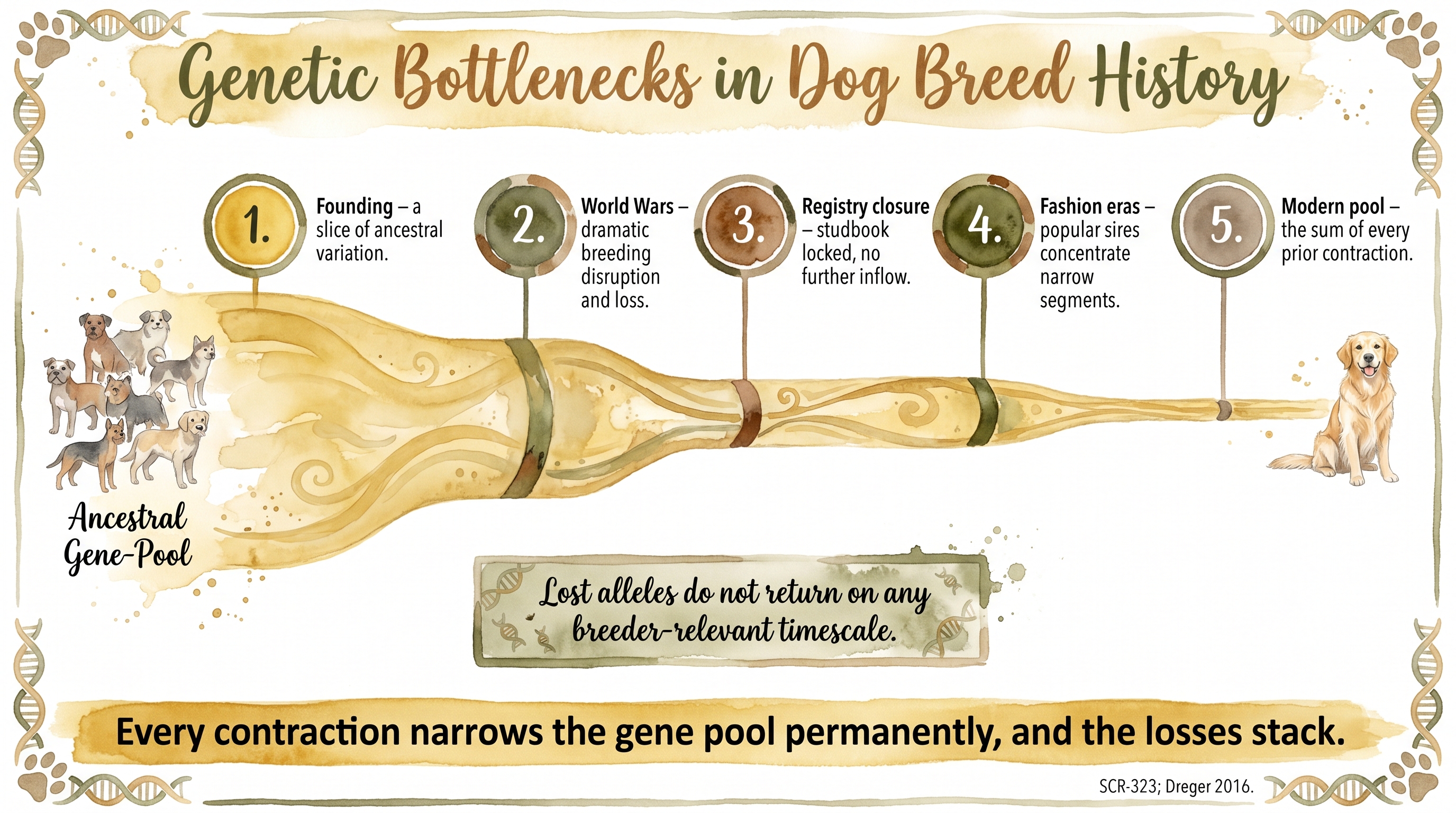
Every contraction narrows the gene pool permanently, and the losses stack.
Key Takeaways
- A bottleneck is a sharp population contraction followed by recovery from a reduced survivor pool.
- Dog breeds often experience multiple bottlenecks across their history, not just the original founder event.
- Each bottleneck removes diversity and increases the constraints later breeders must work within.
- Historical bottlenecks help explain why a popular breed can still have a surprisingly narrow genetic base.
- Bottlenecks set the starting conditions; current breeder decisions determine whether the gene pool narrows further or stabilizes.
The Evidence
This entry uses observed claim-level tags beyond the dedicated EvidenceBlocks below. These tags mark JB program observation or practice-derived claims that need dedicated EvidenceBlock coverage in a later content pass.
- Population-genetics frameworkgeneral population genetics
A bottleneck is a major contraction in population size followed by recovery from a reduced survivor pool, causing loss of alleles and increased relatedness. - Canine demographic and breed-history literaturedogs
Modern dog breeds commonly carry evidence of repeated bottlenecks produced by breed formation, historical disruptions, and narrow line concentration. - Golden Retriever diversity sourcesGolden Retrievers
Golden Retriever population structure reflects historical narrowing and later internal subdivision, even though the breed remained numerically popular.
- Canine diversity literaturedogs
Repeated bottlenecks accelerate rare-allele loss, increase homozygosity, and can expose recessive disease alleles more often as lineages rebuild from narrowed pools. - Canine genomic bottleneck-detection literaturedogs
Dense genomic marker data can reconstruct the timing and severity of historical bottlenecks from linkage-disequilibrium and runs-of-homozygosity patterns in modern dogs.
No study has quantified in any single dog breed how much of current homozygosity comes from the breed's founding bottleneck versus later drift, which would clarify how much of the diversity problem is historical versus contemporary.
SCR References
Sources
- Dreger D.L., Rimbault M., Davis B.W., Bhatnagar A., Parker H.G., & Ostrander E.A. (2016). Whole-genome sequence, SNP chips and pedigree structure: building demographic profiles in domestic dog breeds to optimize genetic-trait mapping. Disease Models & Mechanisms, 9(12), 1445-1460. doi:10.1242/dmm.027037
- Calboli F.C.F., Sampson J., Fretwell N., & Balding D.J. (2008). Population structure and inbreeding from pedigree analysis of purebred dogs. Genetics, 179(1), 593-601. doi:10.1534/genetics.107.084954
- Pfahler S., Distl O., & ARCA Members. (2015). Effective Population Size, Extended Linkage Disequilibrium and Runs of Homozygosity in the Norwegian Lundehund. PLoS ONE, 10(4), e0122680. doi:10.1371/journal.pone.0122680
- Wijnrocx K., Bekaert M., Georges M., & Leroy G. (2016). Half of 23 Belgian dog breeds has a compromised genetic diversity, as revealed by genealogical and molecular data analysis. Journal of Animal Breeding and Genetics, 133(5), 375-383. doi:10.1111/jbg.12203
- Leroy G. (2011). Genetic diversity, inbreeding and breeding practices in dogs: Results from pedigree analyses. The Veterinary Journal, 189(2), 177-182. doi:10.1016/j.tvjl.2011.06.016
- Melis C., Castelli M., Scandura M., Scaltritti E., Pietrasanta A., & Mattiello S. (2022). Genetic Rescue of the Highly Inbred Norwegian Lundehund. Genes, 13(1), 163. doi:10.3390/genes13010163