Coat Texture and Feathering Genetics in Dogs
Canine coat type is one of the clearest examples of how a few major genes can build a recognizable breed look, while smaller quantitative differences still create everyday variation that families notice when they compare individual dogs within the same breed. In dogs generally, RSPO2, FGF5, and KRT71 explain much of the major structure of coat furnishings, length, and curl, and the Cadieu three-gene model that identified these loci is one of the most elegant examples of how morphological variation in domestic animals can be traced to a small number of high-effect genetic contributions. Golden Retrievers sit at a relatively stable point in that system: long-coated, non-furnished, and typically non-curly to mildly wavy. Understanding how that stability is produced and where the remaining variation comes from helps families set realistic expectations for the dog they are considering and helps breeders think clearly about where coat selection should and should not sit among their priorities. Documented
What It Means
The three-gene framework
The Cadieu three-gene model is the best-known framework for understanding canine coat type, and it has held up well since it was first published because the biology it describes genuinely captures most of the major variation between breeds. The model identifies three loci whose combinations explain a surprisingly large fraction of the observable coat differences across the domestic dog species. Documented
RSPO2 influences furnishings such as beards, eyebrows, and the distinctive wiry facial hair that many terriers and other wire-coated breeds show. Dogs with the furnishing allele at RSPO2 develop the characteristic facial coat structure that is a hallmark of breeds like Wire Fox Terriers, Schnauzers, and Scottish Terriers. Dogs without that allele, including Golden Retrievers and most other retriever breeds, have smoother facial coats without the wiry furnishings.
FGF5 strongly influences coat length, with specific variants producing the long coat characteristic of breeds like Golden Retrievers, Irish Setters, and many spaniels, while other variants produce the short coat typical of breeds like Labradors, Beagles, and Greyhounds. The FGF5 locus is where much of the long-versus-short coat decision is made in the breed-level genetic architecture, and Golden Retrievers carry the long-coat alleles that give the breed its characteristic flowing outline.
KRT71 influences curl, with specific variants producing the tight curling seen in breeds like Poodles and Portuguese Water Dogs, while other variants produce the straight to wavy coat seen in most retriever breeds. Golden Retrievers typically carry variants that produce the straight-to-wavy coat rather than tight curling, which is why Goldens and Poodles look so different despite both being water-working breeds with some overlapping ancestry in the broader retriever group.
The Golden Retriever coat signature
Golden Retrievers carry the major-gene pattern that gives the breed its familiar outline across most individuals: long coat and feathering rather than short coat (from the FGF5 long-coat variants), no terrier-like furnishings because the breed does not carry the RSPO2 furnishing allele, and a coat that is usually straight to mildly wavy rather than tightly curled (from the KRT71 straight-coat variants). The combination of these three major-gene states produces the recognizable Golden Retriever outline that families can identify at a glance across a dog park.
That means much of the breed look is genuinely predictable at the major-gene level. A Golden Retriever puppy from Golden Retriever parents will develop the Golden Retriever coat type as it matures, and the basic architecture of long-feathered-straight-to-wavy is not going to shift dramatically within litters or between lines. Breeders who have worked with the breed for years can predict, with high confidence, that their puppies will grow into recognizable adult Goldens from a coat-type perspective, and families who love the breed's look can be confident that the dog they bring home will grow into that look as well.
Where the within-breed variation comes from
But predictable is not the same as identical, and families who compare several Golden Retrievers side by side notice differences that are real even though the overall breed signature is stable. Within the breed, families still notice differences in feathering length on the legs, belly, ears, and tail, undercoat density and how heavily the dog sheds during seasonal transitions, overall coat fullness or sparseness, the degree of wave from nearly straight to distinctly wavy, and how heavy or light the grooming burden feels over the course of a year.
Those differences likely reflect smaller-effect quantitative variation layered on top of the fixed major-gene profile. The research on which specific modifier loci contribute to within-breed coat variation in Goldens is less complete than the three-gene breed-level work, but the pattern is consistent with polygenic modifier contribution rather than additional major-gene influence. Documented A dog with unusually heavy feathering and a dog with lighter feathering are both genetically Golden Retrievers at the major loci; they differ at whatever modifier loci are producing the quantitative variation, and the sum of those small differences is what families perceive as the individual coat character.
The practical implications of stability
The stability of the major-gene pattern has useful implications for both breeders and families. Breeders do not have to select aggressively at the major-gene level to maintain the breed look; the genes are fixed or nearly fixed across the population, and the basic outline persists across generations without requiring special effort. This frees up selection pressure for other traits (health, temperament, soundness) that require ongoing attention because they are not similarly stabilized.
Families, in turn, can treat coat type as one of the more predictable features of getting a Golden Retriever. The dog will shed. The dog will need regular brushing. The dog will develop feathering that accumulates over the first year or two of life. The dog will benefit from attention to its ear canals because the pendulous ears and the surrounding feathering can trap moisture and contribute to ear infections if not managed. These features are not negotiable aspects of the breed, and families who are not prepared to live with them should probably be looking at a different breed rather than expecting a low-maintenance Golden Retriever, because that combination is not well supported by the breed's coat genetics.
Why coat texture should not dominate breeding priorities
One risk in breeding programs that value coat heavily is that the selection pressure spent on coat quantity, density, or quality can crowd out selection pressure on more consequential traits. A program that emphasizes coat above other priorities may produce dogs that look stunning in photographs but carry other problems (orthopedic, cardiac, temperamental, or health-related) that the program did not attend to with equal care. Documented This is not a criticism of caring about coat; it is a caution against letting visible traits dominate the evaluation framework at the expense of invisible traits that matter more for daily life.
Coat quality is real, heritable, and worth attending to. It is not, however, a substitute for health and temperament selection, and breeders or families who treat it as the central evaluation criterion are likely missing the things that will actually matter over the dog's lifetime.
Why It Matters for Your Dog
For families, coat genetics matter mostly in the practical sense of setting realistic expectations for what daily life with the dog will involve. A Golden Retriever coat comes with a fairly stable care profile that families should understand before bringing the puppy home. Regular brushing is required, and skipping it leads to mats and tangles that can become painful for the dog and difficult to resolve without professional grooming help. Seasonal shedding is substantial, with heavier periods during spring and fall coat transitions, and families should expect to find dog hair on furniture, clothing, and floors as a normal part of Golden Retriever ownership. Ear attention is important because the pendulous ear leather and the surrounding feathering can trap moisture and debris, and regular ear checks help catch infections early.
What varies between individual dogs is usually degree rather than category. Some Goldens shed more, some less, within the broader pattern of being a shedding breed. Some have heavier feathering that requires more grooming time, some have lighter feathering that is easier to maintain. These differences are real and may matter to individual families, but they are differences within a broadly stable care profile rather than differences that change the fundamental nature of Golden Retriever ownership.
That means coat texture is useful for setting expectations about what daily grooming and care will look like, but it should not dominate breeding priorities. A very full coat may look impressive in photographs and in the show ring, yet if extreme emphasis on coat quantity comes at the expense of diversity, structural soundness, or temperament, the program is selecting too hard for cosmetics and too lightly for the traits that will actually shape the dog's life and the family's experience of living with it. Documented
For JB, the right reading is simple and consistent with the program's broader selection philosophy. The Golden coat is part of breed identity and deserves to be produced in healthy, properly structured form. The small differences within it are not where the deepest breeding decisions should live, and the program's finite selection pressure is better spent on traits that contribute more directly to the kind of dog the Five Pillars framework is designed to produce. Families who understand this framing can appreciate the coat they see on JB dogs without mistaking it for the main thing the program is trying to accomplish. Observed-JB
What This Cannot Predict
Coat-type genetics can tell you a lot about the breed average and about the predictable features of any Golden Retriever puppy from responsible breeding. They cannot tell you exactly how plush, sparse, silky, or heavily feathered one individual Golden will be, because the quantitative modifiers contributing to within-breed variation produce individual outcomes that are not fully forecastable from parental phenotype alone.
That is the important scale boundary. The major genes make Goldens recognizably Goldens, and the breed outline is stable across generations and lines. The finer texture differences still vary within litters and between lines, and they are usually more cosmetic than biologically profound, meaning that a dog's coat fullness or feathering length says very little about its health or temperament prospects.
It also cannot predict exactly how the coat will mature. Golden Retriever puppies often look quite different from the adult dogs they become, and the final coat develops gradually over the first one to two years of life as the puppy coat is replaced by the adult coat and as the feathering accumulates. Families who expect their eight-week-old puppy to already look like an adult Golden will be surprised by the transformation, and the timing of that transformation varies between individuals in ways that are not precisely predictable from the genetics alone.
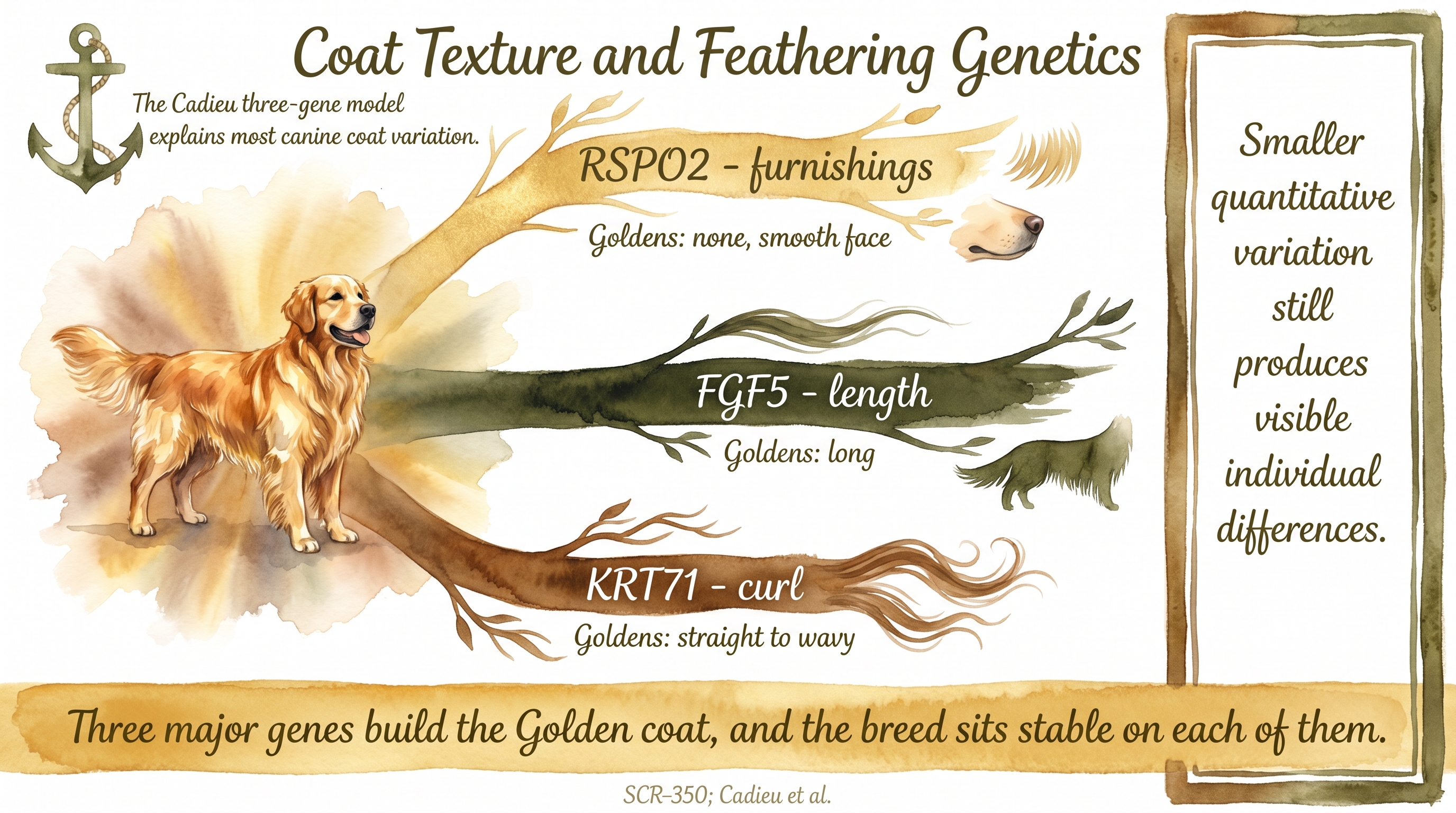
Three major genes build the Golden coat, and the breed sits stable on each of them.
Key Takeaways
- A few major genes explain much of canine coat type, especially furnishings, length, and curl.
- Golden Retrievers occupy a stable long-coated, non-furnished, usually non-curly position in that system.
- Within-breed variation in feathering and coat density still exists, but it is mostly quantitative and cosmetic.
- Coat genetics help set grooming expectations, but they should not outrank health, diversity, or temperament in breeding decisions.
- Puppy coats mature gradually over the first one to two years, so adult coat character is not fully visible at placement age.
The Evidence
This entry uses observed claim-level tags beyond the dedicated EvidenceBlocks below. These tags mark JB program observation or practice-derived claims that need dedicated EvidenceBlock coverage in a later content pass.
- Cadieu et al. and related canine morphology literaturedogs
RSPO2, FGF5, and KRT71 explain much of the major between-breed variation in furnishings, coat length, and curl. - Canine morphology synthesisdogs
Breeds fixed for specific combinations at these loci show highly predictable basic coat profiles, even while smaller quantitative variation remains within the breed.
- Golden Retriever population-health synthesisGolden Retrievers
The breed is expected to show the classic long, feathered double coat, with most remaining variation affecting density, fullness, and wave rather than changing the basic breed coat type.
No published study directly maps the modifier loci controlling within-breed Golden Retriever coat variation in feathering, density, and texture, or correlates individual locus effects with grooming requirements and shedding patterns.
SCR References
Sources
Sources pending: a dedicated source doc for this topic is queued for the next research cycle. The entry's factual claims draw on the broader JB Knowledgebase synthesis; peer-reviewed citations will be added when the source doc is built. This note will be replaced during the next audit pass.