Coat Color Genetics in Golden Retrievers
Golden Retriever color genetics are simpler than many marketing narratives make them sound, but more nuanced than a one-gene story. The breed is fixed for recessive e/e at MC1R, which means Goldens produce phaeomelanin rather than black eumelanin in the coat. What varies within the breed is mostly intensity, from very pale cream through rich gold to deep red, and that intensity appears to be influenced by multiple loci rather than one simple switch. Understanding both layers of this picture matters because the color conversation in the Golden Retriever world has been distorted by marketing language for long enough that families often arrive with expectations the biology cannot support, and honest color genetics is part of how those expectations can be recalibrated toward the things that actually matter for living with the dog. Documented
What It Means
The breed-fixed foundation
The load-bearing fact about Golden Retriever color is that the breed is effectively fixed for a coat-color state that prevents black pigment expression in the hair shaft. At the MC1R locus, which controls whether a dog can produce eumelanin (black pigment) in its coat, Golden Retrievers carry two copies of the recessive e allele, and this homozygous recessive state means the dog's hair follicles cannot produce black pigment regardless of what other color-related genes the dog carries. Documented The result is a coat built from phaeomelanin (the reddish-yellow pigment family) rather than eumelanin, and that phaeomelanin foundation is what gives every Golden Retriever its characteristic warm color family regardless of the exact shade.
This breed-fixed state is why a Golden Retriever cannot produce a black puppy under any normal breeding circumstance. The absence of the dominant E allele across the entire breed means that even if a Golden is bred to another Golden, neither parent can contribute a functional eumelanin-enabling allele to the offspring. The breed's color consistency at this level is a direct consequence of the homozygous recessive state being effectively fixed across the population over many generations of selection.
That gives the breed a shared baseline color architecture that families can rely on. Every Golden will be some shade of yellow-to-red. That much is settled by the genetics.
The within-breed intensity continuum
On top of that baseline, there is still visible variation that every family notices when they look at Golden Retrievers as a group. Some Goldens are very pale cream, appearing almost white in bright light and only slightly yellow in reflected tones. Some are mid-gold, showing the rich warm color most people associate with the breed in classic imagery. Some are darker red-gold, with a deeper saturated tone that can approach the color of an Irish Setter at the darker end of the breed's acceptable range. All of these dogs are equally and correctly Golden Retrievers, and the range is recognized within the breed standard even if different populations and judging traditions favor different points on the continuum.
That second layer is where the genetics become more quantitative and less Mendelian. Intensity-modifying loci, including MFSD12 and likely other contributing regions that the research is still mapping, help explain why two genetically "golden" dogs (both homozygous recessive at MC1R) can still differ meaningfully in shade. Documented The intensity modifiers control how much phaeomelanin is produced and deposited in the hair shaft, and the cumulative effect of variation at multiple intensity loci produces the continuous range of shades rather than sorting dogs cleanly into discrete color categories.
This is why coat color in Golden Retrievers is best understood as two overlapping facts rather than one single story. The breed-level golden phenotype rests on a major, breed-fixed pigment architecture that is essentially settled by homozygosity at MC1R. The within-breed cream-to-red continuum behaves more like a quantitative trait, with polygenic contributions from multiple intensity-modifying loci that interact to determine the individual dog's position on the shade spectrum.
Why this structure matters for accurate color talk
That is also why color talk becomes so vulnerable to oversimplification in the Golden Retriever marketing world. People often speak as though "cream" and "red" are separate biological types that deserve different breed names or different health expectations. They are not. They are positions on a within-breed continuum, and the dogs at either end share the same underlying MC1R genetics and the same broad breed identity as the dogs in the middle. A cream Golden and a red Golden are more similar to each other genetically than either is to a truly different breed, and the visible color difference rests on a relatively small portion of their genomes concentrated at the intensity-modifying loci.
The term "English Cream" matters here mostly as a marketing lesson that families should understand before they encounter it in breeder advertising. It is not a separate genetic breed, not a separate breed standard recognized by most major kennel clubs, and not an official designation for anything other than a loosely defined style preference. It usually names a style preference inside the same breed rather than a distinct biological category, and the "English" portion sometimes refers to lines with European conformation-ring heritage that tend toward the paler end of the color continuum, but the dogs are still Golden Retrievers and still subject to the same breed-wide genetic architecture.
When a breeder advertises "English Cream" puppies as if they were a distinct product with superior characteristics, families should understand that the claim is primarily a marketing frame rather than a biological fact. The puppies may be lovely dogs, and the breeder may be doing genuinely good work, but the color designation alone is not evidence of anything beyond the shade preference the breeder has selected toward. Health, temperament, and breeding quality must be evaluated on their own terms rather than assumed from color language.
The fake-health claims problem
One of the most damaging distortions in the English Cream marketing space is the claim that paler Goldens are healthier, longer-lived, or less cancer-prone than their more traditionally colored counterparts. No strong peer-reviewed evidence supports these claims, and the reasoning behind them is usually based on informal comparisons between differently sourced populations (for example, comparing European show-line dogs to American backyard-bred dogs) rather than on rigorous analysis of color per se. Observed-JB
If there are differences in health outcomes between populations that happen to differ in color, those differences are almost certainly attributable to other factors (breeding program quality, line history, selection priorities, genetic diversity) rather than to the color genes themselves. Color and health can correlate in population samples without being causally connected, and breeders who use color as evidence of health are making an inference the data does not support.
Families encountering "our cream Goldens live longer" or "English Cream dogs have less cancer" should ask for specific evidence, look for peer-reviewed support rather than anecdote, and be skeptical of any answer that does not distinguish between color itself and the many other factors that influence outcomes in any breeding population.
Where real color variation does exist
To be fair to the underlying science, coat color genetics in dogs is an active area of research and new loci continue to be identified. Documented The intensity modifiers contributing to the cream-to-red continuum in Goldens are real, and understanding them is part of accurate breed genetics even if the practical breeding implications are limited to aesthetic preference. Research on dilution loci, graying patterns, and other pigment-related traits continues to refine the picture, and some of that work may eventually connect to breed-relevant health questions in ways that would change how color should be interpreted.
But the current state of the science does not support treating color as a proxy for anything important beyond itself. Color is color. It is real, it is heritable, and it is largely cosmetic within the Golden Retriever breed.
Why It Matters for Your Dog
Families often hear color language before they hear population-genetics language when they begin researching Golden Retrievers. That early exposure can distort priorities in ways that are hard to undo later, and the result is sometimes that families spend the decision phase focused on shade preferences while overlooking the selection factors that will shape their daily life with the dog for the next decade.
The practical reality is straightforward once the marketing noise is filtered out. Color is real and heritable, reflecting the breed-fixed MC1R state and the polygenic intensity modifiers layered on top of it. The cream-to-red range is entirely normal inside the breed, and all points on the continuum are equally Golden Retriever. The variation is mostly cosmetic from a health and temperament standpoint, with no strong evidence that any particular shade confers advantages beyond aesthetic preference. Color preference is therefore a legitimate personal taste question, but it is not a health strategy, and families who choose puppies primarily on color are not protecting themselves from the problems they likely care most about.
For JB, this matters because selection pressure is always finite. A breeder's attention, time, and available breeding stock all have limits, and every generation of dogs represents a set of trade-offs between competing selection priorities. If a breeder spends too much of that finite pressure chasing a cosmetic shade, that effort is not being spent on temperament stability, orthopedic health, cardiac screening, cancer line management, or diversity preservation. The opportunity cost of heavy color selection is real even when the color itself is beautiful, and families should understand that trade-off rather than assume color and substance can be pursued equally at no cost to either.
The healthier family question is not "What color are the puppies?" It is "What is this breeder selecting for first, and does the answer reflect priorities that will actually shape my dog's daily life and long-term wellbeing?" A breeder who leads with color is telling families something about their priorities whether or not that signal is the one they intended to send.
What This Cannot Predict
Color genetics can predict some population-level patterns in a breeding program, such as the likely shade distribution of puppies from parents at known positions on the continuum. Documented They cannot tell you that one pale puppy will be healthier, calmer, or more typical than one darker puppy.
That is the key boundary, and it is worth stating plainly because it runs against so much of the marketing language families encounter.
Within Golden Retrievers, coat shade is primarily a cosmetic trait. It is not a meaningful proxy for temperament quality, orthopedic soundness, cancer risk, or longevity. The genes contributing to color are largely separate from the genes contributing to the traits families actually care about for daily life with the dog, and the correlation between color and those deeper traits is weak or absent in any population where selection for health and temperament has been pursued seriously.
A breeder selecting heavily for color is selecting for appearance first, and the finite attention any breeder can devote to selection criteria means that color-first programs are often diverting energy from selection priorities that would matter more for the dog the family will actually live with.
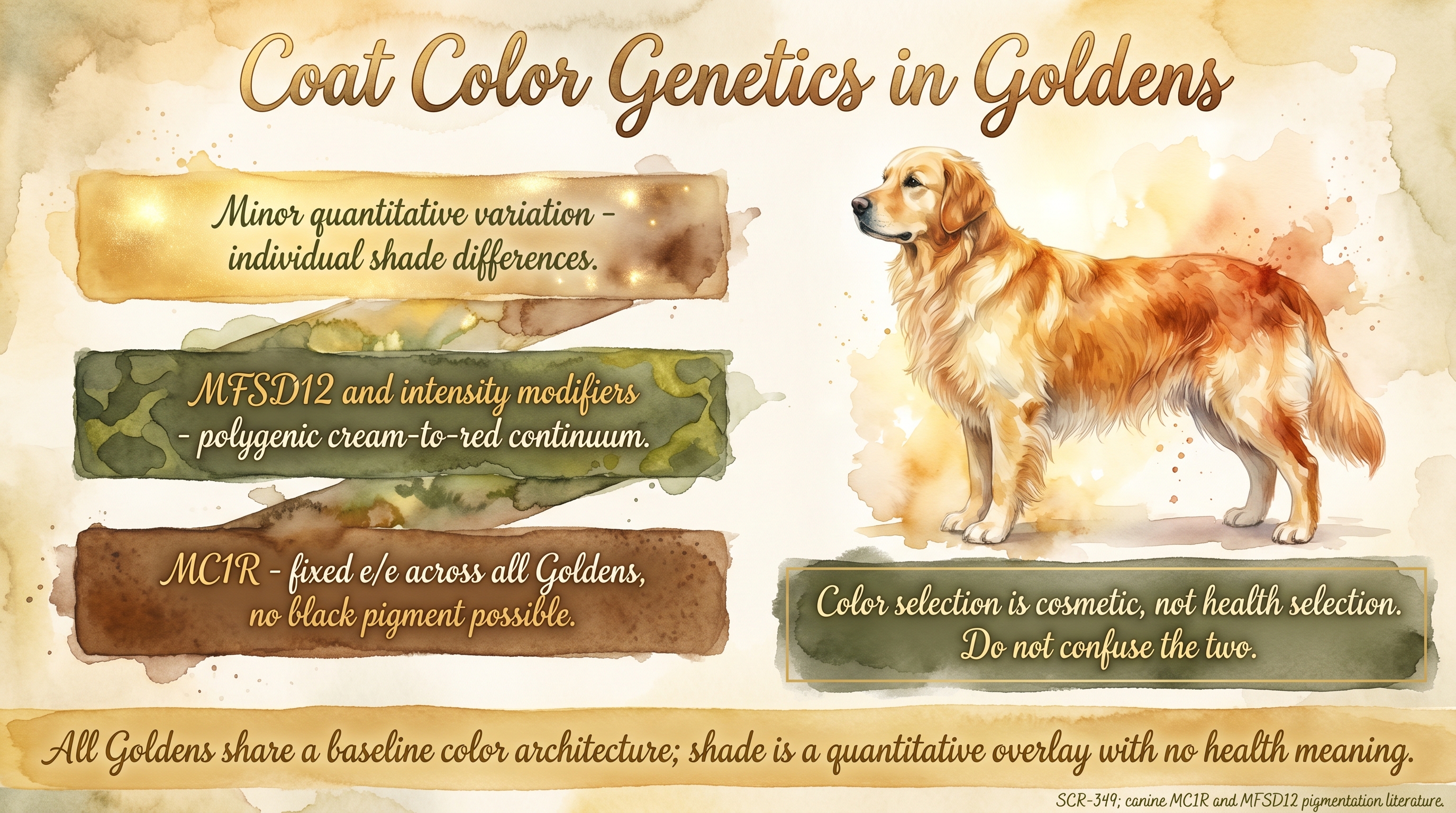
All Goldens share a baseline color architecture; shade is a quantitative overlay with no health meaning.
Key Takeaways
- Golden Retrievers are golden because the breed is effectively fixed for a recessive MC1R pigment state.
- The shade range from cream to red is a real within-breed continuum influenced by multiple intensity-modifying loci.
- Terms like English Cream usually describe style and marketing more than a separate biological category.
- Color selection is mostly cosmetic and should not be confused with health or temperament selection.
- Heavy color selection has an opportunity cost because finite selection pressure spent on shade is not spent on traits that matter more for daily life.
The Evidence
This entry uses observed claim-level tags beyond the dedicated EvidenceBlocks below. These tags mark JB program observation or practice-derived claims that need dedicated EvidenceBlock coverage in a later content pass.
- Canine coat-color genetics literaturedogs
MC1R and ASIP help organize the major pigment pathways in dogs, and Golden Retrievers are classically understood as fixed for the recessive MC1R state that produces a phaeomelanin-only coat. - Recent canine pigmentation studiesdogs
Within-breed shade differences are influenced by intensity-modifying loci, including MFSD12, which helps explain cream-to-red variation inside breeds already fixed for a major color state.
- Golden Retriever inherited-disease and diversity synthesisGolden Retrievers
No strong peer-reviewed evidence supports treating pale versus darker Golden coat shades as meaningful predictors of health or temperament. The distinction is largely stylistic.
No published study directly compares health outcomes, lifespan, or cancer incidence across the cream-to-red Golden Retriever color continuum when controlling for breeding program selection, genetic diversity, and population structure. The absence constrains both sides of the color-health question equally.
SCR References
Sources
Sources pending: a dedicated source doc for this topic is queued for the next research cycle. The entry's factual claims draw on the broader JB Knowledgebase synthesis; peer-reviewed citations will be added when the source doc is built. This note will be replaced during the next audit pass.