Polyvagal Theory and Its Critique
Compound evidence detail1 SCR / 2 parts
- Documentedthe cross-species behavioral principle that parasympathetic-dominant autonomic states support social engagement, with direct canine HRV evidence (Berg 2026, Wormald 2017, Koskela 2024)
- Ambiguousthe polyvagal-theory-specific neuroanatomical mechanism, with the Grossman 2026 critique and Porges 2026 rebuttal active in current literature
Polyvagal theory is one of the most widely used modern frameworks for talking about calmness, safety, and autonomic regulation. It has also become one of the most criticized. The most defensible summary is not that the theory is either fully proven or useless. It is that the stronger neuroanatomical version is heavily disputed, while the broader behavioral observation that parasympathetic-dominant states support social engagement and regulation remains solid. Ambiguous
What It Means
Polyvagal theory is one of the most widely used modern frameworks for talking about calmness, safety, and autonomic regulation. In its most familiar form, it proposes a hierarchy of autonomic states: a myelinated vagal system supporting social engagement and calm regulation, sympathetic mobilization supporting fight or flight, and a more primitive immobilization response associated with shutdown. Documented This framework became influential because it gave clinicians and educators a vivid way to talk about how state changes shape behavior.
Why It Spread So Widely
Polyvagal theory offered a memorable link between physiology and everyday relational behavior. Documented It helped explain why facial expression, vocal prosody, posture, and social context can matter so much to regulation. That descriptive usefulness is real. Many people encountered the framework because it gave language to experiences of safety, overwhelm, and social connection that already felt true in practice.
The Critique
The strongest criticism is not that autonomic state is irrelevant. It is that the specific comparative-neuroanatomical story told by strong versions of polyvagal theory is not well supported by current evidence. Grossman and colleagues, along with other critics, have argued that key phylogenetic and physiological premises of the theory are untenable or at least seriously overstated. The debate is not a minor footnote. It is a major scientific challenge to the strongest mechanistic version of the theory. That means pages like this should not present polyvagal theory as if it were the settled final map of mammalian autonomic organization.
What Still Holds Up
SCR-013 captures the safest position. The behavioral principle that parasympathetic-dominant autonomic states support social engagement, regulation, and learning capacity is independently supported across multiple frameworks. Documented In other words, the useful insight does not stand or fall entirely with one contested theory. That principle can also be supported through neurovisceral integration models, social-buffering literature, canine HRV findings, and broader mammalian stress-regulation work. This is why the responsible correction is not "throw out the entire idea of vagal regulation." It is "separate the behavioral principle from the strongest disputed anatomy claims."
Why It Matters for Your Dog
In dogs, the safest operational use of the framework is modest. It is reasonable to say that vagal and parasympathetic regulation matter, HRV is a meaningful autonomic marker, and calmer physiological states support better social and cognitive functioning. It is less reasonable to say that dog behavior science has confirmed the full polyvagal story in all its evolutionary and anatomical detail. This distinction matters because dog writing can easily slide from "useful regulatory lens" to "settled canine neuroanatomy." The first is defensible. The second is not. For families, the practical takeaway is straightforward: a dog in a calm, parasympathetic-dominant state is better positioned to learn, engage socially, and regulate than a dog stuck in sympathetic arousal. That principle survives the debate about whether the exact neuroanatomical explanation offered by strong polyvagal theory holds up. You do not need the full theory to understand that calm supports functioning.
The parasympathetic-tone layer is strongest when it relies on the broader behavioral principle that calmer autonomic states support regulation and social engagement. That principle survives even if the strongest version of polyvagal theory is contested.
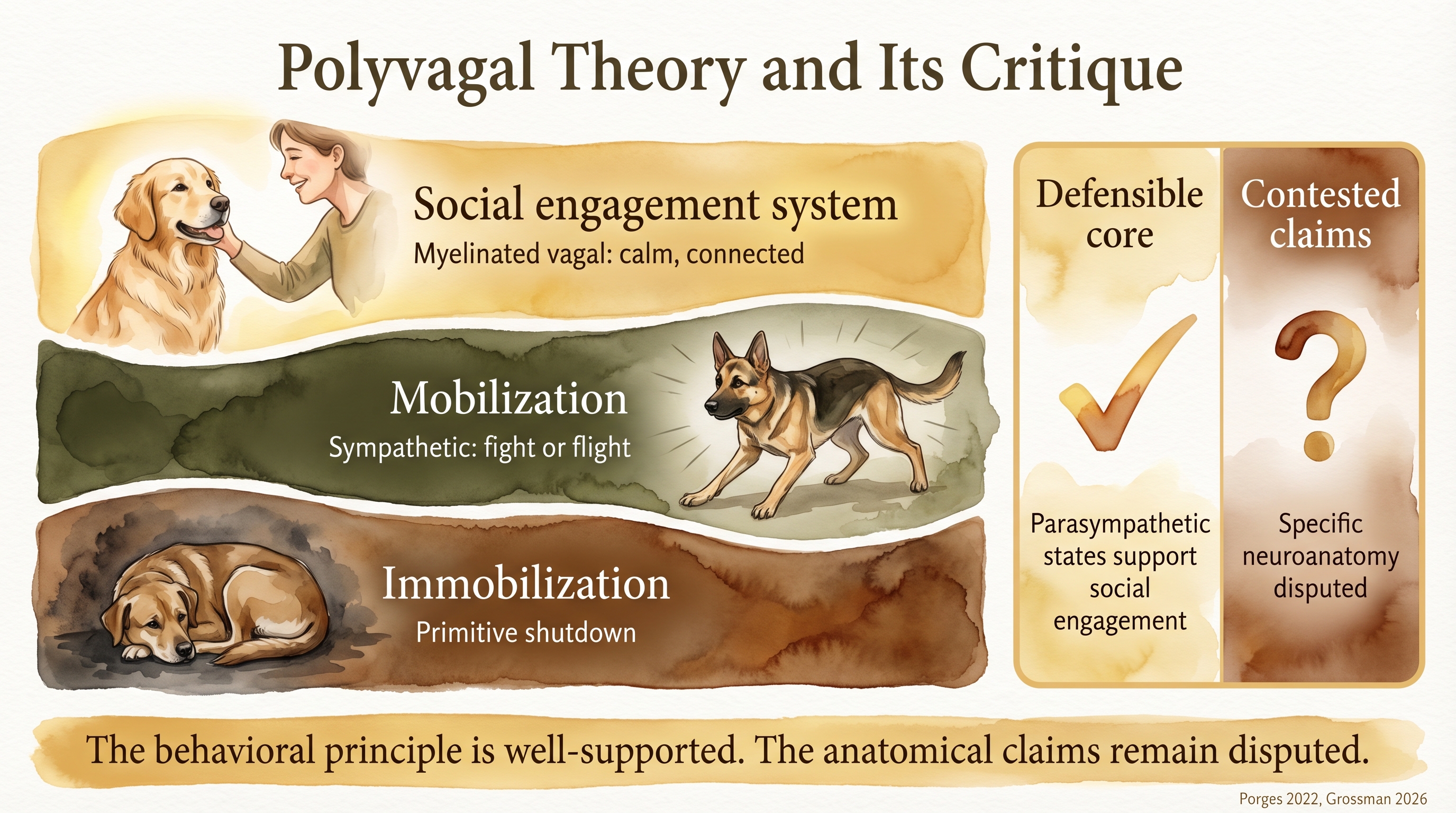
Polyvagal theory proposes three autonomic states but faces significant phylogenetic critique - the clinical intuitions outrun the neuroscience.
Key Takeaways
- Polyvagal theory became influential because it linked physiology, safety, and social behavior in memorable ways.
- The strongest criticism targets the theory's neuroanatomical and phylogenetic claims, not the importance of autonomic regulation itself.
- The broad behavioral principle that calmer autonomic states support regulation remains well supported outside polyvagal theory alone.
- In dog science, the safest use of the framework is as a bounded regulatory lens, not as settled canine neuroanatomy.
The Evidence
- Thayer, J. F., & Lane, R. D. (2000)humans and broader mammalian application
Neurovisceral integration provides an independent framework linking autonomic regulation with flexible behavior and self-regulation. - Hennessy, M. B. et al. (2009)multiple mammals
Social buffering literature supports the broader principle that physiology and social context shape regulation together. - Canine HRV literaturedomestic dogs
Dog studies support HRV as a meaningful marker of autonomic state and regulatory flexibility.
- Porges, S. W. (2022, 2026)theoretical framework
Defended polyvagal theory as a systems-level account of social engagement and threat response. - Grossman, P. et al. (2026)theoretical framework
Argued that key neuroanatomical and evolutionary premises of polyvagal theory are untenable. - Grossman, P., & Taylor, E. W. (2007)theoretical framework
Earlier critique challenged oversimplified autonomic interpretations built around vagal measures.
No direct canine research located for this specific topic. Current understanding relies on related research, clinical observation, and cross-species inference.
SCR References
Sources
- Grossman, P., & Taylor, E. W. (2007). Toward understanding respiratory sinus arrhythmia: Relations to cardiac vagal tone, evolution and biobehavioral functions. Biological Psychology, 74(2), 263-285.
- Grossman, P., et al. (2026). Why the polyvagal theory is untenable. Clinical Neuropsychiatry.
- Hennessy, M. B., Kaiser, S., & Sachser, N. (2009). Social buffering of the stress response: Diversity, mechanisms, and functions. Frontiers in Neuroendocrinology, 30(4), 470-482.
- Porges, S. W. (2022). Polyvagal perspectives on social engagement and co-regulation.
- Porges, S. W. (2026). Response to recent critiques of polyvagal theory. Clinical Neuropsychiatry.
- Thayer, J. F., & Lane, R. D. (2000). A model of neurovisceral integration in emotion regulation and dysregulation. Journal of Affective Disorders, 61(3), 201-216.