Panksepp's Affective Systems
Panksepp's affective-neuroscience framework proposes that mammals share a set of primary-process affective systems rooted in subcortical circuitry. The classic list includes SEEKING, RAGE, FEAR, LUST, CARE, PANIC/GRIEF, and PLAY. The framework is strongest as comparative mammalian neuroscience, and it becomes useful in dogs when it is applied carefully rather than treated as if every element has already been directly mapped in canine imaging. Documented-Cross-Species
What It Means
Panksepp's contribution was to argue that emotion is not only a higher-order interpretive layer. Core affective systems are built into the mammalian brain and can organize behavior from subcortical levels upward. Documented That matters because it helps explain why distress on separation can feel biologically urgent, exploratory motivation has its own affective tone, play is not reducible to simple reward delivery, and caregiving and contact-seeking belong to a real mammalian system architecture.
The Seven Systems
The classic systems are SEEKING, RAGE, FEAR, LUST, CARE, PANIC/GRIEF, and PLAY. Different JB topics touch different parts of this list. Documented-Cross-Species Separation distress connects most obviously to PANIC/GRIEF. Bonding and parental regulation connect to CARE. Exploratory motivation and reward-system pages overlap with SEEKING. Rough-and-tumble and social flexibility connect to PLAY.
Why Dogs Fit the Framework
The framework is not dog-specific in origin. It is comparative neuroscience built mainly from mammalian evidence, especially rodent and other experimental work. That said, the dog application is not arbitrary. Dogs are mammals with the same broad social, affective, and attachment architecture that makes the framework useful across species. Recent canine-oriented applications in the JB source layer support cautious use of Panksepp in dogs, especially for attachment, separation distress, play, and motivational systems. Documented The key word is cautious. The framework gives a scientifically serious vocabulary for mammalian affect, but it does not mean every named system has a fully established one-to-one canine biomarker or imaging map.
CARE and PANIC/GRIEF
These two systems matter the most for attachment and distress pages. Documented CARE helps explain why parental and affiliative regulation are not just learned conveniences. They are rooted in mammalian caregiving biology. PANIC/GRIEF helps explain why social separation can produce real distress rather than mere annoyance. This is why separation distress in dogs can be discussed as more than a training nuisance. The framework supports a deeper affective account, even while diagnosis and management still require behaviorally grounded case interpretation.
SEEKING and PLAY
SEEKING is the motivational system most often associated with exploratory drive and the energized pursuit of outcomes. PLAY is distinct. It is not simply reward pursuit in miniature. It has its own affective structure and social function. That distinction matters in dog writing because play can easily be confused with generic reinforcement or with chronic high arousal. Panksepp's framework supports a more nuanced interpretation: play is not just training fuel, and motivated engagement is not reducible to one emotional channel.
Why It Matters for Your Dog
The affective-systems framework helps explain why raising dogs is not only about behavior management or training mechanics. Documented Dogs have biological substrates for separation distress, caregiving, play, and exploratory motivation that are not simply trained into or out of existence. Understanding these systems helps families understand why a dog separated from loved ones experiences genuine distress, not willful misbehavior. It explains why play time is not frivolous but developmentally essential. It shows why calm parental presence matters in ways that go beyond simple command compliance. For families, this means that respecting the biological reality of your dog's affective systems - rather than dismissing them as behavioral problems - is aligned with science.
How to Use the Framework Responsibly
The strongest use of this page is explanatory, not absolutist. It is responsible to say that mammals share core affective systems, dogs are meaningfully interpretable within that comparative framework, and attachment, separation, exploration, and play have deeper affective substrates than surface behavior alone suggests. It is not responsible to say that dog-specific neuroscience has already fully mapped each Panksepp system in precise circuit detail.
The secure-base layer often treats attachment as something rooted in mammalian biology rather than in sentiment alone. Panksepp's framework supports that move, especially around CARE and PANIC/GRIEF, as long as the dog application remains carefully bounded.
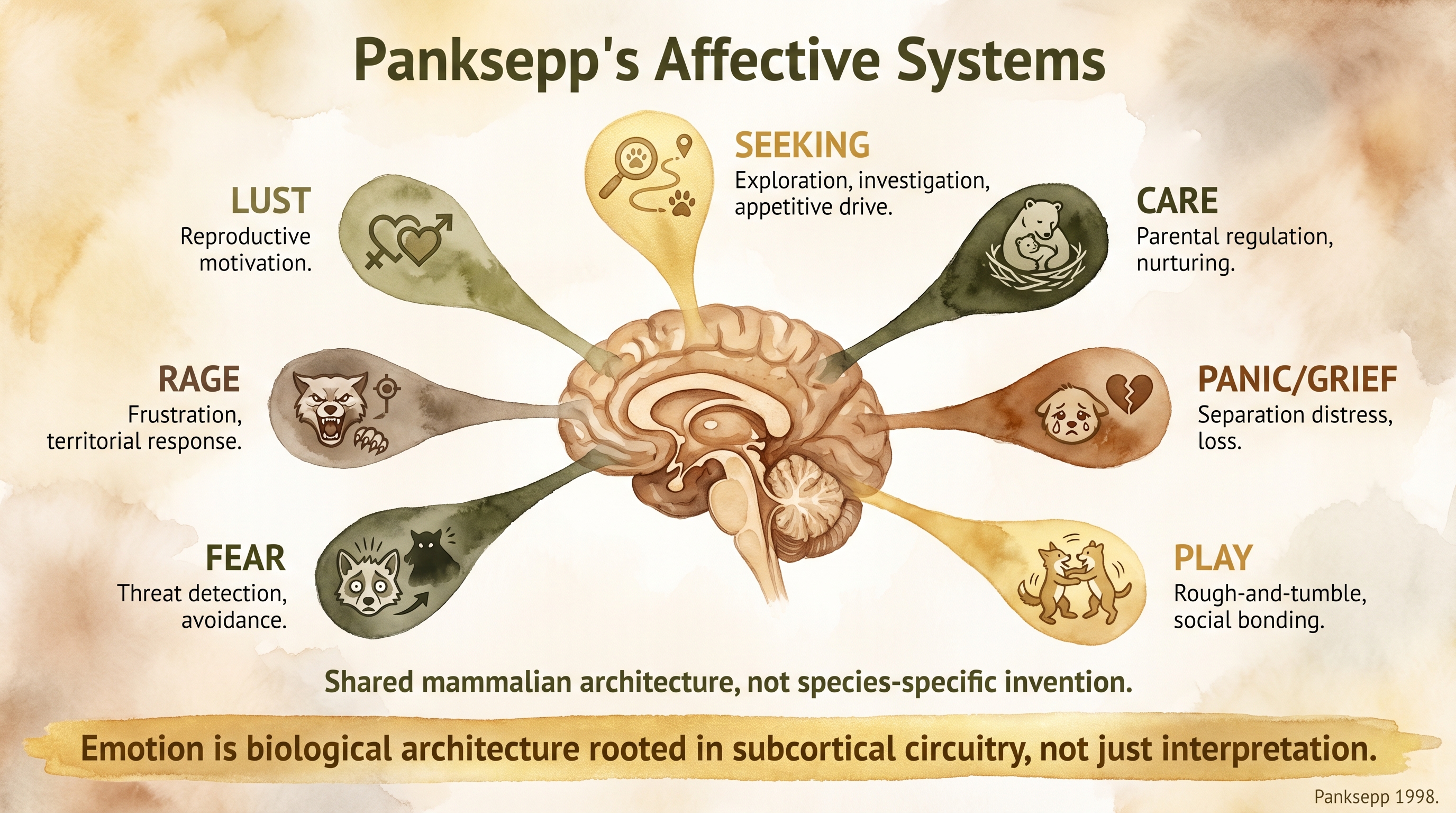
Panksepp identified seven primary affective systems - SEEKING, RAGE, FEAR, LUST, CARE, PANIC, and PLAY - shared across mammals.
Key Takeaways
- Panksepp's framework treats core affective systems as a mammalian biological architecture, not just a metaphor.
- CARE and PANIC/GRIEF are especially relevant to canine attachment and separation-distress discussions.
- SEEKING and PLAY help separate motivation from simplistic pleasure or obedience language.
- The framework is strongest in dogs when used as careful comparative neuroscience rather than as a fully mapped canine circuit atlas.
The Evidence
- Panksepp, J. (1998)multiple mammals
Outlined seven core affective systems rooted in mammalian subcortical circuitry. - Panksepp, J. et al. (1978 and later work)multiple mammals
Linked separation distress and affiliative systems to biologically meaningful mammalian affective processes.
- Bhave, et al. (2024)domestic dogs
Applied affective-neuroscience concepts to canine emotional and relational interpretation. - Cetintav, et al. (2025)domestic dogs
Extended canine application of mammalian affective-system language in behavior and welfare interpretation. - Canine source synthesisdomestic dogs
Supports careful use of CARE, PANIC/GRIEF, SEEKING, and PLAY language in dogs without pretending the full canine circuit map is complete.
No study has directly measured whether dogs showing particular behavioral phenotypes related to PANIC/GRIEF (separation distress) or PLAY capacity show the predicted underlying circuit-level activation of Panksepp-identified systems.
No published study in dogs has validated the full seven-system model as a complete and non-overlapping framework for canine emotional and behavioral organization.
SCR References
Sources
- Bhave, et al. (2024). Canine applications of affective neuroscience.
- Cetintav, et al. (2025). Affective systems and canine behavior interpretation.
- Panksepp, J. (1998). Affective neuroscience: The foundations of human and animal emotions. Oxford University Press.
- Panksepp, J., Herman, B., Conner, R., Bishop, P., & Scott, J. P. (1978). The biology of social attachments: Opiates alleviate separation distress. Biological Psychiatry, 13(5), 607-618.