Allostatic Load
Allostasis means achieving stability through change. Allostatic load is the cumulative physiological cost of doing that work too often, too intensely, or too inefficiently. The framework comes from Bruce McEwen's mammalian stress research and is one of the most useful ways to think about chronic strain. In dogs, the framework is conceptually strong and partly supported by direct analogs, but there is not yet a validated canine allostatic-load index in the way the human literature sometimes imagines. Documented-Cross-Species
What It Means
Allostasis is not failure. It is the body's attempt to adapt. The load appears when adaptive systems are used in ways that become cumulatively expensive.
McEwen's framework is often described through four broad routes to burden: repeated hits from frequent stressor exposure, failure to shut off efficiently after the stressor ends, inadequate response in one system that forces compensation in others, and chronic overactivity of compensating systems. The point is not just "stress is bad." The point is that systems designed for short-term adaptation become costly when activated in chronic patterns.
Framework Details
More detailed discussion appears below under The Strong and Weak Parts of the Dog Evidence, How It Connects to Immune and Cellular Measures, and What the Framework Does Not License. Documented
Why It Matters for Your Dog
The canine literature does not yet give us a gold-standard multi-biomarker load score that predicts later disease cleanly. Documented What it does give us are strong analogs: chronic housing or restriction studies with sustained endocrine and immune changes, shelter and intake studies with prolonged cortisol and hematologic shifts, telomere and cumulative-welfare discussions that fit the load model, and extreme contexts where the stress system itself appears blunted or exhausted. These are exactly the kinds of patterns that make the allostatic-load framework useful. Dogs do not need a formal index for the concept to help organize what the data are showing.
The Strong and Weak Parts of the Dog Evidence
The strong part is that dogs in chronically adverse or unstable environments show measurable multisystem strain. Cortisol, immune markers, hematology, rest patterns, and behavior can all shift together over time. That is consistent with elevated allostatic load.
The weaker part is formalization. The literature itself says that an integrated canine allostatic-load index has not yet been validated. That means pages like this should use the framework as an organizing model, not as if there were already a universally adopted veterinary score that can be looked up and applied.
One vivid canine example in the source layer comes from conflict-zone therapy-dog work, where abnormally low urinary cortisol was interpreted not as ideal calm but as a possible exhausted or dysregulated stress system. Documented That is a useful reminder that chronic burden does not always look like simple high cortisol forever. Systems can become flattened as well as overactive.
How It Connects to Immune and Cellular Measures
Allostatic load becomes especially useful when paired with chronic-stress and immune pages. If repeated activation and poor shutoff keep stress systems engaged, it becomes easier to understand why immune markers, mucosal defenses, and cellular maintenance measures start to move. Documented
This is also where telomere discussions belong conceptually. Telomeres are not themselves an allostatic-load score, but they are often discussed as one kind of cumulative biological scar consistent with long-term strain. The same is true of repeated immune dysregulation or HPA flattening.
What the Framework Does Not License
Because the concept is elegant, it is easy to overapply. The framework does not prove that every stimulating household creates measurable canine allostatic damage, that one cortisol-lowering intervention automatically reduces total allostatic load, or that every biomarker movement reflects the same kind of burden. Documented The source documents are clear on this point. Dog evidence supports the existence of chronic-strain analogs, but it does not yet quantify a precise dose-response pathway from ordinary household overstimulation to later immune failure or disease incidence.
The calmness pillar uses this framework to argue that the real target is not just fewer acute spikes but a lower cumulative stress burden. The science supports that general logic, while still requiring caution about how directly the formal allostatic-load model has been mapped in dogs.
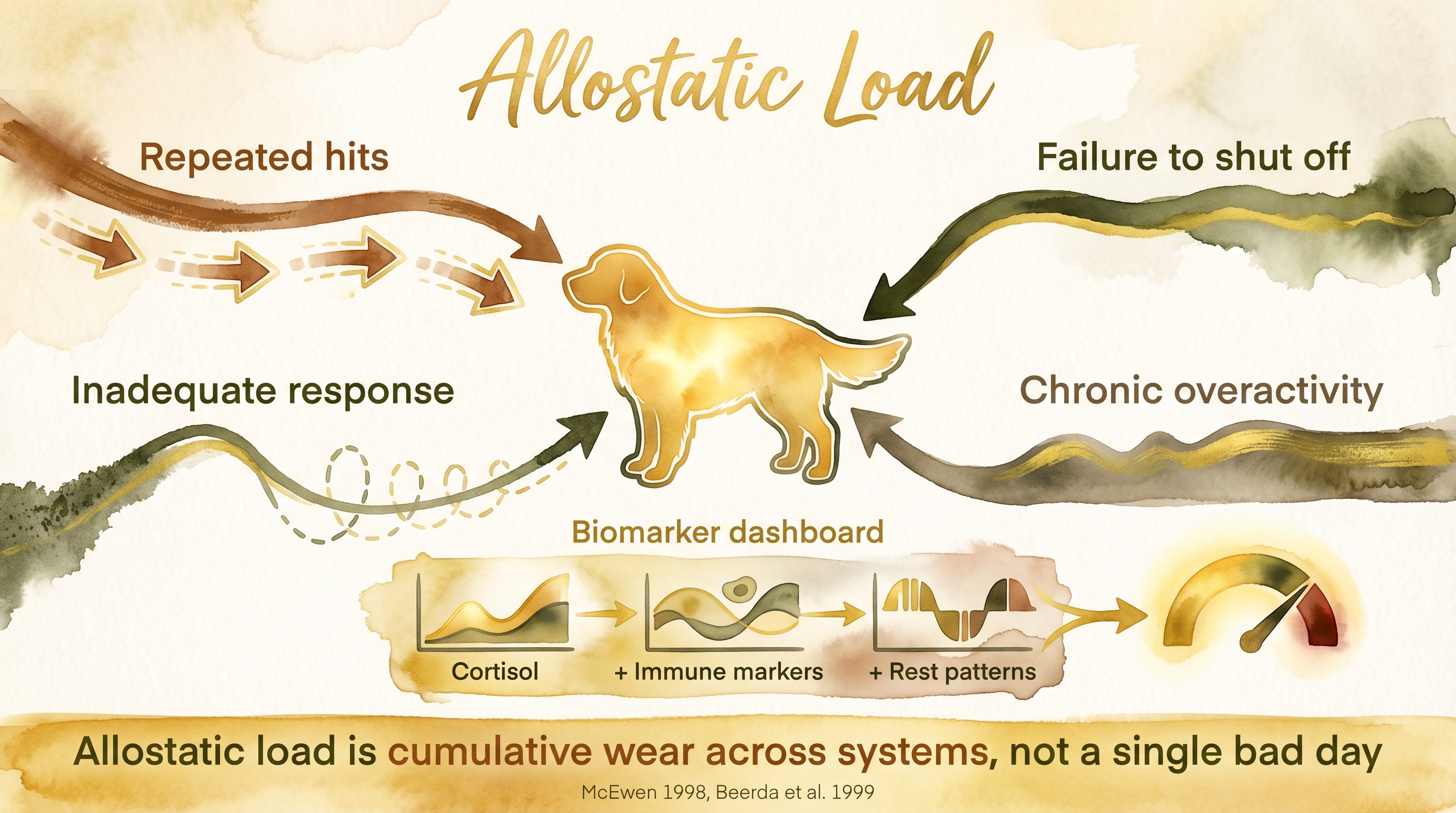
Allostatic load is cumulative wear across biological systems, not a single stressful event.
Key Takeaways
- Allostasis is adaptive regulation through change; allostatic load is the cumulative cost of that regulation.
- The framework is strongly established in mammalian stress science and useful for organizing chronic-stress findings in dogs.
- Dog studies support real analogs to cumulative physiological burden, especially in chronic adverse environments.
- What dogs do not yet have is a fully validated, standardized allostatic-load index that can be applied the way the human model sometimes is.
The Evidence
- McEwen, B. S. (1993, 1998)multiple mammals
Defined allostasis and allostatic load as the physiological wear and tear produced by repeated or inefficient stress-response activation. - Juster, R. P., McEwen, B. S., & Lupien, S. J. (2010)humans
Reviewed biomarker approaches to cumulative stress burden across systems. - Allostasis scoping review (2022)multiple animal species
Extended the framework across animal research while noting species-specific implementation challenges.
- Beerda, B. et al. (1999)domestic dogs
Chronic housing stress altered hormonal, behavioral, and immunological measures in dogs. - Shelter and intake studies summarized in the source layerdomestic dogs
Sustained cortisol disruption and hematologic shifts in dogs under adverse housing are consistent with cumulative physiological burden. - War exposure canine study (2026) as summarized in source synthesisdomestic dogs
Extremely adverse environments can produce paradoxical low-cortisol patterns consistent with exhausted stress-system function rather than healthy calm.
- Stress-immunity source synthesisdomestic dogs
Dogs show meaningful analogs to allostatic burden, but a formally validated canine allostatic-load index predicting later immune or disease outcomes has not yet been established.
No published study has validated a quantitative canine allostatic-load index that predicts downstream disease incidence or mortality, limiting the model to an organizational framework rather than a clinically predictive tool in dogs.
No study has measured how rapidly allostatic-load markers shift in response to environmental improvement, making it unclear whether reversibility is possible in dogs once burden accumulates.
SCR References
Sources
- Juster, R. P., McEwen, B. S., & Lupien, S. J. (2010). Allostatic load biomarkers of chronic stress and impact on health and cognition. Neuroscience & Biobehavioral Reviews, 35(1), 2-16.
- McEwen, B. S. (1993). Stress and the individual: Mechanisms leading to disease. Archives of Internal Medicine, 153(18), 2093-2101.
- McEwen, B. S. (1998). Stress, adaptation, and disease: Allostasis and allostatic load. Annals of the New York Academy of Sciences, 840, 33-44. DOI: 10.1111/j.1749-6632.1998.tb09546.x.
- Seeley, K. E., Proudfoot, K. L., and Edes, A. N. (2022). The application of allostasis and allostatic load in animal species: A scoping review. PLOS ONE, 17(8), e0273838. DOI: 10.1371/journal.pone.0273838.
- Beerda, B., Schilder, M. B. H., van Hooff, J. A. R. A. M., de Vries, H. W., and Mol, J. A. (1999). Chronic stress in dogs subjected to social and spatial restriction. I. Behavioral responses. Physiology & Behavior, 66(2), 233-242. DOI: 10.1016/S0031-9384(98)00289-3.
- Beerda, B., Schilder, M. B. H., van Hooff, J. A. R. A. M., de Vries, H. W., and Mol, J. A. (1999). Chronic stress in dogs subjected to social and spatial restriction. II. Hormonal and immunological responses. Physiology & Behavior, 66(2), 243-254. DOI: 10.1016/S0031-9384(98)00290-X.
- Source-layer synthesis note: shelter and intake studies support chronic-stress analogs in kenneled or shelter dogs; this is a source package rather than one primary citation.
- Stress-immunity source synthesis: dogs show chronic-strain analogs, but no validated canine allostatic-load index is established.
- Foltin, S., Kostenko, S., Hartwig, A.-D., and Glenk, L. M. (2026). War Exposure and Canine Cortisol Responses: Country Differences in Cortisol Profiles of Therapy Dogs. Animals, 16(3), 381. DOI: 10.3390/ani16030381.