Ichthyosis in Golden Retrievers
Ichthyosis is one of the most useful diseases for teaching the difference between disease management and diversity management. In Golden Retrievers, the condition is real, inherited, and common enough at the carrier level that simplistic purity strategies can do more population-level harm than good. That is why the page matters beyond dermatology. It is a population-genetics lesson disguised as a skin disease page, and it is one of the clearest examples in the breed of a situation where the right answer depends on understanding both the molecular genetics of the specific disease and the population-level consequences of different management strategies. Documented
What It Means
The clinical picture
Golden Retriever ichthyosis is a recessive inherited skin disorder associated with a mutation in the PNPLA1 gene, which codes for a protein involved in the formation of the lipid barrier of the skin's outermost layer. When the gene is disrupted, the skin's normal shedding and keratin-processing machinery does not function properly, and the result is dry, flaky, scaling skin that persists throughout the dog's life. Clinically, the disease usually produces visible scales that can range from fine dandruff-like flakes to larger plaques, sometimes more visible on the belly and trunk than on the back and head, and sometimes worsening and remitting over time in response to season, bathing, or other environmental factors.
The severity is variable across affected dogs. Many affected dogs have a mild but visible lifelong dermatologic issue rather than a catastrophic welfare crisis. Some cases are barely noticeable to a casual observer and cause no clinical discomfort beyond a cosmetic scaling pattern that the dog and family adapt to easily. Other cases are more extensive and require ongoing management with specialized shampoos, dietary support, or topical products. The disease is not typically life-limiting and does not appear to substantially shorten lifespan, which distinguishes it from several of the more serious inherited conditions the breed faces.
That mildness can make the condition easy to trivialize, and some breeders and families do exactly that. "It is just a skin thing" is a common reaction to ichthyosis disclosures, and the sentiment is not entirely wrong at the individual-dog level. The population-genetics problem, however, is not trivial, and the individual-level mildness is exactly what makes the population-level story more important than it first appears.
Why carrier frequency drives the story
Ichthyosis matters most because the carrier frequency in some Golden populations has been high enough to make blunt elimination strategies dangerous. When a recessive allele is present in a substantial fraction of breeding dogs (estimates in some surveyed populations have run quite high, though the precise figures vary by source and by subpopulation), the usual instinct to remove affected dogs and their carriers from breeding becomes catastrophic rather than helpful. If a breeder attempts to remove every PNPLA1 carrier from a population where carriers are common, the breeder is removing a large fraction of the gene pool in a single generation, and with it the other genetic contributions those dogs would have made to future generations. That kind of aggressive exclusion trades a manageable skin condition for a much harder-to-reverse loss of genetic diversity.
If a recessive allele is widespread, "remove every carrier now" is not an elegant solution. It is a recipe for narrowing the gene pool sharply and throwing away useful dogs for the sake of one locus. The math of carrier exclusion gets worse the more common the allele is, because each carrier removed represents not only a single dog but also that dog's contribution to the effective genetic diversity available for future selection. Documented A breed that loses 20 percent of its breeding pool to carrier exclusion will feel the loss in every other trait it tries to manage for decades afterward.
Why carrier management is the right strategy
That is why ichthyosis is such a clean example of why carrier management exists as a rational strategy rather than a lazy one. A recessive disease with a common carrier base demands precision: test accurately to identify who is carrying the allele, avoid matings that would produce affected puppies by using carrier-to-clear pairings at the relevant locus, track the allele frequency across generations so that the breed can slowly reduce it without abrupt loss, and preserve enough diversity to prevent the cure from becoming a worse problem than the disease itself. Documented Each of those steps requires discipline and attention, and the combination works better than any simpler alternative.
The disease itself follows classical Mendelian logic, which makes the individual-dog level of management straightforward. A carrier bred to a clear dog produces no affected puppies at that locus. A clear-to-clear mating produces no carriers at all at that locus. Two carriers bred together produce an expected 25 percent affected rate and should generally be avoided. Those rules are the same as for any autosomal recessive condition, and they work. The population strategy, however, cannot stop at individual-mating logic. It has to account for the aggregate effect of many breeding decisions across many years, and it has to weigh the cost of diversity loss against the cost of continued carrier presence.
Slow reduction versus abrupt elimination
The most defensible long-term strategy for a common recessive allele is usually slow, deliberate reduction of the allele frequency across multiple generations rather than abrupt elimination in one. A program that uses carrier-to-clear matings consistently will see the carrier frequency in its population drift downward over time as clear puppies are preferentially retained for the breeding program and carrier puppies are placed in pet homes. The drift is gradual but real, and over several generations it can substantially reduce the population-level burden of the allele without causing the diversity collapse that abrupt exclusion would trigger.
This kind of patient population management requires thinking in decades rather than in years. Breeders who are willing to commit to that horizon can make real progress. Breeders who want to eliminate a common recessive disease immediately are usually trading one problem for another and should think carefully about whether the trade is worth it. Observed-JB
The broader lesson
Ichthyosis is also worth understanding because the same reasoning applies to other common recessive alleles in other breeds. The specific locus matters less than the general principle: when an allele is common, blunt exclusion is destructive and precision management is preferable. Families who understand the principle through the ichthyosis example can apply it to any similar situation they encounter, which makes this page useful beyond its specific dermatologic content.
Why It Matters for Your Dog
Families often react strongly to the phrase "genetic skin disease," and the breeder's job is not to minimize the reaction falsely. Observed-JB The better explanation is more precise and more honest. The condition is real, it is inherited, and it is not something to pretend does not exist. It is usually not one of the most devastating disorders in the breed, though individual severity varies. And the genetic-management problem is bigger than the skin phenotype alone because of how common the allele can be in some Golden Retriever populations, which means blanket exclusion would cause more harm than good.
That is why a breeder who keeps a strong carrier-management policy rather than an exclusion-only policy may be making the more responsible population choice even if the language sounds less cosmetically tidy than "all our dogs are clear." A breeder who uses carrier-to-clear matings, tracks allele frequency over generations, and explains to families why this approach is better for the breed long-term is practicing the kind of disciplined population management that is actually needed for common recessive alleles. A breeder who advertises "all clear, no carriers ever" is either not testing thoroughly, lying about the results, or (most concerningly) actually excluding carriers in a way that damages the population for the sake of marketing language.
Families buying a puppy from a program that discloses carrier status openly and uses carrier-to-clear matings should understand that the puppy may itself be a carrier, and that this carrier status has no effect on the puppy's own health or quality of life. The only thing it affects is future breeding decisions, and for a pet puppy that will not be bred, the carrier status is biologically invisible across the dog's entire life.
For JB, ichthyosis matters because it is one of the clearest examples of evidence-based restraint in breeding decisions. Good breeding avoids producing affected puppies, but it does not sacrifice long-term diversity for the emotional comfort of absolute-sounding language. The program's position is that carrier management is the right tool for common recessive alleles, and that position is defensible on both individual-disease and population-genetics grounds. Families who understand the reasoning will appreciate the precision; families who want a simpler story can still make an informed choice, but the more honest version is what the science actually supports.
What This Cannot Predict
Ichthyosis testing cannot predict clinical severity in individual affected dogs because the phenotype is variable and the modifiers are not fully understood. Documented
It cannot predict whether a particular carrier's descendants will ever be paired in a way that produces affected puppies, which depends on future breeding decisions rather than on the carrier status itself.
And it cannot settle the broader question of how aggressively the breed should work to reduce the allele's frequency over time, which is a population-level strategy question rather than a molecular testing question.
The tool is powerful for managing individual matings. It is not a substitute for thoughtful long-term population planning.
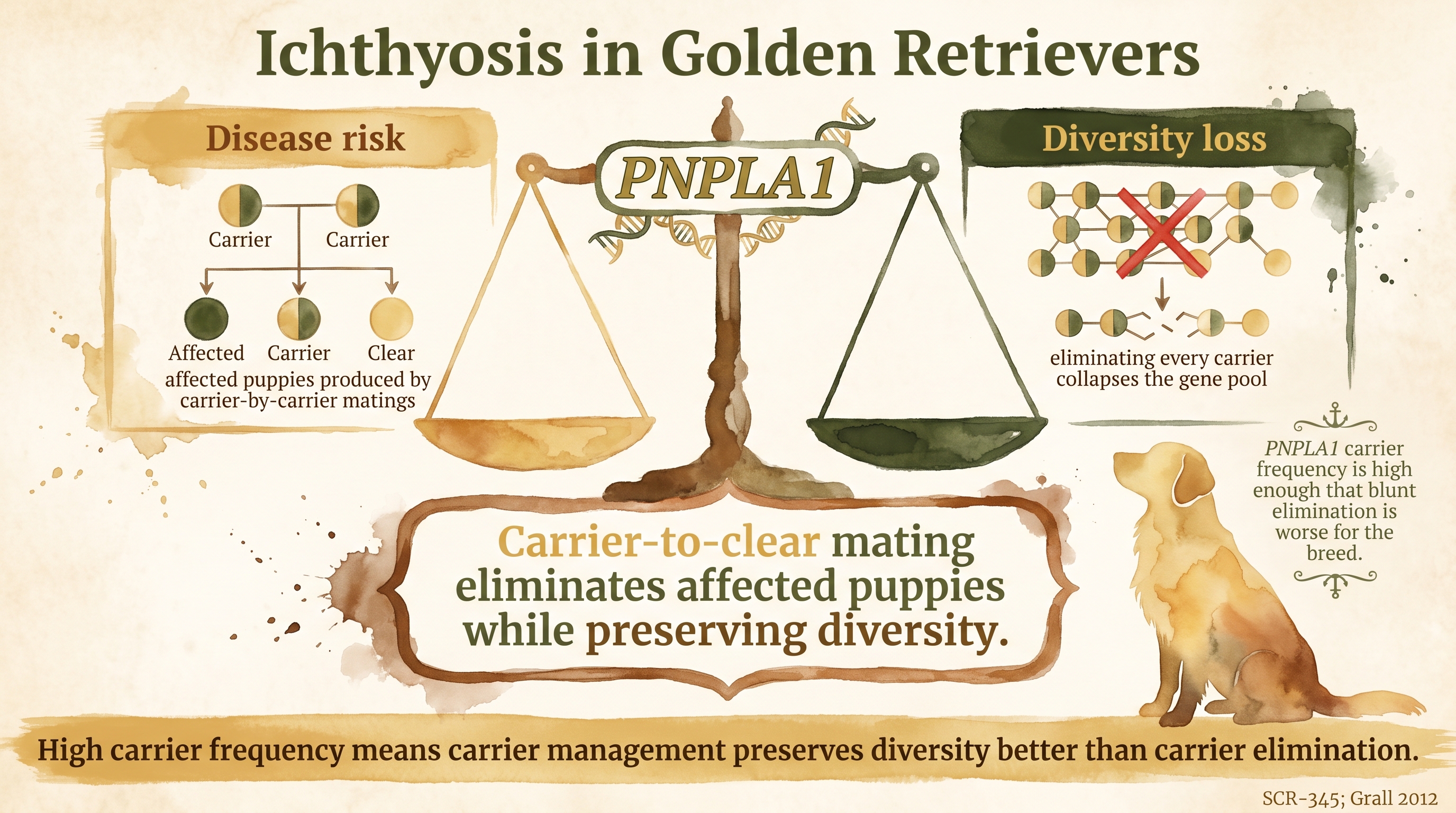
High carrier frequency means carrier management preserves diversity better than carrier elimination.
Key Takeaways
- Ichthyosis in Golden Retrievers is a real recessive skin disorder, usually associated with PNPLA1-related inheritance.
- Its importance in breeding is amplified by carrier frequency, not only by the visible skin phenotype.
- A high carrier rate makes blanket carrier exclusion a diversity risk.
- The rational goal is to avoid affected puppies while preserving enough genetic breadth for the breed's long-term health.
- Slow multi-generational reduction of common recessive alleles is usually better than abrupt elimination.
The Evidence
This entry uses observed claim-level tags beyond the dedicated EvidenceBlocks below. These tags mark JB program observation or practice-derived claims that need dedicated EvidenceBlock coverage in a later content pass.
- Grall and related Golden Retriever genetics literatureGolden Retrievers
Golden Retriever ichthyosis is a documented recessive skin disorder associated with PNPLA1 variation and characterized by scaling and flaking of variable severity. - Golden Retriever inherited-disease source synthesisGolden Retrievers
The breed can carry a relatively high carrier frequency in some populations, making diversity-aware management more appropriate than blanket carrier exclusion.
- Canine population-genetics logicdogs
When a recessive allele is common, carrier-to-clear breeding often preserves breed diversity more responsibly than trying to purge all carriers at once. - Long-term allele frequency management literaturedogs and other managed populations
Gradual reduction of common recessive allele frequencies across multiple generations preserves diversity better than abrupt exclusion and is a standard population-management approach.
No published study has directly compared long-term population genetic outcomes between carrier-exclusion versus carrier-to-clear management strategies for common recessive alleles in dog populations.
SCR References
Sources
- Grall A., Guaguère E., Planchais S., et al. (2012). PNPLA1 mutations cause autosomal recessive congenital ichthyosis in golden retriever dogs and humans. Nature Genetics, 44(2), 140-147. doi:10.1038/ng.1056
- Graziano L., Vasconi M., & Cornegliani L. (2018). Prevalence of PNPLA1 Gene Mutation in 48 Breeding Golden Retriever Dogs. Veterinary Sciences, 5(2), 48. doi:10.3390/vetsci5020048
- Kiener S., Wiener D.J., Hopke K., Diesel A.B., Jagannathan V., Mauldin E.A., Casal M.L., & Leeb T. (2021). ABHD5 frameshift deletion in Golden Retrievers with ichthyosis. G3: Genes|Genomes|Genetics, 12(2), jkab397. doi:10.1093/g3journal/jkab397
- Shaffer L.G., Sundin K., Geretschlaeger A., Segert J., Swinburne J.E., Royal R., Loechel R., Ramirez C.J., & Ballif B.C. (2018). Standards and guidelines for canine clinical genetic testing laboratories. Human Genetics, 138(5), 493-499. doi:10.1007/s00439-018-1954-4
- Farrell L.L., Schoenebeck J.J., Wiener P., Clements D.N., & Summers K.M. (2015). The challenges of pedigree dog health: approaches to combating inherited disease. Canine Genetics and Epidemiology, 2, 3. doi:10.1186/s40575-015-0014-9