Shaping and Successive Approximation
Shaping is the process of building a target behavior by reinforcing progressively closer approximations to that behavior. Instead of waiting for the finished act to appear all at once, the trainer reinforces small steps in the right direction and gradually tightens the criteria. It is one of the most technically elegant tools in operant training and one of the easiest to do poorly. Documented
What It Means
In shaping, the learner is not usually lured all the way through the final behavior from the start. Observed-JB Instead, the trainer reinforces fragments, starting with an orientation, then a step, then a touch, then a longer hold, and finally the full target sequence. This is why the method is often called successive approximation. Each reinforced step is closer to the final response than the last one.
Shaping became famous through Skinner's work with pigeons and other laboratory animals, where complex actions could be built from tiny reinforced increments. Modern clicker training imported that logic into dog work. Documented A marker helps tell the dog exactly which micro-behavior met criterion, and food or another reinforcer follows.
At its best, shaping is precise and efficient. At its worst, it is muddy. If criteria move too fast, the learner gets lost. If criteria move too slowly, the session stalls. If reinforcement timing is sloppy, the dog may learn something adjacent to the intended behavior. The method asks a lot from the human, including sustained attention, rapid observation, clear criteria, frustration tolerance, and consistency across repetitions. Documented That human skill requirement is one reason shaping is more impressive in theory than in average household practice. Skilled shaping exists, but it is rarer than clicker-training culture sometimes implies.
The JB source layer adds one important context note. Natural canine development does not appear to use shaping in the formal laboratory sense. Heuristic Puppies certainly learn in graded ways across time, but the specific human technique of marking and reinforcing successive approximations is an engineered training procedure rather than a documented maternal teaching analog.
Why It Matters for Your Dog
Shaping matters because it explains how very specific trained performances get built. Nose targets, platform work, chained tricks, scent alerts, body-position refinements, and many polished obedience behaviors are easier to understand once you see the approximation logic underneath them.
Good shaping requires the human to read the learner closely. Criteria that ignore the dog's confusion or frustration do not just slow learning. They can destabilize the whole session.
It also matters because shaping highlights a broader truth: complex behavior can be produced without the learner fully understanding the final picture from the start. Documented That is scientifically useful. It does not automatically mean the method is the best fit for every developmental goal.
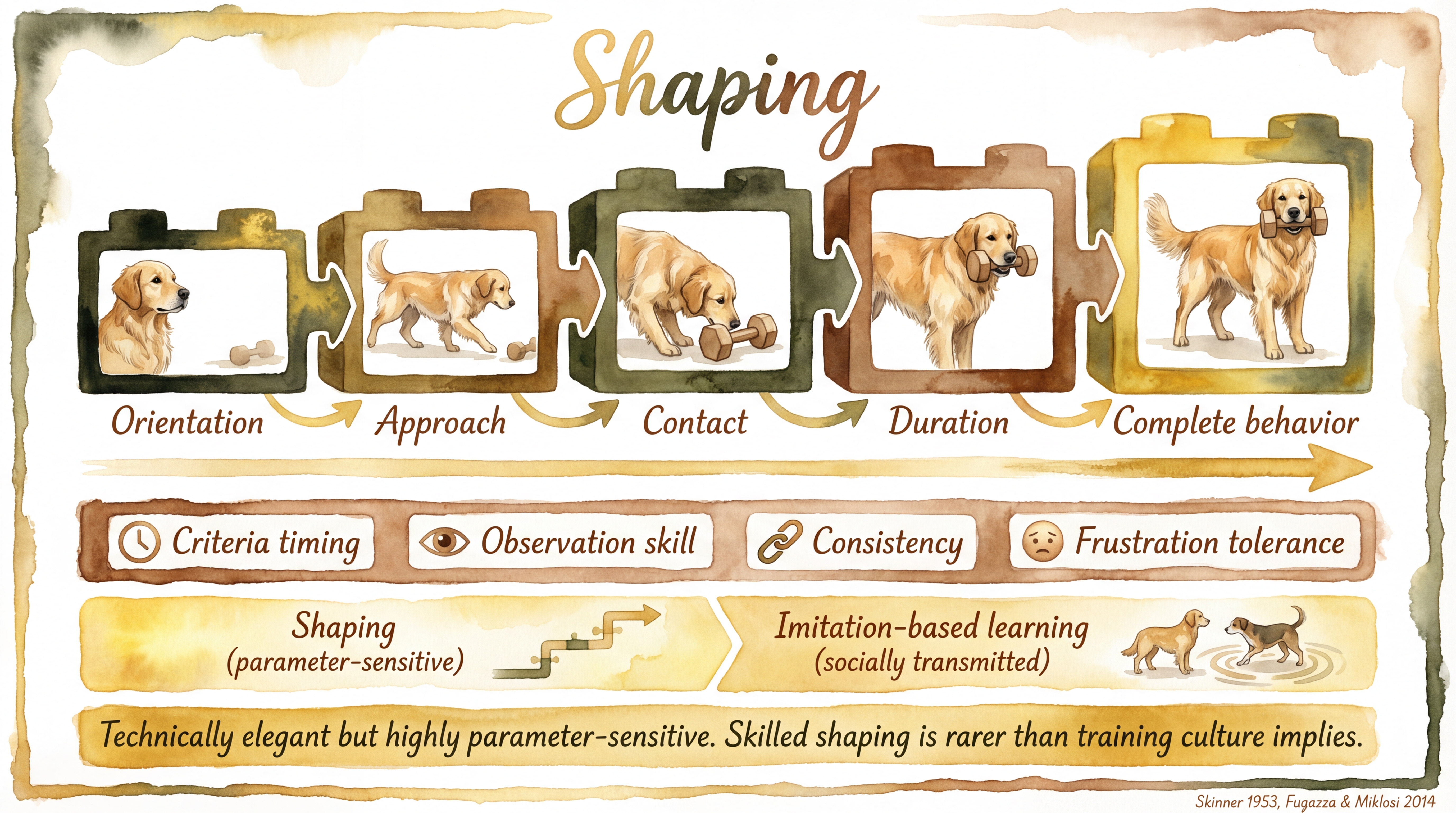
Shaping builds complex behavior by reinforcing successive approximations toward the target - gradual, not all-or-nothing.
Key Takeaways
- Shaping builds complex behavior by reinforcing progressively closer approximations.
- It is technically elegant but highly dependent on human timing, criteria control, and observation.
- Clicker training often uses shaping logic, but the marker itself does not guarantee good shaping.
- Shaping is a real training technology, not a documented natural mother-puppy teaching protocol.
The Evidence
This entry uses observed claim-level tags beyond the dedicated EvidenceBlocks below. These tags mark JB program observation or practice-derived claims that need dedicated EvidenceBlock coverage in a later content pass.
- Skinner, B. F. (1938, 1953)multiple species
Established shaping through successive approximation as a core operant method for building complex behavior. - Gilchrist, R. J. et al. (2021)domestic dogs
Compared clicker and reinforcement methods in naive dogs, illustrating both the possibilities and the parameter sensitivity of marker-based acquisition. - Chiandetti, C. et al. (2016)domestic dogs
Found no simple universal clicker advantage, reinforcing that shaping outcomes depend heavily on task structure and implementation details.
- Fugazza, C., & Miklosi, A. (2014)domestic dogs
Reported that dogs trained with an imitation rule outperformed shaping or clicker-based methods for some object-related actions, showing that shaping is not the only route to complex acquisition.
- SCR-004 synthesisdomestic dogs
The claim that natural canine development does not use shaping in the formal laboratory sense is an ethological inference, not a directly tested finding.
No published study has directly compared shaping-based acquisition against observational learning or environment-structured learning across equivalent target behaviors in dogs with long-term performance follow-up.
SCR References
Sources
- Chiandetti, C., Avella, S., Fongaro, E., & Cerri, F. (2016). Can clicker training facilitate conditioning in dogs? Applied Animal Behaviour Science, 184, 109-116.
- Fugazza, C., & Miklosi, A. (2014). Social learning in dog training: The effectiveness of the Do as I Do method compared to shaping or clicker training. Applied Animal Behaviour Science, 153, 53-61.
- Gilchrist, R. J., Gunter, L. M., Anderson, S. F., & Wynne, C. D. L. (2021). The click is not the trick: The efficacy of clickers and other reinforcement methods in training naive dogs to perform new tasks. PeerJ, 9, e10881.
- Skinner, B. F. (1938). The behavior of organisms: An experimental analysis. Appleton-Century.
- Skinner, B. F. (1953). Science and human behavior