The Pet Professional Guild (PPG)
Compound evidence detail1 SCR / 2 parts
- Documentedthe documented absence of any RCT establishing single-method superiority across canine behavioral domains, paired with the on-record organizational position statements (AVSAB 2008 and 2021, APDT 2020 and 2023, CCPDT 2025, IACP 2025, plus Ziv 2017 and Todd 2018 reviews) which constitute institutional policy rather than scientific consensus
- Heuristicthe JB characterization of professional ideological fragmentation across force-free, balanced, and compulsion approaches, carrying the load-bearing firewall that absence of method-superiority RCT does not equalize methods on welfare grounds where SCR-026, SCR-028, and SCR-036 document harm from aversive methods independently of the outcome comparison gap
The Pet Professional Guild is one of the clearest examples of how dog-trainer credentials can function as moral and philosophical signals as much as competency signals. Founded in 2012 and publicly identified by the organization as led by founder and president Niki Tudge, the PPG was created not as a general exam body but as an explicitly force-free professional association. That distinction matters immediately. When a trainer lists PPG, the family should not hear "licensed" or even necessarily "tested." The family should hear "this person is publicly aligning with a specific ethical and methodological camp." Documented
The public PPG membership materials make that camp unusually clear. The organization's Join page says it is the only international membership association across multiple pet-service disciplines that holds aversive methods causing pain, fear, or harm should not be used, or even deemed necessary, in strategic training or behavior modification. The same page and related behavior-team materials say members agree to operate within the guild's Guiding Principles and Code of Conduct. In other words, the signal is not subtle. PPG membership communicates a force-free commitment first. Documented
From a JB perspective, that signal is both valuable and incomplete. It is valuable because the force-free movement helped raise the industry's moral floor and made overtly aversive practice harder to normalize. It is incomplete because membership is not the same thing as assessed practical competence, and because JB does not collapse every form of correction into punishment or fear-based aversion. That second point is a philosophical disagreement and should be read that way, not as a denial of the welfare literature that pushed the industry away from harsher methods. Families who see the distinction clearly can appreciate the guild without romanticizing the logo. Heuristic
What It Means
What the PPG Is
The first thing families need to know is that the PPG is a membership organization. The source layer states this directly, and the public site reinforces it. Joining the guild means aligning with its principles, paying the required dues, and entering a professional community built around force-free practice, advocacy, and education. This is not the same thing as sitting for a general competency exam like the CPDT-KA, nor is it the same thing as completing a curriculum-specific school such as KPA.
That does not make the signal trivial. In a fragmented profession, values matter. The PPG gives force-free practitioners a clear home and gives families a quick way to identify trainers who oppose shock, prong, choke, spray, and startle-based methods.
The Distinctive Force-Free Position
The PPG's force-free position is stricter than the mainstream LIMA bodies discussed elsewhere in this category. The source document makes that contrast explicit. IAABC and, historically, CCPDT were aligned with LIMA-style least-intrusive language that still left theoretical room for aversives as a last resort. The PPG took a cleaner line, arguing that pain, fear, force, or coercive aversive tools should not be used or treated as necessary parts of a strategic behavior plan.
Public PPG materials reinforce the same point from multiple angles. The Join page presents the organization as committed to methods that avoid pain, fear, and harm. Educational materials aimed at pet owners state that PPG membership means no shock, prong, or choke use in training or care. The membership signal is therefore not generic humane branding. It is a concrete force-free commitment.
Membership Versus Competence
This is where families need precision. Membership communicates philosophy. It does not automatically communicate skill depth, case experience, or good judgment under pressure. The source document's broader credentialing analysis applies here forcefully. In an unregulated profession, organizations can help organize values and community, but that does not make membership equivalent to independently verified competence.
The PPG itself seems aware of this problem. Its materials repeatedly speak about industry standards, regulation gaps, and educational support. That is admirable. It also shows why the family should not assume the logo solves the competence question on its own.
Where the PPG Helped the Profession
Historically, the guild mattered because it hardened the force-free wing of the profession into a visible institution. It gave owners a language of humane practice that was easier to identify than abstract policy statements. It also pushed the profession to talk more plainly about fear, pain, welfare, and the ethics of tool choice. In that sense, the guild helped make the welfare critique of aversive methods culturally durable rather than merely academic.
That contribution should not be minimized. The positive reinforcement revolution changed family culture, and the PPG helped keep that change organized and public. Documented
Where JB Sees the Limit
JB's disagreement begins at the point where force-free identity becomes broad enough to treat every meaningful correction as ethically suspect. Heuristic The guild's public framing can make sense if the comparison is shock, prong, choke, spray, or startle-based interruption. JB agrees that those tools carry serious welfare questions and should not be normalized casually. The disagreement arises when the category of "aversive" stretches so widely that quiet spatial interruption, parental disapproval, or low-drama relational correction are treated as ethically equivalent to punitive tool use.
JB does not accept that equivalence. From the JB perspective, correction can be communication rather than imposed suffering. That is a philosophical distinction, not a claim that the entire profession agrees with JB on this point.
There is also a practical consumer advantage in the guild's clarity. In many other organizations, owners have to infer a trainer's ethical floor from hints and euphemisms. PPG removes much of that guesswork. Even if a family ultimately decides the guild is not the only filter it cares about, the explicitness itself is valuable in a crowded market.
PPG membership can be a useful sign that a trainer is committed to minimizing fear and pain. JB shares that moral concern. JB parts company only where force-free rhetoric begins treating all correction as if it were the same kind of event.
Why It Matters for Your Dog
For a Golden Retriever family, PPG membership can be very helpful if what you want is a clearly force-free trainer for puppy classes, household manners, family coaching, and humane day-to-day support. Goldens are social, food-motivated, and often very responsive to reward-based work, so many families will find that a PPG-aligned trainer is a comfortable and sensible fit for early training help.
That is especially true if the family is sorting through a noisy market and wants a quick ethical filter. A PPG member is publicly telling you they reject shock, prong, choke, and similar tool-based strategies. For many families, that matters a great deal, and it should.
Where this history becomes more subtle is when the family starts assuming the membership logo answers every other question too. It does not tell you whether the trainer is excellent with adolescent overarousal, whether they understand breeder transition, whether they can coach children well, or whether they have the judgment to distinguish immaturity from pathology. It also does not tell you whether the trainer has enough practical experience for a serious fear or aggression case.
A Golden-specific example helps. Suppose a young retriever is wildly social, jumps on everyone, steals objects, and becomes frenzied when the house gets busy. A PPG-aligned trainer may be a very good fit if the trainer combines humane skills with strong household coaching. But if the trainer frames every meaningful limit as potentially aversive and does not help the family communicate disapproval, control access, and slow the emotional environment down, the family may end up with good treat mechanics and weak social structure.
That is not a criticism of all PPG members. It is a consumer warning about overreading the philosophy badge. Goldens need kindness. They also need adult clarity. The best trainers can hold both.
This matters even more if the dog is showing a harder problem. If a Golden is guarding, biting, panicking, or showing severe distress, the family should not assume that force-free affiliation alone settles case competence. The right question becomes broader: what can this person actually handle, and when do they refer upward?
So for your dog, the PPG is best read as a valuable ethics clue, not as the whole evaluation.
That consumer value is strongest in the kinds of cases many Golden families actually face first. A puppy class, a family-manners course, an adolescent who is too wild around guests, a dog who needs cooperative handling, or a household that wants to rule out harsh tools immediately. In these scenarios, PPG membership can narrow the field quickly and often helpfully. The family has learned something real about the trainer before making first contact.
The limitation appears once the dog or the household problem becomes more demanding. A highly overaroused Golden may need a trainer who can communicate meaningful limits without either harshness or paralysis. A guarding or fear case may require more case depth than philosophy alone can guarantee. A family trying to build calmness may need more than a pledge against aversive tools. It may need a trainer who knows how to organize life with quiet authority.
This is also where families can become unfair to themselves. Some owners hear force-free language and assume they must never show disapproval, block access, or use spatial interruption. Then the dog receives endless information about rewards and very little information about boundaries. That outcome is not inevitable with PPG members, but it is one of the misunderstandings JB families should know how to watch for.
For Goldens, this often shows up around excitability. A humane trainer may reject harsh tools appropriately and still need a strong picture of how to guide a dog downward in arousal without turning every moment into either reinforcement or negotiation. That is one of the places where JB families should listen carefully.
The family can therefore treat the PPG badge as an ethical doorway rather than a final answer. It helps rule some things out quickly, which is useful. It does not remove the need to ask what kind of adult guidance the trainer thinks a family dog still needs.
That extra clarity is often what keeps humane intent from collapsing into fuzzy household leadership. That is especially important when the dog is sensitive but still clearly needs adult guidance. Goldens often live in that middle ground, and the family needs a trainer who can stay humane there without becoming vague.
That middle space is exactly where careful families have to keep thinking.
What This Means for a JB Family
For a JB family, the Pet Professional Guild is easiest to appreciate when it is read in its strongest and narrowest sense. It says the trainer or consultant is publicly committed to avoiding pain, fear, and force-heavy methods. That is meaningful. JB is not interested in rolling the profession back toward casual aversion.
The place where JB draws its own line is conceptual. JB does not believe humane dog raising requires the elimination of all correction. Heuristic It believes humane raising requires distinguishing between punishment as imposed suffering and correction as low-drama, relational communication inside a secure social bond. That distinction is central to the JB philosophy and not something the PPG framework, as publicly presented, clearly preserves.
So a JB family can still find a good PPG member very useful. The family simply should not hand over its whole philosophy to the acronym. Ask how the trainer handles household boundaries. Ask how they communicate disapproval. Ask how they prevent overarousal from becoming normal life. Ask whether they can support a home that wants both kindness and structure.
That is the practical JB takeaway. Keep the moral seriousness about welfare. Refuse unnecessary harshness. Then keep thinking clearly enough not to let a membership badge stand in for the full work of raising a stable family dog.
For a JB family, the practical use of the PPG is to keep the welfare floor high while still asking second-order questions. How does this trainer handle structure? How do they think about saying no? How do they protect calmness rather than only rewarding alternatives? What happens when the dog needs guided interruption, not just planned reinforcement? Those questions help the family see whether the humane signal can actually support the life it is trying to build.
That is why the JB position on the guild is respectful without being total. Keep the moral seriousness. Keep the refusal of unnecessary harshness. Then continue the analysis until the full work of raising is back in view.
A family who asks those questions can often keep the best part of the guild's influence, moral seriousness about welfare, while avoiding the confusion that comes from treating every form of correction as the same kind of event. That is the JB middle path here.
That extra question is where JB's contribution begins. Welfare commitments matter deeply. So does precision about what counts as fear-inducing punishment and what counts as ordinary, quiet social guidance. A family that keeps both questions alive will read the guild more intelligently.
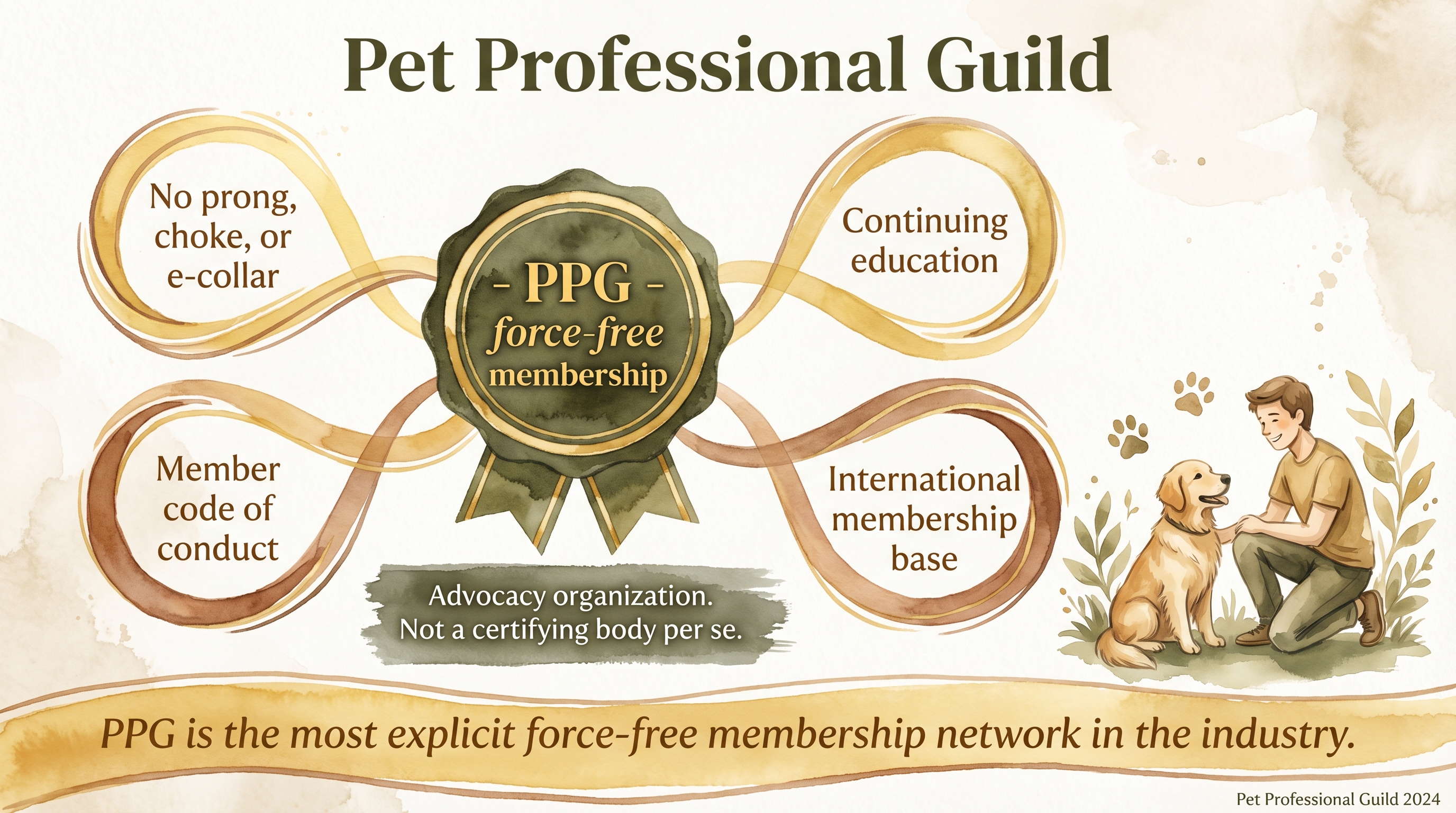
PPG is the most explicit force-free membership network in the industry.
Key Takeaways
- PPG membership is primarily a force-free ethical and philosophical signal, not a general competency exam result.
- That signal can be very useful for families who want to exclude shock, prong, choke, and similar aversive tool use from consideration.
- Membership still does not settle practical competence, scope, or fit for a particular dog and family.
- JB shares the welfare concern that animates the PPG while disagreeing that all meaningful correction should be treated as ethically equivalent.
The Evidence
This entry uses heuristic claim-level tags beyond the dedicated EvidenceBlocks below. These tags mark JB interpretive application rather than direct study findings.
- dog training profession
Describes the PPG as a membership organization founded in 2012, stricter than LIMA bodies, and organized around a categorical force-free stance. - PPG Join page and guiding-principles materialspublic organizational record
Show that membership is tied to agreement with the guild's ethical commitments and explicit rejection of fear-, force-, and pain-based methods. - SCR-027domestic dogs
Supports the broader welfare rationale for why force-free positions gained institutional traction in the profession. - SCR-174 and SCR-176dog trainer credentialing and method landscape
Support the consumer caution that philosophical affiliation and practical competence remain related but distinct questions in a fragmented field.
- domestic dogs
No published study directly isolates the long-term dog-level and family-level effects of the pet professional guild (ppg) across ordinary companion-dog contexts.
SCR References
Sources
- Pet Professional Guild. Join PPG.
- Pet Professional Guild. The Guiding Principles.
- Pet Professional Guild. Behavior Teams.
- Pet Professional Guild. Position Statements.
- Pet Professional Guild. Knowing How to Choose the Right Dog Trainer.